
Nonverbal intelligence tests measure cognitive abilities such as abstract reasoning, spatial reasoning, problem-solving, and pattern recognition, all without relying on language. These tests assess an individual’s capacity to understand and solve visual and spatial problems, helping to evaluate intellectual functioning in a way that is independent of verbal skills, making them ideal for people with language difficulties, learning disabilities, or cultural differences.
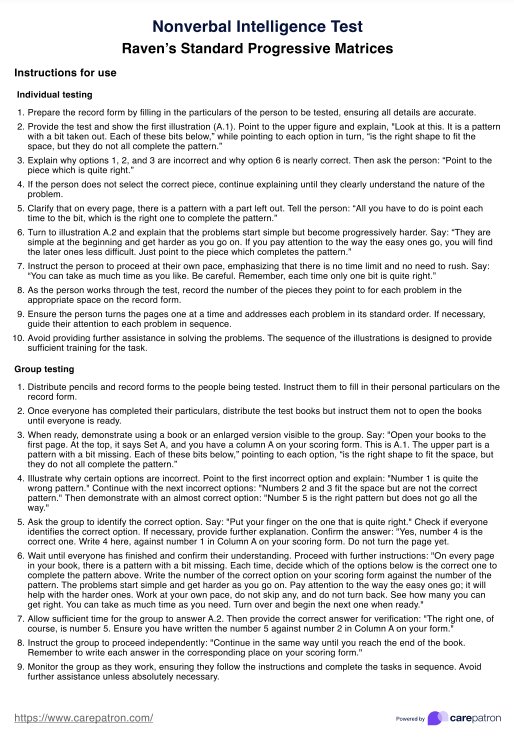



Nonverbal Intelligence Test
Access a free Nonverbal Intelligence Test based on Raven's Progress Standard Matrices. Download the PDF now.

Use Template
Nonverbal Intelligence Test Template
Commonly asked questions
Individuals with language difficulties, learning disabilities, or cultural differences benefit from this language-free assessment.
Several well-known nonverbal intelligence tests assess cognitive abilities without relying on language. Raven's Progressive Matrices (SPM) measures abstract reasoning and pattern recognition through visual puzzles. The Leiter International Performance Scale (Leiter-R) is used for individuals with developmental disorders or language barriers. The Naglieri Nonverbal Ability Test (NNAT) focuses on reasoning and problem-solving through visual tasks. Lastly, the Wechsler Nonverbal Scale of Ability (WNV) evaluates problem-solving, reasoning, and memory without verbal communication. These tests are valuable for individuals facing language or cultural challenges.










EHR and practice management software
Get started for free
*No credit card required
Free
$0/usd
Unlimited clients
Telehealth
1GB of storage
Client portal text
Automated billing and online payments