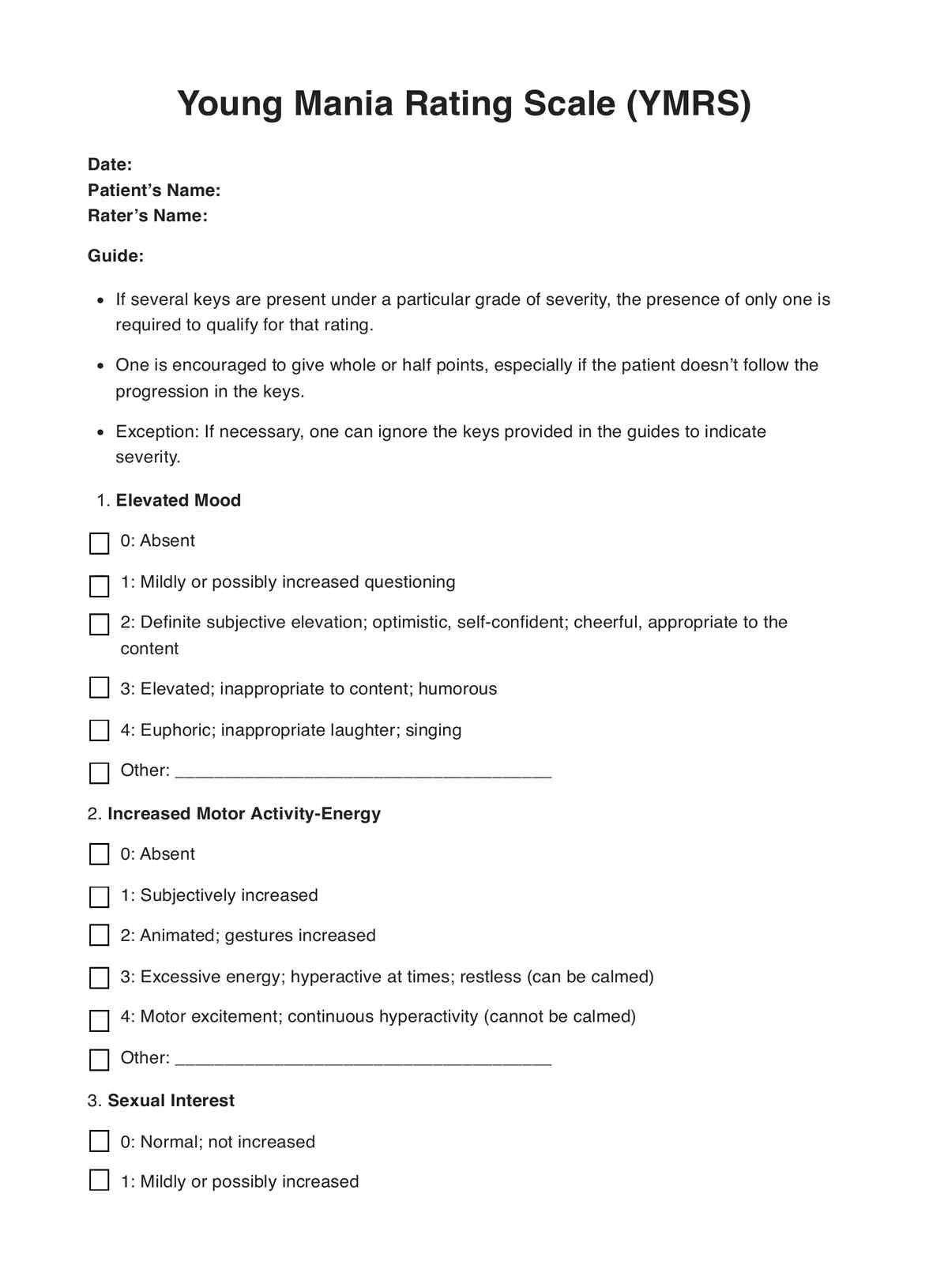
Looking for a good tool to gauge a patient/client's mania? Read our guide to learn more about assessing mania and what could happen if left unaddressed. Then, use the Young Mania Rating Scale to assess your client's mania severity.
## **What is mania?**
Mania is a state where the person who has it has an elevated mood characterized by high energy, euphoria, excitement, and heightened irritability (Migala, 2022). It's an extreme change in one's mood that is known to impact a person's functioning, meaning it can disrupt a person's school life, home life, and work. It can also last over a week, so sometimes a person with mania will be described as someone who is having a "manic episode." Another thing of note regarding this kind of mood/state is that it is characteristic of people who have bipolar disorder.
### **Signs and symptoms of mania**
Besides the four mentioned above, the signs and symptoms of mania include:
- Being restless and unable to sleep because of excessive energy
- Having high self-esteem
- Being more talkative than usual
- Being easily distracted
- Being completely absorbed by an activity or something attention-grabbing
- Pacing around and other purposeless movements
### **Why is it problematic?**
Now, based on the signs and symptoms indicated above, you're probably wondering, how is this problematic?
Besides the potential of mania disrupting a person's school, home, and/or work life, mania can lead to other unwanted problems if left unchecked and unaddressed.
Those with mania might start exhibiting impulsive behavior, which isn't necessarily bad per se, but impulsivity may result in poor decisions being made. One could suddenly start spending all their money until there's little or none left, suddenly engaging in violence, and having reckless sex (Cleveland Clinic, 2021).
If the mania is severe, it's possible for the person to start having delusions and hallucinations, both of which can contribute to impulsive behavior.
That's why, if you're handling patients suspected of having mania (or confirmed to have a bipolar disorder diagnosis), it's best to assess them as soon as possible to determine the severity so you can develop the necessary treatment/management plans.
## **What is the Young Mania Rating Scale?**
The Young Mania Rating Scale is a reliable, valid clinician-administered interview scale that practitioners use to check and track a patient's manic symptoms. It's a diagnostic questionnaire with eleven items, enumerating the core mania symptoms. This has four multiple-choice questions per item, describing their severity and corresponding scores per description.
Practitioners and researchers recommend that the answers to the test should consider the symptoms exhibited or clinical condition for the past 48 hours.
To score the scale, the practitioner may check the appropriate description and use the score assigned to that description. If the patient exhibits any features under a symptom description, they are automatically given that score. If any of these don't hit the mark, the practitioners can give half points and write down additional observations they may have during the interview or session.
Please note that this only assesses and evaluates manic symptoms, and some parts will rely on a patient's subjective report about themselves. Please note that you can't use this to assess other potential mental health problems/disorders, such as psychotic symptoms. If you have patients experiencing psychotic symptoms, make sure to use other tools like the Brief Psychiatric Rating Scale and a bunch of other similar assessments to cover more ground.
Medical health practitioners, particularly those with expertise in diagnosing mental health conditions like therapists, psychologists, and psychiatrists, can employ the young mania rating scale template for various purposes. These include screening for mania, determining the severity of mania, making a diagnosis based on the results, devising a treatment plan for the patient's condition or any other mental health issue that may be causing manic symptoms, and monitoring the progress of the patient's treatment.
As the responses to the test rely on the patient's self-report, it is feasible to provide the patient with a copy of the test for self-administration. Nonetheless, it is strongly recommended that a trained clinician conduct the test to ensure accurate and reliable results.
### **Is this scale reliable?**
The scale has been analyzed by experts using the Clinical Global Impressions Bipolar (CGI-BP) mania scale to determine its usefulness and optimal YMRS severity threshold. This scale has a minimal clinically significant difference of 6.6. It was also found to have a positive predictive value of 83% and a negative predictive value of 66% (Lukasiewicz et al., 2013).
Back then, tools like the Beigel Scale, Petterson Scale, and Brief Psychiatric Rating Scale existed to be the tools for assessing mania, but there was a demand for a clinician-administered interview scale with a broader scope, greater sensitivity, shorter, and explicit severity ratings (Medscape, 2020). The Young Mania Rating Scale was made to do just that.
All of this has made the YMRS a staple when it comes to assessing the core symptoms of mania.
## **How does it work?**
Think you'll benefit from a copy of the Young Mania Rating Scale template you can edit or fill out? Keep reading below for instructions on accessing and downloading our template.
### **Step 1: Access the template**
To access and download our printable young mania rating scales template, you can do either of the following:
- Clicking the “Use Template” or “Download Template” button above
- Searching the “Young Mania Rating Scale” in Carepatron's template library on our app or website
### **Step 2: Interview the client and complete the scale**
Once the necessary details are provided at the top of the page and the guide has been reviewed, the next step is to finalize the scale. This involves selecting the suitable description and its corresponding score according to the client's subjective report of their observations. The practitioner is permitted to use half-points when assessing the client's condition.
There are 11 items covering elevated mood, increased motor activity-energy, sexual interest, sleep, irritability, speech (rate and amount), language-thought disorder, content, disruptive-aggressive behavior, appearance, and insight.
Each one has its own answer set, so you're going to see answer choices like:
- For elevated mood: absent, mildly, definite subjective elevation
- For sexual interest: normal, mildly increased
- For sleep: no reports of decrease, sleeping less than normal
All you need to do is ask patient questions concerning the 11 items on the scale. Then rate them based on their answers.
### **Step 3: Interpret the scores**
The final step is to add the scores obtained for each number and interpret the total score. Here's a quick list of what each score range may indicate in a patient:
- Less than or equal to 12: Remission
- 13 -19: Minimal symptoms
- 20 - 25: Mild mania
- 26 - 37: Moderate mania
- 38 - 60: Severe mania
Feel free to write additional notes or observations in the dedicated space at the bottom of the template's page.
### **Step 4: Secure and store**
Once done, ensure the completed template is securely stored. This can be done by keeping it in a safe physical location or using a HIPAA-compliant electronic health record (EHR) system such as Carepatron.
## **Mania management**
There are two common ways to manage mania.
The first one is the use of mood stabilizers. As to which one will depend on your prescription, which will be based on all your findings concerning the patient's mania (Centre for Addiction and Mental Health, 2018). Examples of such stabilizers include lurasidone and olanzapine. If the patient has mania due to a mood disorder, the focus on the treatment should be on the disorder itself, though mood stabilizers may still be used as part of it.
The second is talk therapy. Talk therapy and its various types can help people identify any factors that might be contributing or triggering one's mania, help modify the patterns of thinking that accompany mood shifts, find ways to mitigate the potential strain manic episodes have on one's relationships, and develop routines to follow despite the mood shift, and to help one establish sleeping schedules considering those with mania tend to be restless (Mayo Clinic, 2024).
## **References**
Centre for Addiction and Mental Health. (2018). Mood stabilizing medications. (2018). https://www.camh.ca/en/health-info/mental-illness-and-addiction-index/mood-stabilizing-medication
Cleveland Clinic. (2021, September 14). Mania: What is it, causes, triggers, symptoms & treatment. Cleveland Clinic. https://my.clevelandclinic.org/health/diseases/21603-mania
Lukasiewicz, M., Gerard, S., Besnard, A., Falissard, B., Perrin, E., Sapin, H., Tohen, M., Reed, C., Azorin, J. M., & Emblem Study Group (2013). Young Mania Rating Scale: how to interpret the numbers? Determination of a severity threshold and of the minimal clinically significant difference in the EMBLEM cohort. International journal of methods in psychiatric research, 22(1), 46–58. https://doi.org/10.1002/mpr.1379
Mayo Clinic. (2024). Bipolar disorder. Mayo Clinic. https://www.mayoclinic.org/diseases-conditions/bipolar-disorder/diagnosis-treatment/drc-20355961
Medscape. (2020). Young Mania Rating Scale (YMRS). https://reference.medscape.com/calculator/473/young-mania-rating-scale-ymrs
Migala, J. (2022, October 29). Here’s how to know if you or someone else is having a manic episode. Health.com. https://www.health.com/condition/mental-health-conditions/mania
Park, S. C., & Choi, J. (2016). Using the Young Mania Rating Scale for Identifying Manic Symptoms in Patients with Schizophrenia. Yonsei medical journal, 57(5), 1298–1299. https://doi.org/10.3349/ymj.2016.57.5.1298
Samara, M., Levine, S., & Leucht, S. (2022). Linkage of Young Mania Rating Scale to Clinical Global Impression Scale to Enhance Utility in Clinical Practice and Research Trials. Pharmacopsychiatry, 56(01), 18-24. doi: 10.1055/a-1841-6672
Serrano, E., Ezpeleta, L., Alda, J. A., Matalí, J. L., & San, L. (2011). Psychometric properties of the Young Mania Rating Scale for the identification of mania symptoms in Spanish children and adolescents with attention deficit/hyperactivity disorder. Psychopathology, 44(2), 125–132. https://doi.org/10.1159/000320893
Youngstrom, E. A., Danielson, C. K., Findling, R. L., Gracious, B. L., & Calabrese, J. R. (2002). Factor structure of the Young Mania Rating Scale for use with youths ages 5 to 17 years. Journal of Clinical Child and Adolescent Psychology, 31(4), 567–572. https://doi.org/10.1207/S15374424JCCP3104_15