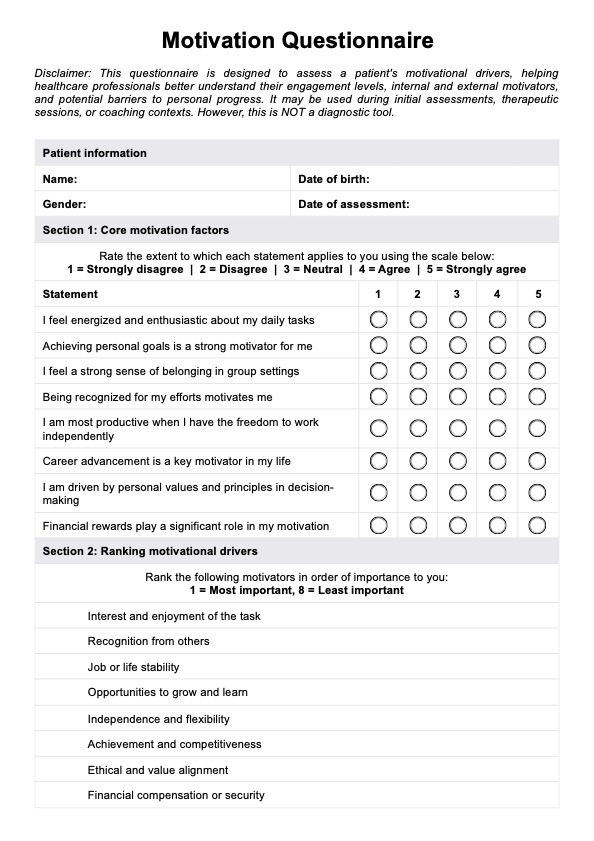
## **What is a Motivation Questionnaire?**
A Motivation Questionnaire is a structured tool used by healthcare professionals to understand what drives a patient’s behavior, decisions, and engagement in various areas of life—especially in the context of health, wellness, and treatment adherence. By exploring personal motivators, this questionnaire helps identify both internal (intrinsic) and external (extrinsic) sources of motivation, offering insight into the emotional, psychological, and social factors that influence a patient’s readiness for change. These self-report measures are particularly effective for fostering self-reflection and self-awareness, both critical for self-regulation and long-term life satisfaction.
The questionnaire includes a mix of rating scales, ranking tasks, and open-ended questions that encourage patients to reflect on their values, goals, and preferred ways of working or engaging with others. It also helps pinpoint challenges or demotivators—such as fear of failure, lack of recognition, or external pressures, that may be interfering with progress. Understanding the biggest challenge or prime motivator in everyday life can help determine behavior and satisfaction.
In clinical settings, this tool supports patient-centered care by guiding personalized interventions, improving communication, and increasing engagement with care plans. Whether used during an initial assessment, therapy session, or health coaching appointment, the Motivation Questionnaire empowers both the patient and provider to build a clearer, more collaborative path toward meaningful, sustainable outcomes. It is grounded in self determination theory and social psychology, often used to measure motivation and evaluate human motivation using evidence-based research design.
## **How to use our Motivation Questionnaire template**
Carepatron’s Motivation Questionnaire offers a structured, clinically sound way to explore your patient’s personal drivers and barriers. It fits seamlessly into your workflow and helps support goal-setting, treatment planning, and long-term behavioral change—all within a few guided steps.
### **Step 1: Access the template**
Click the “Use template” button to get started. You’ll be directed to open or download the Carepatron app, where the Motivation Questionnaire is preloaded and ready to use. It’s free to access and designed for seamless integration into your existing assessment process.
### **Step 2: Use the template in patient assessment**
Incorporate the questionnaire during initial consultations, routine check-ins, or therapeutic sessions. It provides a reliable structure for uncovering motivation-related insights, helping you tailor care to individual patient needs. The flexible format supports both in-person and telehealth interactions.
### **Step 3: Conduct the assessment**
Guide the patient through each section—rating scales, ranking tasks, and open-ended prompts. You may complete it collaboratively during a session or have the patient fill it out independently beforehand to encourage reflection and self-awareness.
### **Step 4: Gather and interpret results**
Review the responses to identify patterns across intrinsic and extrinsic motivators. The template’s structure makes it easy to pinpoint high-priority drivers, potential barriers, and readiness for change, all of which can inform clinical decision-making and care planning.
### **Step 5: Discuss results with patient**
Use the completed questionnaire as a conversation tool. Discuss key motivators, areas of resistance, and emotional themes that emerge. This collaborative dialogue builds trust and empowers the patient to take an active role in their care journey.
### **Step 6: Provide patient support and next steps**
Based on the insights gained, offer personalized support strategies—whether it's behavioral coaching, goal setting, or referrals to other services. The structured format ensures continuity across follow-ups and aligns care plans with what truly motivates each patient.
## **When would you use this form?**
The Motivation Questionnaire is a versatile tool that finds relevance across various professional settings and is valuable for different types of practitioners. Here are some critical contexts and scenarios where this questionnaire can be effectively employed:
### **Healthcare settings**
In healthcare, practitioners can use the Motivation Questionnaire to assess a patient's motivation for adhering to treatment plans, making lifestyle changes, or managing chronic conditions. It helps tailor healthcare strategies to patients' motivations, ultimately improving health outcomes, performance, and satisfaction. Understanding motivational factors helps clinicians support patients through tough times and better determine their progress.
### **Educational institutions**
Educators and school counselors can utilize the questionnaire to understand students' motivations for learning, behavior, or engagement in extracurricular activities. It aids in identifying students' intrinsic interests and aligning teaching methods accordingly. For example, understanding a student's motivation over the last six months can improve their development and success in class.
### **Workplace and human resources**
HR professionals and managers can deploy the Motivation Questionnaire to evaluate employee motivations, job satisfaction, and productivity drivers. This can inform employee engagement, performance improvement, and talent retention strategies. The employee motivation survey can help companies examine workplace culture, provide better feedback, and motivate teams using targeted incentives.
### **Personal development and coaching**
Life coaches and personal development practitioners can use the questionnaire to explore clients' intrinsic motivations, helping them set and achieve personal goals and navigate life transitions effectively. Identifying values, internal motivation, and external motivation is essential in this process.
### **Sports and fitness training**
Coaches and trainers in the sports and fitness industry can employ this tool to understand athletes' motivations, which is crucial for designing effective training regimens and maintaining high performance. This contributes to a productive environment and better use of support resources.
### **Rehabilitation and mental health services**
Therapists and counselors can use the Motivation Questionnaire to assess clients' motivations for recovery or behavioral change, helping tailor therapy plans and interventions.
### **Research and academia**
Researchers studying human behavior, motivation, or psychology can utilize the questionnaire to gather structured data for academic studies, potentially contributing to the broader understanding of motivational factors.
### **Nonprofit and social services**
Organizations in the nonprofit and social services sector can apply the questionnaire to assess the motivations and needs of their communities, enabling more targeted and impactful interventions.
The Motivation Questionnaire is a flexible resource applicable in numerous professional settings where understanding and harnessing motivation are essential. It enables practitioners to gain valuable insights into individuals' motivations, providing a foundation for tailored strategies, interventions, and decision-making to achieve desired outcomes. Whether in healthcare, education, the workplace, personal development, or research, this tool can significantly enhance the practitioner's ability to engage, support, and empower individuals toward positive change and growth.
## **Benefits**
Using free Motivation Questionnaires offers several significant benefits across various domains and professional settings:
### **Enhanced engagement**
These questionnaires help practitioners understand individuals' motivations, enabling them to tailor their approach to align with what motivates each person. This increases engagement in activities, treatment plans, or educational pursuits.
### **Improved outcomes**
By gaining insights into intrinsic and extrinsic motivations, practitioners can design interventions and strategies that resonate with individuals, increasing the likelihood of achieving desired outcomes, whether in healthcare, education, or personal development.
### **Personalization**
Free Motivation Questionnaires enable practitioners to provide personalized care, support, or guidance based on each person's unique motivations. This personalization fosters a sense of individual attention and care.
### **Efficiency**
These questionnaires offer a structured and efficient way to collect information about motivations, saving practitioners time and effort in gathering insights from individuals.
### **Evidence-based decision-making**
Practitioners can use the data collected from the questionnaires to make evidence-based decisions in healthcare, education, and other fields, ensuring that strategies and interventions are rooted in a deep understanding of what drives behavior.
### **Enhanced communication**
By discussing the results of the Motivation Questionnaire with individuals, practitioners can open up dialogues about motivations, goals, and challenges. This communication strengthens the practitioner-client or practitioner-patient relationship and fosters trust.
Incorporating free Motivation Questionnaires into practice allows practitioners to harness the power of motivation to achieve better results, provide more personalized support, and enhance the overall experience for individuals in their care.
## **Research & evidence**
A robust body of psychological research supports motivation questionnaires and are often grounded in well-established theories like self-determination theory (Deci & Ryan, 2000) and achievement motivation theory. These tools are designed to assess specific aspects of motivation, including intrinsic drives, external rewards, and goal-oriented behaviors. For example, the Intrinsic Motivation Inventory (IMI) (Center for Self-Determination Theory, n.d.) and the Academic Intrinsic Motivation Scale (AIMS) (Gottfried, 2019) reliably measure internal factors such as interest, enjoyment, and perceived value, and have been widely validated in educational and clinical studies.
Extrinsic motivation tools evaluate the influence of rewards, status, and recognition on behavior. Broader instruments like the Achievement Motivation Inventory (AMI) and Motivational Styles Inventory (MSI) assess traits like persistence, competitiveness, and preferred goal approaches. Tools based on self-determination theory—such as the College Students’ Health Motivation Questionnaire (CSHM-Q)—measure autonomy, competence, and relatedness, which are critical for sustainable motivation.
Domain-specific tools like the Science Motivation Questionnaire II (SMQ II) and Motivation to Learn Online Questionnaire (MLOQ) offer validated insights in targeted contexts. Finally, comprehensive tools such as Tammiste’s Motivation Questionnaire (MQ) integrate multiple dimensions, including internal and external motivators and synergy factors, making them ideal for clinical, organizational, and coaching use. These validated instruments enhance personalized care and behavioral interventions.
## **References**
Center for Self-Determination Theory. (n.d.). Intrinsic motivation inventory (IMI). https://selfdeterminationtheory.org/intrinsic-motivation-inventory/
Gottfried, A. E. (2019). Academic intrinsic motivation: Theory, assessment, and longitudinal research. In A. J. Elliot (Ed.), Advances in motivation science (Vol. 6, pp. 83–111). Elsevier. https://doi.org/10.1016/bs.adms.2018.11.001
Ryan, R. M., & Deci, E. L. (2000). Self-determination theory and the facilitation of intrinsic motivation, social development, and well-being. American Psychologist, 55(1), 68–78. https://doi.org/10.1037/0003-066X.55.1.68