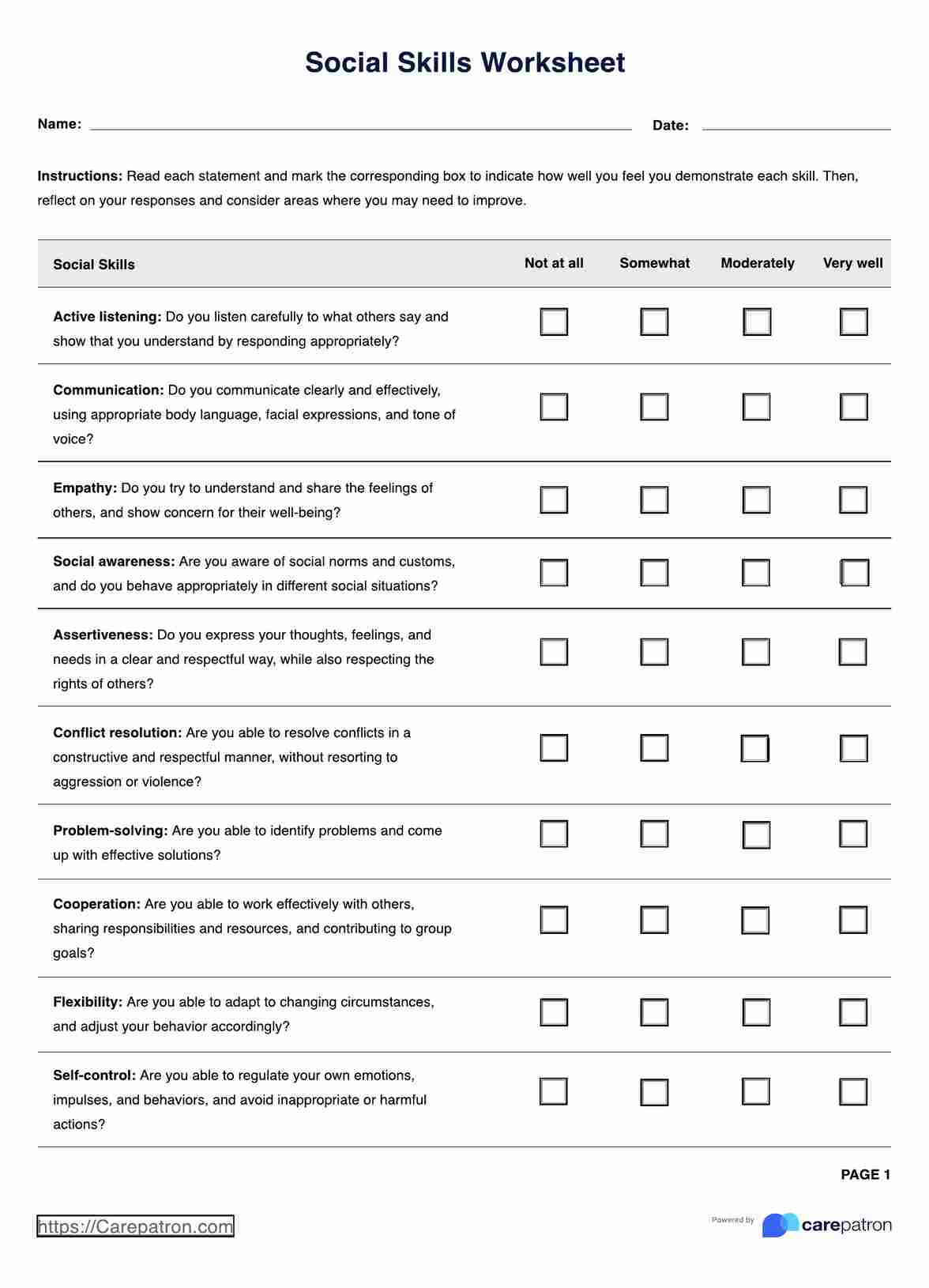
Looking for a tool to help your clients identify their social skills, strengths, and weaknesses? Read our guide to learn more about social skills and how our Social Skills Worksheet can help your clients become more aware of what they can and can't do in social interactions so that you can work with them to develop strategies for improvement.
## **Understanding social skills**
Social skills are the abilities that allow us to communicate, interact, and build relationships with others effectively. These competencies develop throughout our lives, starting in childhood and continuing into adulthood, shaped by both neural development and social experience (Soto-Icaza et al., 2015).
Core social skills include effective communication, active listening, empathy, conflict resolution, understanding emotions, reading body language, and respecting boundaries. These abilities help us navigate everything from casual conversation to complex professional relationships. When we possess good social skills, we can start conversations with appropriate conversation starters, maintain eye contact, interpret social cues, and respond appropriately in different social situations.
For children and students, developing these competencies is particularly critical. Research shows that social skills develop through cognitive modeling processes that involve both neural maturation and environmental learning (Soto-Icaza et al., 2015). In the classroom and at school, kids learn to share, take turns, work in small groups, and resolve conflicts with their friends. These early experiences create the foundation for more sophisticated social abilities in teens and adults.
The importance of social skills extends beyond childhood. In professional settings, these abilities affect job performance, career advancement, and workplace satisfaction. Strong social skills allow adults to collaborate effectively, manage conflict, and build professional networks. For individuals with disabilities or developmental differences, targeted social skills training can significantly improve quality of life and employment outcomes.
When social skills are lacking, individuals may struggle to form meaningful connections, experience social isolation, face challenges in educational or work environments, and encounter difficulties understanding others' perspectives. They may find it hard to deal with conflicts, navigate complex social expectations, or respond appropriately in unfamiliar situations. These challenges can affect mental health, academic performance, and overall well-being.
Teaching social skills requires intentional practice and structured support. Whether you're working with learners in therapy, education, or other settings, providing clear examples, creating opportunities for skill application, and offering constructive feedback all contribute to meaningful development. The goal is to help individuals build confidence in their ability to interact with others authentically and effectively.
## **What is a Social Skills Worksheet?**
Social Skills Worksheets in healthcare guide individuals in developing essential social skills. These worksheets enhance social interactions by encompassing conversation skills, body language, and emotional awareness.
Most Social Skills Worksheets include several common components. Self-assessment scales allow individuals to rate their comfort and proficiency with specific skills like maintaining conversation, reading facial expressions, or managing disagreements. Scenario-based exercises present realistic situations where users must identify appropriate responses, helping them practice decision-making in a safe environment. Reflection prompts encourage individuals to write about their experiences and understand patterns in their social interactions.
One key advantage of Social Skills Worksheets is their versatility. Whether in individual or group therapy sessions, these social skills printables assist in honing the skills necessary for establishing and maintaining healthy relationships. They are comprehensive and address specific areas such as active listening, recognizing emotions, and understanding non-verbal cues.
These worksheets also serve as a means of self-reflection. By completing the activities, individuals gain insight into their own social skills and identify areas for improvement. This promotes personal growth and development, leading to enhanced communication and relationships.
However, these resources have limitations. Worksheets alone cannot fully capture the complexity and spontaneity of real social interactions. They work best when combined with other interventions like role-playing, real-world practice, and direct coaching. Cultural context matters too—what's considered respectful or appropriate varies across communities, and worksheets may not always address these differences. Some individuals may find written exercises less engaging than interactive activities, particularly kids who learn better through play or movement.
## **How does this Social Skills worksheet work?**
Our Social Skills Worksheet offers a comprehensive approach that sets it apart from generic alternatives you might find online. Designed specifically for clinical and therapeutic use, this resource addresses both verbal and non-verbal communication while incorporating reasoning skills like active listening, empathy, assertiveness, and conflict resolution. Unlike basic checklists, our worksheet provides space for nuanced assessment and goal-setting, helping you create targeted intervention plans.
The worksheet is organized into sections that assess different dimensions of social competence:
- **Communication assessment**: This section examines how your client expresses themselves verbally and how well they communicate their needs, thoughts, and feelings. It looks at conversation skills including how they start interactions, maintain dialogue, and respond to others.
- **Non-verbal skills**: Here you'll assess awareness of body language, facial expressions, eye contact, and personal space. This helps identify whether your client can read social cues and understand the unspoken aspects of interaction.
- **Social awareness**: This portion explores empathy, perspective-taking, and emotional recognition.
- **Conflict and problem-solving**: This section examines your client's approach to conflict resolution, their ability to apologize, and their strategies for finding common ground.
- **Self-reflection**: The worksheet also includes space for clients to reflect on their own social experiences, identify patterns, and recognize areas where they'd like to improve.
Follow these steps to integrate the worksheet into your clinical practice:
### **Step 1: Download the worksheet**
Access the free Social Skills Worksheet using the link on this page. You can also get a copy from the Carepatron app or our resources library. This helps you save time in organizing your workflow rather than starting from scratch.
### **Step 2: Give your patient a copy**
Provide your patient with a copy of the Social Skills Worksheet. Explain how the form works and why it's essential to complete it. For children and teens, you might read through examples to ensure they understand what's being asked. Emphasize that there are no "wrong" answers—you're simply gathering information to help them build skills.
Give your client adequate time to respond thoughtfully. Encourage them to think of specific examples from their own life rather than answering abstractly. If they get stuck, you might act out scenarios or discuss situations they've encountered recently to help them formulate their answer.
For clients who struggle with written expression, consider having them talk through their responses while you record them. The goal is to capture accurate information, not to evaluate writing skills.
### **Step 3: Analyze the results**
Review their answers and analyze the results once your patient has completed the worksheet. Look for patterns: Are there consistent strengths? Do certain situations trigger particular challenges? Are there discrepancies between how they view themselves and how others might perceive them? Discuss areas where they have strong social skills and areas that could use improvement.
### **Step 4: Develop an action plan**
Create an [action plan](https://www.carepatron.com/templates/action-plan) outlining how the patient can improve their social skills. This could include attending classes, joining a support group, or other activities that will help them practice and develop their social skills. You can use the SMART Treatment Plan to ensure the goals are clear, measurable, and achievable.
The action plan should include concrete strategies: specific conversation techniques to practice, ways to recognize and respond to emotions, ideas for handling everyday challenging situations, and opportunities to apply skills in real-world contexts. Consider what resources or support your client needs. For example, it could be joining a social skills group, practicing with family members, or keeping a reflection journal.
You can also incorporate this [worksheet for autism](https://www.carepatron.com/templates/autism-worksheets) into your practice to facilitate targeted skill-building and personalized support. These free resources and worksheets are designed to help clients develop crucial social skills and manage autism-related behaviors.
## **Importance of social skills for people with autism spectrum disorder**
The prevalence of Autism Spectrum Disorder (ASD) is rising, with recent data suggesting that 1 in 36 U.S. children (up from 1 in 44) and 1 in 45 adults are on the spectrum (Autism Speaks, 2023). However, despite this growing population, only 21% of people with disabilities, including autism, are employed.
The good news is that social skills training can significantly improve employment outcomes for autistic individuals. Nearly 60% of autistic children find employment after receiving state-provided vocational rehabilitation services, often including social skills development (Autism Speaks, 2023). This highlights the critical role of social skills in fostering opportunities for individuals with ASD.
Here's a closer look at why social skills training is essential:
- Stronger social skills allow individuals with ASD to express themselves more clearly and effectively, reducing interaction misunderstandings and frustration.
- Improved social skills help build meaningful connections with others, combating feelings of isolation and loneliness.
- Social skills training makes understanding social cues and navigating social norms easier, leading to less stress and more successful everyday interactions.
- Many jobs require teamwork and effective communication. Developing strong social skills can significantly improve job prospects and workplace success.
By prioritizing social skills development, individuals with ASD can thrive in social settings, improve their quality of life, and reach their full potential. Social skills and emotional health worksheets can be valuable tools to support this process.
## **References**
Autism Speaks. (2023). Autism statistics and facts. Autism Speaks; Autism Speaks Inc. https://www.autismspeaks.org/autism-statistics-asd
Soto-Icaza, P., Aboitiz, F., & Billeke, P. (2015). Development of social skills in children: neural and behavioral evidence for the elaboration of cognitive models. Frontiers in neuroscience, 9, 333. https://doi.org/10.3389/fnins.2015.00333