





What is the VAN screening tool?
The Vision, Aphasia, Neglect (VAN) screening tool is a clinical assessment method used primarily in the evaluation of acute ischemic stroke patients, specifically to identify large vessel occlusion (LVO) strokes. A large vessel occlusion stroke is caused by a blockage in one of the major arteries of the brain, and it requires rapid identification and treatment, often including endovascular therapy.
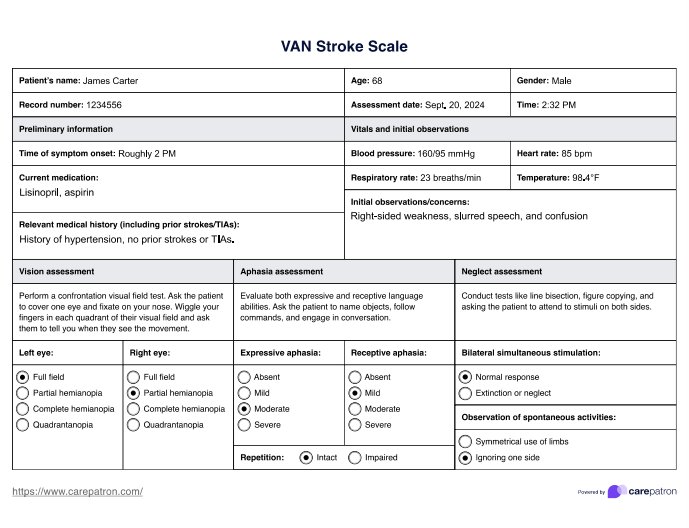
Here are the VAN scale's components:
- Vision: This component assesses visual field defects. Patients are evaluated for any loss of vision or visual field cuts, which can indicate an issue with certain brain regions like the occipital lobe or specific large vessels like the posterior cerebral artery.
- Aphasia: This part of the assessment focuses on language. Aphasia refers to the impairment of language ability. The evaluation might include tasks like naming objects, repeating phrases, or following commands. Speech and language comprehension issues can point to dysfunction in brain areas such as the temporal or frontal lobes, often supplied by the middle cerebral artery.
- Neglect: This component assesses signs of neglect, a condition where the patient ignores or is unaware of one side of their body or the space around them. Neglect can be a sign of a stroke in the brain's right hemisphere, which may affect awareness and attention to the left side of the body and environment.
The VAN screening tool is specifically designed to quickly identify strokes that might benefit from advanced treatments like thrombectomy (a procedure to remove a blood clot from a blood vessel). It's valuable because it focuses on identifying symptoms associated with blockages in large vessels, which are crucial to recognize early for effective treatment.
In clinical settings, emergency medical services (EMS) personnel, nurses, and physicians often use the VAN tool to rapidly assess stroke symptoms and expedite decision-making regarding stroke care, particularly in deciding whether to transfer a patient to a comprehensive stroke center capable of performing rapid endovascular treatment.
Compared to other screening tools, such as the Cincinnati Prehospital Stroke Scale, the Rapid Arterial Occlusion Evaluation (RACE), and the Los Angeles Motor Scale (LAMS), the VAN Stroke Scale has shown a higher positive predictive value for detecting emergent large vessel occlusion (ELVO) strokes, particularly in patients with suspected ischemic strokes.
While the National Institutes of Health Stroke Scale (NIHSS) has a high negative predictive value (100%) for ruling out an emergent large vessel occlusion stroke (Teleb et al., 2016), it is not considered prehospital friendly due to its complexity (Curry, n.d.). By contrast, VAN’s simplicity makes it suitable for rapid prehospital use, especially by EMS personnel. Additionally, VAN’s streamlined approach helps identify patients who may benefit from advanced stroke interventions, such as thrombectomy, ensuring timely treatment.









