Everyone has a story to tell, and here we share and celebrate those who chose care as their life's work.
These are their words, their work and we're grateful to share them.
Elizabeth and Dennis handed their billing to Carepatron and grew My Therapeutic Concepts from five clients to seventy in two months, without losing their evenings.
Clients can learn the urge surfing technique best through structured, guided practice that connects to their real-life experiences. As a healthcare professional, your role is to make the exercise engaging and relatable. Learn how to effectively guide clients through the process and reinforce the skill using the Urge Surfing Worksheet below.
## **What is urge surfing?**
Urge surfing is a mindfulness-based technique developed by G. Alan Marlatt, a clinical psychologist widely recognized for his research on addiction recovery and relapse prevention. The concept teaches individuals how to manage cravings and unwanted urges, such as those related to substance use, overeating, or other addictive behaviors, by mindfully observing them rather than acting on them(Bowen & Marlatt, 2009).
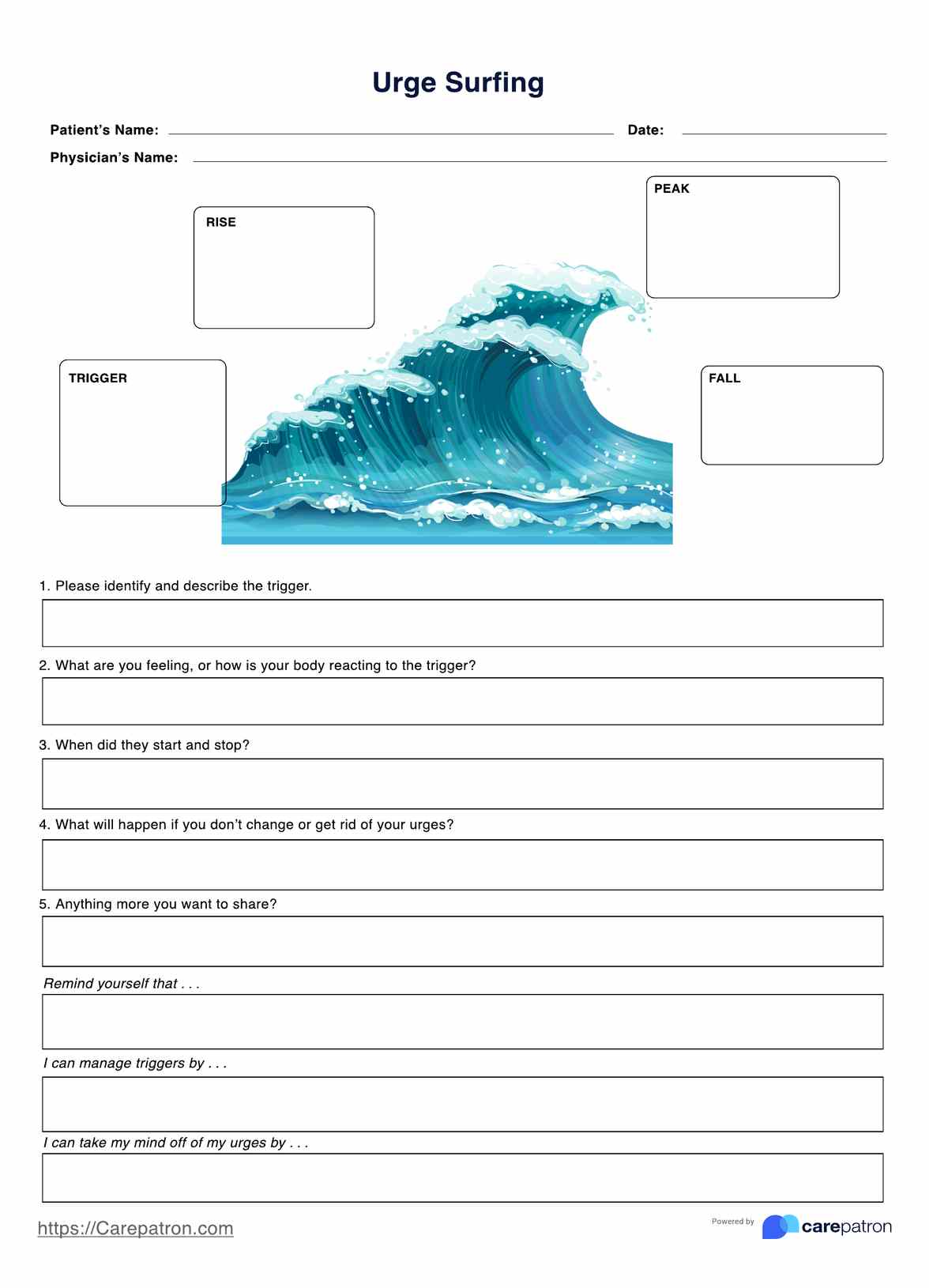
The urge surfing technique takes its name from the image of a wave rising, cresting, and falling. Cravings work similarly. They build in intensity, peak, and eventually fade away. Instead of trying to fight, avoid, or suppress these feelings, clients are encouraged to “ride the wave” of discomfort until it passes (Marlatt et al., 2002). This method promotes distress tolerance, impulse control, and self-compassion, helping clients realize that urges are temporary sensations, not commands that must be followed.
Urge surfing helps clients understand that urges are internal experiences that can be observed without judgment. By doing so, they learn to respond mindfully rather than react automatically. This separation between the urge to act and the act itself allows for greater self-control and emotional regulation, key skills in addiction recovery and daily life.
Therapists often use urge surfing as a dialectical behavior therapy (DBT) skill or as part of Mindfulness-Based Relapse Prevention (MBRP) programs to help clients manage cravings, unwanted behaviors, and difficult emotions. It can be applied across various situations, from attempts to stop smoking or resist alcohol to coping with stress, anger, or emotional eating.
### **Mindful steps in urge surfing**
When clients practice urge surfing, they typically move through these mindful steps:
1. Notice the urge: Identify when the craving begins and where it shows up as physical sensations (e.g., tension, restlessness, pressure).
2. Focus on the breath: Use slow, steady breathing as an anchor to stay grounded in the moment.
3. Observe without reacting: Mindfully observe the sensations and thoughts, knowing they will rise and fall like a wave.
Over time, this urge surfing skill helps clients build tolerance to discomfort, improve self-awareness, and manage future urges more effectively. It also enhances their ability to cope with intense emotions, contributing to stronger mental health and more stable behavioral control.
## **What is an Urge Surfing Worksheet?**
An Urge Surfing Worksheet is a structured therapeutic tool designed to help clients practice the urge surfing technique. This worksheet guides clients through the process of identifying, observing, and managing cravings or urges as they arise, whether during a therapy session or in their daily life.
Much like the metaphor of an ocean wave, the worksheet helps clients visualize how urges build, crest, and eventually fade away. It encourages them to stay present and observe their physical sensations, emotions, and thoughts mindfully instead of reacting impulsively. By writing down their experiences, clients can better understand their triggers, recognize patterns, and strengthen their emotional regulation over time.
Unlike other forms of urge surfing handouts that describe the concept, our template includes fillable spaces and guided questions that prompt reflection and deeper awareness. Practitioners can use it to assess how effectively clients are using the technique and to help them refine their coping strategies or integrate other skills alongside urge surfing.
## **How does it work?**
The Urge Surfing Worksheet is designed to make the urge surfing technique practical and straightforward for both clinicians and clients. It guides users through each stage of managing cravings or difficult emotions, from understanding the process to reflecting on their experiences. Here’s how to integrate it into your sessions and help clients apply it effectively in their daily lives.
### **Step 1: Download the template**
To access and download our printable urge surfing worksheets, click the “Use Template” or “Download Template” button above. Search “Urge Surfing Worksheets” in [Carepatron's template library](https://www.carepatron.com/templates/). on our app or website.
### **Step 2: Explain the worksheet to your client**
When you give them a copy, you must teach them how to use the worksheet to help them cope with their feelings. Explaining the wave points they must ride when they have urges will help them know what to expect and find ways to deal with them
### **Step 3: Give them the worksheet**
Give your client multiple copies of the worksheet and explain that they can use the worksheets to record how they managed their urges. That way, the next time they have a session, they'll have a basis for conversation.
### **Step 4: Discuss the answers**
During your session, you may review how the patient dealt with their urges and suggest more effective coping methods.
### **Step 5: Securely store**
Afterward, since the worksheet and your notes carry sensitive information, remember to store them in a secure physical location or a HIPAA-compliant EHR like Carepatron.
This worksheet is part of Carepatron’s full catalog of evidence-based mental health resources. These templates are designed to support practitioners in teaching mindfulness-based techniques that improve emotional regulation and enhance long-term recovery outcomes. Access our resource library for more resources you can use in your practice.
## **How to teach urge surfing effectively**
Teaching urge surfing is most effective when presented as an engaging, hands-on exercise that most people can relate to, rather than a purely theoretical concept. The aim is to help clients feel comfortable enough to accept the experience of urges and learn how to manage them mindfully.
### **Acknowledge and normalize urges**
Begin by acknowledging that cravings, impulses, or unwanted behaviors are natural parts of human experience. Every person encounters moments of discomfort or temptation—it’s the response that determines the outcome. By framing urges as temporary and manageable sensations rather than failures of willpower, clients become more open to learning how to “ride the wave.”
### **Use imagery to make the concept relatable**
Invite clients to imagine an ocean wave rising, cresting, and falling. Explain that their cravings or emotions work in much the same way—they grow in intensity, peak briefly, and then fade. Encourage them to pause, notice sensations in their body (like tightness, warmth, or restlessness), and observe how these sensations shift over time. This visualization helps translate mindfulness into a tangible experience.
### **Practice the skill together**
Guide clients through a brief in-session exercise. Have them focus on slow, steady breathing while mindfully observing any sensations or thoughts that arise. Remind them that the goal isn’t to eliminate the urge but to accept and observe it without judgment. Afterward, discuss what they noticed—did the intensity change, or did they feel more in control? Encourage them to repeat this practice regularly between sessions.
### **Reinforce learning through the worksheet**
Once clients are familiar with the exercise, introduce the Urge Surfing Worksheet as a way to extend practice beyond the session. Ask them to record what triggered the urge, how it felt in their body, and what helped them manage it. Reviewing these reflections later allows both practitioner and client to identify progress, refine strategies, and strengthen the client’s ability to stay present during challenging moments.
## **References**
Bowen, S., & Marlatt, A. (2009). Surfing the urge: Brief mindfulness-based intervention for college student smokers. Psychology of Addictive Behaviors, 23(4), 666–671. https://doi.org/10.1037/a0017127
Marlatt, G., Parks, G., & Witkiewitz, K. (2002). Clinical guidelines for implementing relapse prevention therapy: A guideline developed for the behavioral health recovery management project. https://www.drugsandalcohol.ie/13620/1/NTA_RPT.pdf
Commonly asked questions
Urge surfing is a mindfulness technique that teaches individuals to observe cravings or impulses without acting on them. It’s based on the idea that urges, like waves, naturally rise, peak, and fade away with time. By noticing these sensations mindfully, people can reduce impulsive reactions and build greater self-control.
Urge surfing is most commonly used in Dialectical Behavior Therapy (DBT) and Mindfulness-Based Relapse Prevention (MBRP), though it also draws from Cognitive Behavioral Therapy (CBT) principles. DBT emphasizes using mindfulness to tolerate distress, which aligns with urge surfing’s focus on observing urges nonjudgmentally. In practice, it bridges both approaches—combining CBT’s cognitive awareness with DBT’s mindfulness-based coping skills.
A person trying to quit smoking might notice an intense craving, focus on their breathing, and observe the sensation pass instead of lighting a cigarette. Someone managing emotional eating might feel the urge to snack, but instead, they can watch the discomfort rise and fall like a wave. Another example is a client who, during conflict, pauses, breathes, and lets the anger subside before responding.