








What is a Knee to Wall Test?
The ankles are a crucial part of the body, providing mobility, stability, and shock absorption. They allow us to move efficiently, maintain balance, and perform everyday tasks such as walking, running, and climbing stairs. Additionally, the ankle joint is vital in absorbing impact, preventing excessive stress on the knees, hips, and lower back.
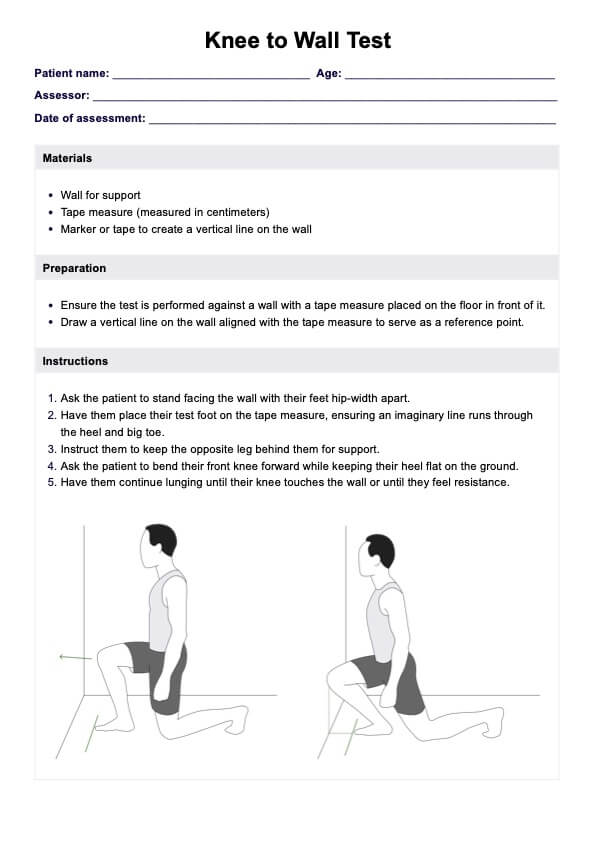
Healthcare professionals, particularly physical therapists, use the Knee to Wall Test, also known as the weight-bearing lunge test (WBLT) or dorsiflexion lunge test (DFT), to assess ankle joint mobility. This test evaluates the ankle dorsiflexion range, helping identify restricted ankle joint dorsiflexion that may contribute to poor ankle mobility and movement inefficiencies.
To perform this test, you need a wall for support, a tape measure to record the distance, and a vertical line drawn on the wall aligned with the tape measure on the floor. The patient begins by placing one foot on the tape measure, ensuring an imaginary line runs through the heel and big toe, aligned with the vertical marker. They then lunge forward, attempting to touch their knee to the wall while keeping the heel flat on the ground. If they succeed, the foot is moved slightly farther away, and the movement is repeated.
The goal is to determine the maximum distance at which the knee can still touch the wall while maintaining heel contact with the ground. The opposite leg remains on the floor for support, and the patient may use the wall for balance. Once the maximum distance is determined, it is recorded in centimeters (cm), with each centimeter corresponding to approximately 3.6° of ankle dorsiflexion.
Because it provides consistent results, this test is reliable for testing ankle range and detecting ankle joint dorsiflexion limitations (Bennell et al., 1998), which can impact functional movement and increase injury risk. Identifying poor ankle mobility early allows targeted interventions, such as mobility exercises and stretching techniques, to restore proper ankle range and prevent compensatory movement patterns.









