








What is the brachial plexus?
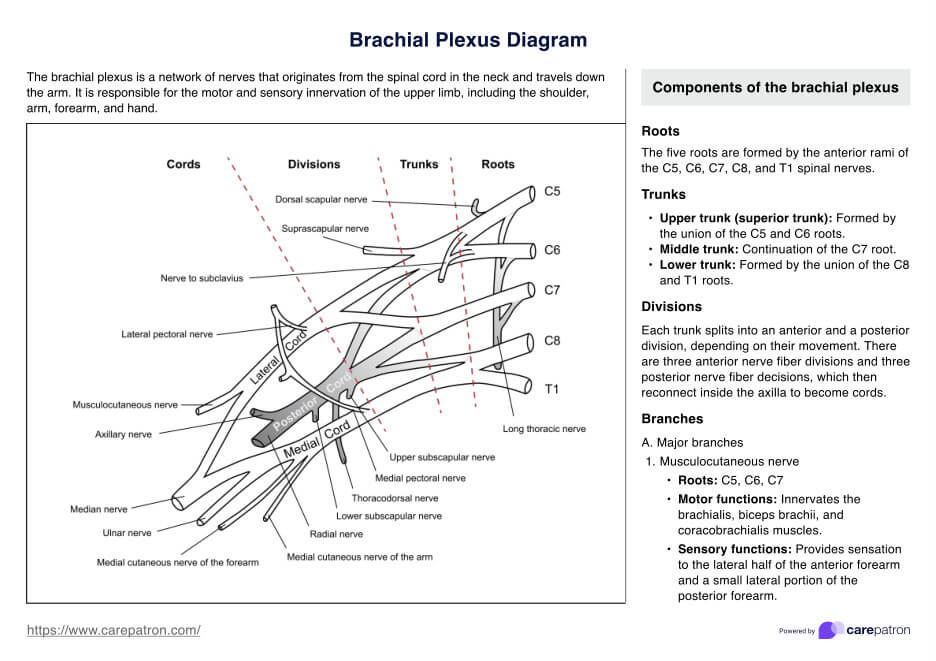
The brachial plexus is a complex network of nerves that originates from the spinal cord in the neck and travels down the upper limb. It is responsible for the motor and sensory innervation of the upper limb, including the shoulder, arm, forearm, and hand. The brachial plexus consists of five parts: roots, trunks, divisions, cords, and branches.
Here's a more detailed breakdown:
- Roots: The anterior rami of the C5, C6, C7, C8, and T1 spinal nerves form the roots of the brachial plexus.
- Trunks: Each nerve root combines to form three trunks:
- Upper trunk (superior trunk): Formed by the union of the C5 and C6 roots.
- Middle trunk: Continuation of the C7 root.
- Lower trunk: Formed by the union of the C8 and T1 roots.
- Divisions: Each trunk splits into an anterior and a posterior division.
- Cords: The divisions form three cords:
- Lateral cord: Formed by the anterior divisions of the upper and middle trunks.
- Posterior cord: Formed by the posterior divisions of all three trunks.
- Medial cord: Formed by the anterior division of the lower trunk.
- Branches: The cords give rise to five major nerves:
- Musculocutaneous nerve: Innervates the brachialis, biceps brachii, and coracobrachialis muscles. Provides sensation to the lateral half of the anterior forearm.
- Axillary nerve: Innervates the teres minor and deltoid muscles. Provides sensation to the inferior region of the deltoid.
- Median nerve: Innervates most of the flexor muscles in the forearm and the thenar muscles. Provides sensation to the lateral part of the palm and the lateral three and a half fingers on the palmar surface.
- Radial nerve: Innervates the triceps brachii and the posterior compartment of the forearm. Provides sensation to the posterior aspect of the arm and forearm.
- Ulnar nerve: Innervates the muscles of the hand (apart from the thenar muscles and two lateral lumbricals), flexor carpi ulnaris, and the medial half of flexor digitorum profundus. Provides sensation to the medial one and a half fingers.
In addition to these major branches, the brachial plexus also has several minor branches that provide innervation to other muscles and skin areas.
- Roots: Dorsal scapular nerve, long thoracic nerve
- Trunks: suprascapular nerve, subclavian nerve (nerve to subclavius)
- Lateral cord: Lateral pectoral nerve
- Medial cord: Medial pectoral nerve, medial antebrachial cutaneous nerve (also known as the medial cutaneous nerve of the forearm), medial brachial cutaneous nerve (also known as the medial cutaneous nerve of the arm or the lesser internal cutaneous nerve)
- Posterior cord: Superior subscapular nerve, thoracodorsal nerve, inferior subscapular nerve









