
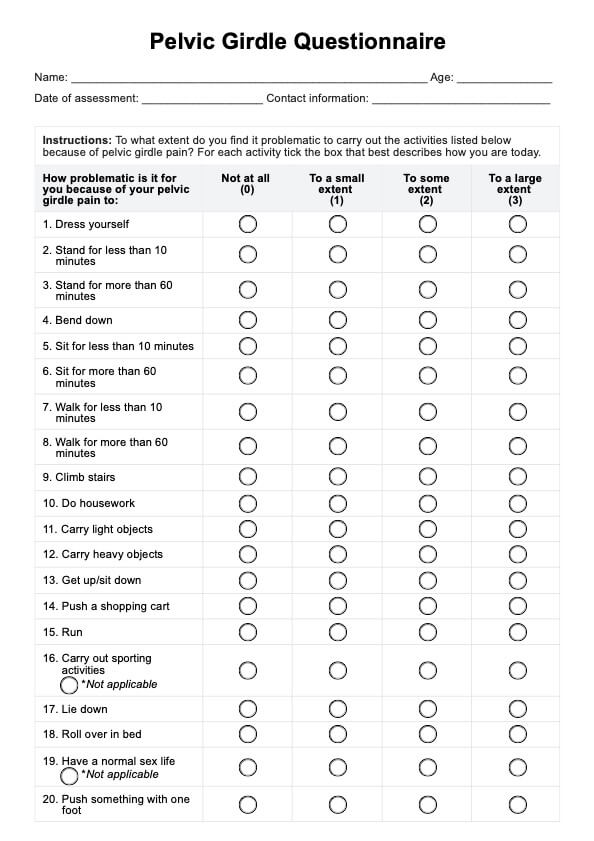




What is the Pelvic Girdle Questionnaire used for?
The Pelvic Girdle Questionnaire (PGQ) is a condition-specific instrument designed to assess and measure the impact of pelvic girdle pain on individuals. It is used primarily in clinical practice and physical therapy to evaluate activity limitations and monitor patients' progress experiencing pelvic girdle pain. The PGQ provides a comprehensive assessment of the patient's condition with European guidelines, capturing the severity of symptoms and the extent to which the pain affects their daily activities and quality of life.
As an outcome measurement instrument, the Pelvic Girdle Questionnaire is essential for diagnosing the condition and tailoring treatment plans. Its robust measurement properties ensure accurate and reliable results, making it a trusted tool for research and clinical practice among healthcare practitioners in the physical health domain.
The Pelvic Girdle Questionnaire measures and documents the impact of pelvic girdle pain on patients. Its application in clinical practice and physical therapy helps assess activity limitations and optimize treatment plans, making it an invaluable health measurement instrument for managing pelvic girdle conditions.
How reliable is the Pelvic Girdle Questionnaire?
The Pelvic Girdle Questionnaire is highly reliable, as demonstrated by its test-retest reliability. The PGQ activity subscale has an intraclass correlation coefficient (ICC) of 0.93 (95% confidence interval 0.86–0.96), while the symptom subscale has an ICC of 0.91 (95% confidence interval 0.84–0.95) (Stuge et al., 2011).
These high ICC estimates indicate strong consistency and stability in the questionnaire’s results over repeated administrations. This reliability makes the PGQ a trustworthy tool for assessing pelvic girdle pain, ensuring accurate and consistent measurement properties of activity limitations and symptoms in clinical practice.









