







What is De Quervain's tenosynovitis?
De Quervain's tenosynovitis (sometimes called De Quervain's syndrome or disease) is a tendon-related condition that affects the thumb area of the wrist. It is characterized by pain in that location whenever the person turns their wrist, balls their hands into a fist, or attempts to grip an object. Patients with this condition might also have swelling at the base of their thumbs.
Engaging in any activity that requires repetitive hand and wrist movements (and there are many of these, including work and activities of daily living) will worsen this condition. When it worsens, the person with De Quervain's tenosynovitis will feel the pain radiate throughout the thumb and even the forearm.
How to diagnose De Quervain's disease
To diagnose De Quervain tenosynovitis, healthcare professionals must conduct several tests, from provocation to imaging tests, to reduce the risk of false positives.
The provocation tests (such as Finkelstein's test and Brunelli's test) are conducted to check for the possibility of the patient having it. These tests look for specific signs, and if those specific signs show themselves, that means a positive test result for each of them. Conducting several is recommended to narrow down the problem and increase the likelihood of the condition.
After the provocation tests, an imaging test will confirm the diagnosis of De Quervain's tenosynovitis or any other potential disease or problem causing pain, like osteoarthritis.
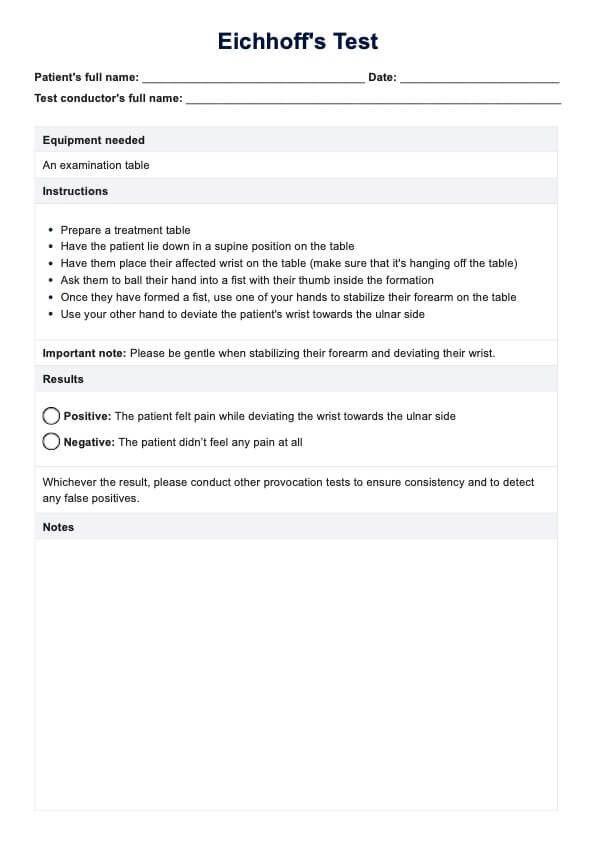
While the Finkelstein Test is used most in clinical practice to detect the condition, you can conduct the Eicchoff's Test to do the same!









