


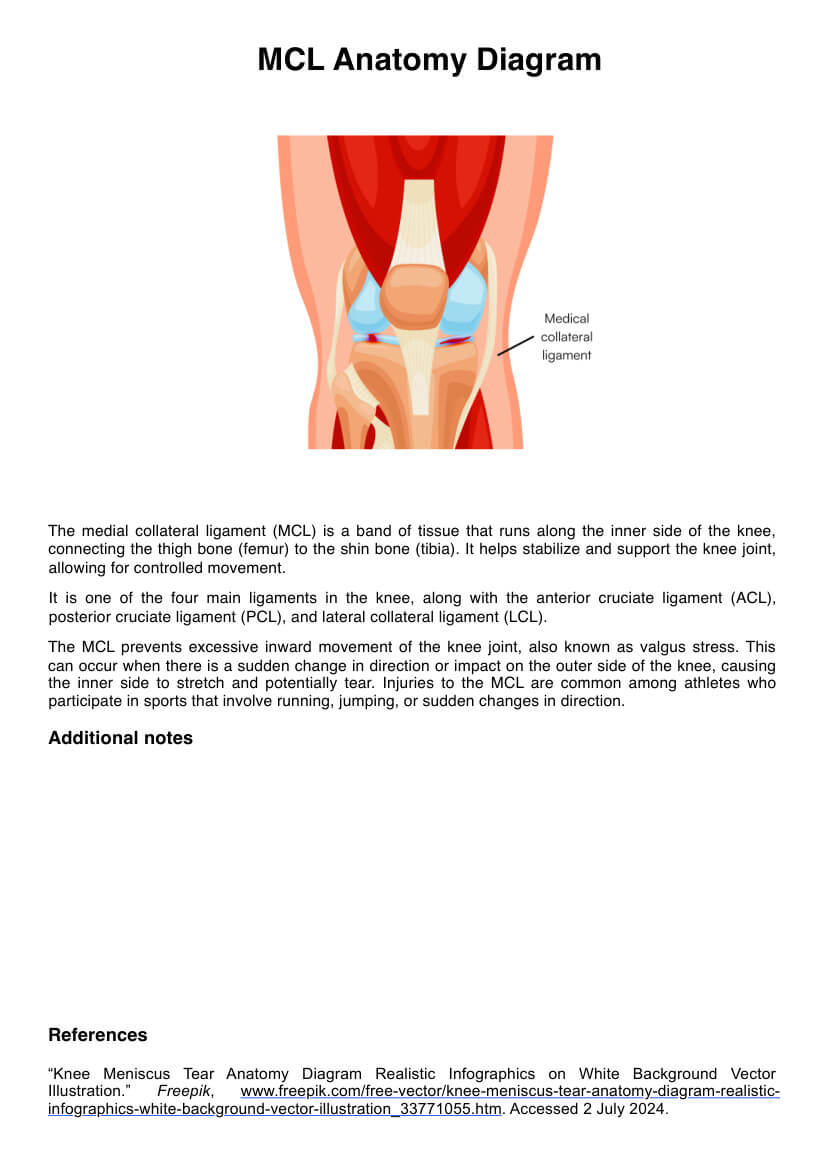




What is the function of the medial collateral ligament (MCL)?
The medial collateral ligament (MCL), also known as the tibial collateral ligament TCL, is a flat connective tissue that runs from the medial femoral epicondyle to the medial condyle of the tibia situated on the medial aspect of the knee joint. It is the largest structure on the medial side, given its length of 8 to 10 cm.
Its primary role is to maintain knee stability by resisting valgus forces, thus preventing the knee from excessively bending inward. In addition, the MCL acts as a primary static stabilizer that assists in the passive stabilization of the knee joint by serving as a secondary restraint to rotational forces and responding to valgus stress.
How is it different from TCLs, ACLs, etc.?
The medial collateral ligament is distinct from other knee ligaments like the anterior cruciate ligament (ACL) and the lateral collateral ligament (LCL), not only in location but also in purpose.
While the ACL is situated deep within the center of the knee, and the LCL is found on the outer side of the knee, the MCL is located on the knee joint’s inner side. Concerning purpose, the MCL’s primary role is to prevent excessive inward bending and to provide rotational stability. This is strikingly different from the ACL, whose primary role is to prevent excessive front-to-back movement, and the LCL’s role is to prevent excessive side-to-side movement, ensuring lateral stability.
Despite these differences, however, these ligaments, along with the posterior cruciate ligament (PCL), posterior oblique ligament (POL), and other ligaments in the knee, contribute to the knee’s overall stability.
What can negatively impact an MCL's functioning?
Given the MCL’s crucial role, one must be aware of the several factors that can impair its function. Primary factors or causes of damage to the MCL are trauma and injuries, often resulting from direct impacts on the outer knee. Examples are cutting maneuvers in sports, such as during a football tackle, awkward landings, or hyperextension in activities like asking. Non-sports-related incidents like car accidents, however, can also damage the MCL.
Aside from these, wear and tear that causes the MCL to lose elasticity, like repetitive stress and activities involving squatting, heavy lifting, and high-impact sports, can also affect its function. Finally, those with previous MCL injuries are also at risk of damage because of an increased likelihood of re-injury.









