## **What is Achilles tendinopathy?**
Achilles tendinopathy is characterized by pain, swelling, and impaired performance of the Achilles tendon, the thick band of tissue connecting the calf muscles to the heel bone. Due to repetitive strain and overuse, this condition commonly affects athletes, particularly those engaged in running and jumping sports.
### **Symptoms of this type of tendinopathy**
Achilles tendinopathy manifests through various symptoms that affect the structure and function of the tendon. Individuals may experience markedly reduced flexibility and persistent local tenderness in the tendon sheath. During tendon palpation, thickening of the tendon might be noticed, which is a key indicator of the condition.
Symptoms often worsen with activities that stress the tendon, such as knee flexion or walking, leading to increased local tenderness in the tender portion of the Achilles tendon. As the tendinopathy progresses, these symptoms may become more pronounced, significantly impacting daily activities and mobility.
### **Causes of this type of tendinopathy**
Achilles tendinopathy is primarily caused by repetitive microtrauma to the tendon fibers, often from activities involving excessive tendon loading, such as running or jumping. Contributing factors include improper footwear that fails to support the foot or distribute the load evenly and inadequate stretching, which leads to decreased tendon flexibility and resilience.
Additionally, biomechanical irregularities, such as flat feet, can exacerbate stress on the tendon, leading to changes in tendon thickness and palpation findings. Over time, these factors collectively contribute to the positive findings of tendinopathy, characterized by thickened tendons, local tenderness, and pain considered positive during clinical assessments.
## **What is the Royal London Hospital Test?**
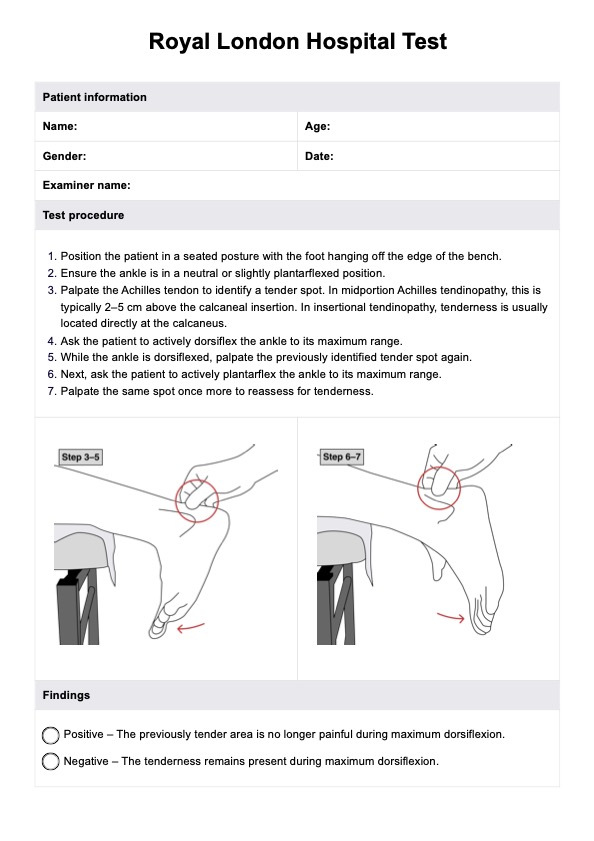
The Royal London Hospital Test is a specialized clinical evaluation designed to assess the condition of the Achilles tendon, particularly to detect the presence of tendinopathy (Reiman et al,. 2014). This palpation test is valuable in the diagnostic process because it focuses on the mechanical and functional aspects of the tendon under stress.
### **Procedures of the test**
During the assessment, clinicians manually palpate the Achilles tendon to identify any areas of tenderness, which may indicate inflammation or damage. The patient is then asked to move their foot into maximum dorsiflexion and plantar flexion while the clinician re-palpates the tender spot (Maffuli et al., 2003). The change in pain level during these movements helps determine the presence or absence of Achilles tendinopathy.
### **Interpreting the results**
The test is considered positive if the initial pain at the tender spot significantly decreases or disappears when the ankle is dorsiflexed. On the other hand, if the pain remains unchanged or worsens during dorsiflexion, it may indicate a negative result.
## **How to use our template**
Our Royal London Hospital Test template includes fillable fields designed for healthcare professionals to create personalized care plans, document interventions, track results, and record important clinical observations efficiently.
### **Step 1: Access the template**
Start by accessing the Royal London Hospital Test template via the Carepatron app by clicking the "Use template" button. Alternatively, you can save a fillable and printable PDF version using the "Download" button.
### **Step 2: Assess the patient**
Perform the test as outlined, positioning the patient appropriately and palpating the Achilles tendon to identify tender spots. Accurately record patient details and findings in the provided fields. Our template has images for guidance.
### **Step 3: Document findings**
Use the provided checkboxes to document the test outcome as positive or negative. Include any additional relevant clinical notes in the provided text fields.
### **Step 4: Discuss results with the patient**
Clearly explain the findings to the patient, demonstrating how to interpret the results. Show the patient how to track their progress by documenting changes over time using the template, promoting patient engagement in their recovery.
## **Common treatments for Achilles tendinopathy**
The treatment of Achilles tendinopathy is aimed at alleviating pain and facilitating the tendon's recovery. Effective management strategies include:
- **Physical therapy**: Tailored exercises are crucial to strengthen the calf muscles and enhance tendon function and flexibility. This therapy also focuses on stretching exercises to increase tendon elasticity and reduce stiffness.
- **Extracorporeal Shock Wave Therapy (ESWT)**: This non-invasive treatment uses shock waves to stimulate healing in the injured tendon. It's particularly useful for cases resistant to conventional treatments.
- **Conservative management**: The RICE protocol—Rest, Ice, Compression, and Elevation—is a foundational approach, especially soon after the injury. Additionally, over-the-counter or prescribed pain medications can effectively manage acute discomfort.
- **Eccentric training**: Gradual loading exercises that lengthen the tendon under tension can help remodel the tendon tissues and alleviate symptoms.
- **Orthotic supports**: Custom orthotics or heel lifts can reduce strain on the tendon by adjusting abnormal mechanics that contribute to tendon stress.
These therapies reduce immediate symptoms and implement long-term changes that prevent recurrence. Each patient's treatment plan may vary, often combining several options based on severity and specifics.
## **Benefits of using this template**
This template streamlines the diagnostic process, ensuring consistency and accuracy when assessing Achilles tendinopathy.
- **Efficient documentation**: Quickly and accurately document patient data, test outcomes, and clinical notes in structured, fillable fields.
- **Enhanced patient communication**: Simplify discussions with patients by clearly showing and explaining the results of the Royal London Hospital Test.
- **Personalized care plans**: Easily track patient progress and tailor treatment interventions based on documented findings.
- **Facilitates patient involvement**: Encourage patient participation by demonstrating how they can use the template to monitor their own symptoms and improvement over time.
Best of all, if you used this template on the Carepatron app, you'll also benefit from Carepatron’s extensive suite of tools designed to streamline your clinical workflows. Our free plan includes scheduling, automated reminders, and even an AI scribe — try it today!
## **References**
Hutchison, A.-M., Evans, R., Bodger, O., Pallister, I., Topliss, C., Williams, P., Vannet, N., Morris, V., & Beard, D. (2013). What is the best clinical test for Achilles tendinopathy? Foot and Ankle Surgery, 19(2), 112–117. https://doi.org/10.1016/j.fas.2012.12.006
Maffulli, N. et al. (2003). Clinical diagnosis of Achilles tendinopathy with tendinosis. Clinical Journal of Sport Medicine, 13(1), 11–15.
Martin, R. L., Chimenti, R., Cuddeford, T., Houck, J., Matheson, J. W., McDonough, C. M., Paulseth, S., Wukich, D. K., & Carcia, C. R. (2018). Achilles pain, stiffness, and muscle power deficits: Midportion achilles tendinopathy revision 2018 – clinical practice guidelines linked to the international classification of functioning, disability and health from the orthopaedic section of the American Physical Therapy Association. Journal of Orthopaedic & Sports Physical Therapy, 48(5), A1–A38. https://doi.org/10.2519/jospt.2018.0302
Reiman, M. et al. (2014). The utility of clinical measures for the diagnosis of Achilles tendon injuries: A systematic review with meta-analysis. Journal of Athletic Training, 49(6), 820–829.