Everyone has a story to tell, and here we share and celebrate those who chose care as their life's work.
These are their words, their work and we're grateful to share them.
Elizabeth and Dennis handed their billing to Carepatron and grew My Therapeutic Concepts from five clients to seventy in two months, without losing their evenings.
Looking for a tool that can help you gather preliminary information about patients for any medical emergency? Read our guide to learn more about Emergency Medical Forms and how they are essential tools for healthcare professionals who work in emergency care. Then, download our template to use for your documentation.
## **The importance of swiftness in the ER**
The swiftness of care in the Emergency Department (ED) is critically important because, in time-sensitive medical emergencies, every second counts for improving patient outcomes and preventing complications (Admin, 2025).
For conditions like a heart attack or stroke, prompt intervention—often within a specific "golden hour" or window—is vital for minimizing permanent damage and increasing survival rates; for instance, rapid treatment for stroke can significantly reduce brain injury, while fast care during a heart attack lessens heart muscle damage, according to the American Heart Association (Physicians Premier ER, 2025).
Delays in diagnosis and definitive treatment, especially in overcrowded EDs, have been linked to increased patient mortality and overall poor patient outcomes, underscoring that efficient patient flow, effective triage, and quick decision-making are essential for patient safety and the delivery of quality emergency care (Samadbeik et al., 2024).
## **What is an Emergency Medical Form?**
As medical professionals, you have definitely considered what would happen if someone in your care had a medical emergency. Whether it's an employee, a client, a student, or a child you're looking after, they may be unable to convey crucial medical information themselves.
Luckily, you can prepare for the worst-case scenarios. Even though we hopefully never have to use it, our Emergency Medical Forms give you peace of mind and allow you to quickly access the information medical providers or first responders may need in an emergency.
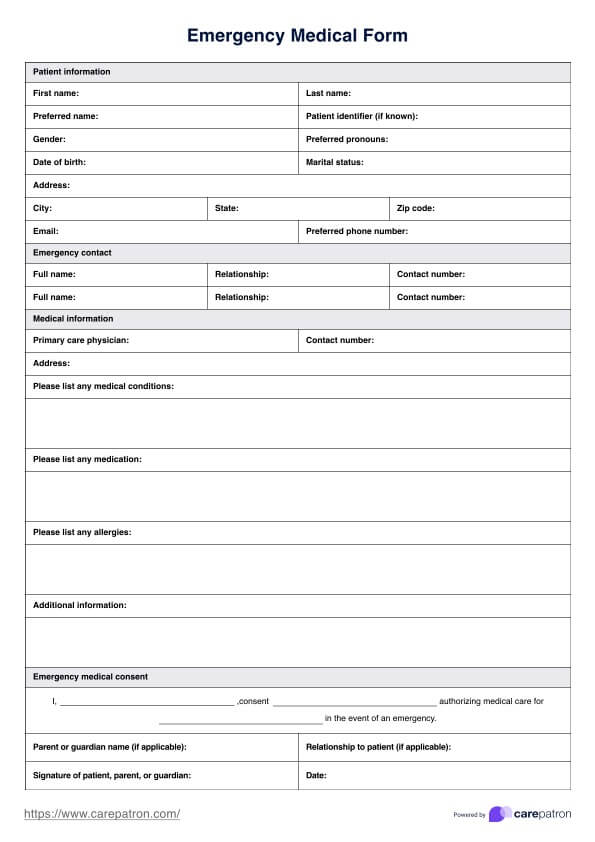
Our Emergency Medical Form template includes spaces for personal and medical history information, current medications, allergies, emergency contacts, and emergency medical
It provides healthcare providers with the information they need to make informed clinical decisions on their patients' behalf. In an emergency, the patient may be unconscious or unable to convey the necessary information. authorization for an adult or child patient.
These forms are versatile for use across all different fields. Take a look at just some of the individuals this form can prove beneficial to:
- **Emergency department physicians and nurses**: Perhaps the most apparent user choice for a medical emergency form is the people who see emergencies daily, that is, emergency responders, doctors, nurses, paramedics, or other clinical and medical staff who work in emergency departments.
- **Assisted living or aged care facilities**: The aging population may be taking several medications or have had specific medical treatments or conditions that will change how they need to be treated in an emergency.
- **Employers**: Companies would be prepared with their medical information if an employee had a medical emergency. The form makes a great addition to a new employee's induction documentation.
- **Schools, daycares, or kindergartens**: Once a child's parent drops them off for the day, they can be confident that information is provided if their child has a medical emergency.
- **Nannies or babysitters**: By having your clients fill in an emergency Medical Information Form for the children you are looking after, you can demonstrate your initiative and capability for your service.
Time is of the essence in an emergency, so having emergency forms, such as emergency contact forms, already filled out and accessible for anyone who may need them is a great way to save crucial minutes and maximize the possibility of a good outcome for the patient.
### **Emergency Medical Forms and HIPAA**
Emergency medical forms, such as Patient Care Reports (PCRs), contain Protected Health Information (PHI) and must fully comply with the HIPAA Privacy and Security Rules (Anthoney, 2024).
Although HIPAA typically requires patient authorization for information disclosure, the Privacy Rule permits sharing PHI for Treatment, Payment, and Healthcare Operations (TPO), which is essential for Emergency Medical Services (EMS) to quickly transfer vital patient information to hospital staff without delay (McMillan, 2025).
To maintain compliance, EMS agencies must implement technical, physical, and administrative safeguards—including secure storage, encryption, and training—to protect this sensitive data throughout the patient encounter and documentation process (U.S. Department of Health and Human Services, 2024).
## **How does our Emergency Medical Form PDF work?**
We've kept this Emergency Medical Form template concise so anyone using it in an emergency doesn't have to search through multiple pages. Everything that needs to be filled in is on a single page, so once you've downloaded the free PDF from the link on this page, let's go through the different steps to filling in this form.
### **Step 1: Ensure you gather personal information accurately**
Begin by collecting relevant information, such as the patient's name, address, and date of birth. This information is crucial for swiftly accessing medical records during an emergency, streamlining the process, and saving valuable time.
### **Step 2: Obtain emergency contact information**
The emergency contact is the primary point of contact in a medical emergency. Encourage patients to select someone who resides nearby or is readily reachable during emergencies. Record their name, contact number, and relationship to the patient for efficient communication in the emergency contact form section.
### **Step 3: Document medical history**
Proceed to document the patient's [medical history](https://www.carepatron.com/templates/medical-history-form/), including any existing medical conditions, a [list of current medications](https://www.carepatron.com/templates/medication-list-template/), allergies, and all information that could aid in effectively managing an emergency.
### **Step 4: Establish emergency medical consent**
Facilitate the process of emergency medical consent, empowering individuals to authorize medical care on their behalf or on behalf of a dependent in case of an emergency. Get the patient's name, the authorized individual or entity, and the designated person responsible for granting consent. If the consent pertains to a child or dependent, complete the parent or guardian section accordingly.
### **Step 5: Ensure accessibility and security**
Emphasize the importance of securely storing the completed emergency information form in a readily accessible location for emergencies. Whether maintaining physical copies or storing digital records, ensure easy retrieval alongside other essential information for swift action when needed.
## **References**
Anthoney, C. (2024, May 6). Using HIPAA compliant forms in emergency medical services (EMS). Paubox. https://www.paubox.com/blog/using-hipaa-compliant-forms-in-emergency-medical-services-ems#:~:text=HIPAA%20mandates%20protecting%20patient%20privacy,pressure%2C%20time%2Dsensitive%20situations.
McMillan, L. K. (2025, February 6). HIPAA and EMS: Navigating information sharing and quality improvement. Journal of Emergency Medical Services. https://www.jems.com/ems-management/hipaa-and-ems-navigating-information-sharing-and-quality-improvement/
Physicians Premier ER. (2025, February 20). Why time matters in medical emergencies: The importance of quick ER access. https://mdpremier.com/why-time-matters-in-medical-emergencies-the-importance-of-quick-er-access/#:~:text=When%20a%20medical%20emergency%20happens,smooth%20recovery%20and%20serious%20complications.
Samadbeik, M., Staib, A., Boyle, J., Khanna, S., Bosley, E., Bodnar, D., Lind, J., Austin, J. A., Tanner, S., Yasaman Meshkat, Barbora de Courten, & Sullivan, C. (2024). Patient flow in emergency departments: a comprehensive umbrella review of solutions and challenges across the health system. BMC Health Services Research, 24(1), 274–274. https://doi.org/10.1186/s12913-024-10725-6
U.S. Department of Health and Human Services. (2024, December 30) Summary of the HIPAA Security Rule. https://www.hhs.gov/hipaa/for-professionals/security/laws-regulations/index.html
Commonly asked questions
If you manage the storage of emergency medical information forms, don't delay. Offer the medical information to the first responders at the medical emergency or the healthcare providers at the emergency department. In an emergency, offering vital information is better than holding it back, thinking it won't be relevant.
Healthcare providers emphasize the necessity of having an Emergency Medical Form, particularly for individuals with conditions like severe allergies, diabetes, epilepsy, chronic conditions, or a history of strokes or heart disease. Ensuring all the details and pertinent health information are readily available to employers, family members, housemates, or caregivers can facilitate swift and appropriate medical intervention during emergencies.
The time it takes to complete an Emergency Medical Form can vary depending on factors such as the individual's medical history, familiarity with their current medications, and the level of detail required. Generally, it may take a few minutes to around half an hour to fill out the form thoroughly and accurately.