Everyone has a story to tell, and here we share and celebrate those who chose care as their life's work.
These are their words, their work and we're grateful to share them.
Elizabeth and Dennis handed their billing to Carepatron and grew My Therapeutic Concepts from five clients to seventy in two months, without losing their evenings.
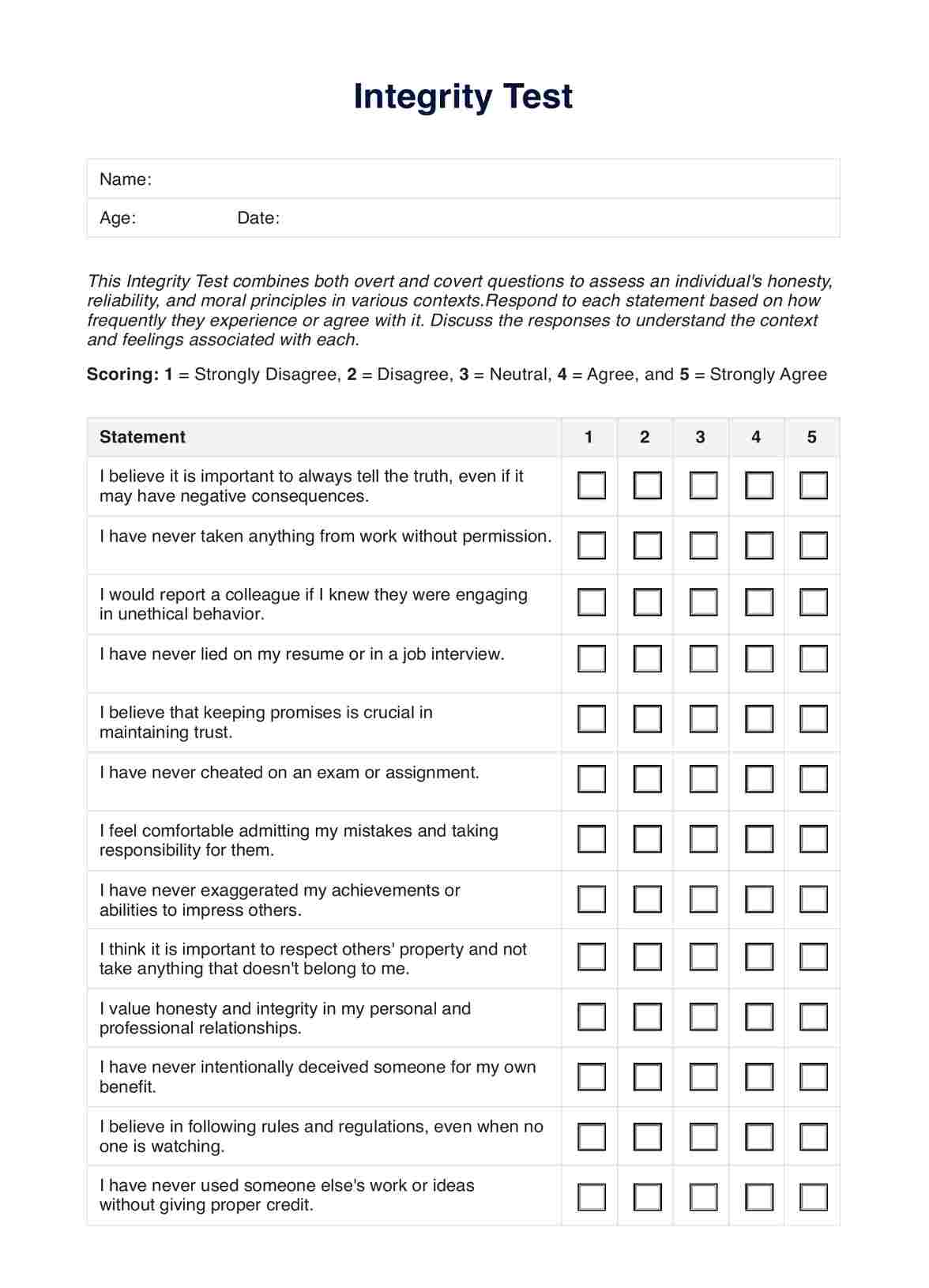
Looking for a good tool to help your client self-reflect about integrity? Read our guide to learn the importance of integrity to one's mental health, then use our Integrity Test to help your clients gauge themselves, their ethical behaviors, and integrity.
Uncover the essentials of integrity with our Integrity Test Template. Designed for mental health professionals, this tool aids in evaluating ethical behavior.
## **What is integrity?**
Integrity is a personal quality encompassing honesty, moral principles, and consistency in actions and values. It involves doing the right thing, even when no one is watching, and adhering to ethical standards in all situations. Integrity is crucial for building trust in relationships, maintaining a good reputation, and ensuring fairness in interactions.
Having integrity is crucial because it forms the foundation of a person's character and influences their interactions with others. People with high integrity are often respected and trusted by their peers, employers, and society as a whole. They are known for their reliability, honesty, and ethical behavior.
Positive consequences of integrity include stronger relationships, emotional stability, and increased self-esteem, to name a few. Individuals with integrity are more likely to be successful in their personal and professional lives, as they are seen as trustworthy and dependable (Koehler, 2023).
On the other hand, a lack of integrity can lead to negative consequences such as damaged relationships, loss of trust, and a tarnished reputation (Thomas, 2025). Dishonest behavior and a disregard for ethical standards can result in counterproductive behaviors and harm to oneself and others.
## **What is an Integrity Test?**
An integrity test is a type of personality test used to evaluate an individual's honesty, trustworthiness, and adherence to moral and ethical principles. These tests are often used in pre-employment screening and the hiring process as an integrity testing screen to identify potential employees who may exhibit dishonest behavior or engage in counterproductive activities in the workplace. Here, we'll discuss the two main types of integrity tests: the overt integrity test and the covert integrity test.
### **Overt integrity tests**
Overt integrity tests, also known as clear-purpose tests, directly ask questions about the test-taker's honesty, ethics, and past behavior related to integrity. Overt tests often include scenarios where the individual must choose how to respond to ethical dilemmas (U.S. Office of Personnel Management, 2023).
### **Covert integrity tests**
Covert integrity tests, or personality-based tests, assess personality traits associated with integrity, such as conscientiousness, reliability, and social responsibility (Wimbush, 2025). These personality questionnaires, or tests, do not directly ask about honesty but infer integrity from the individual's responses to various personality questions.
The Integrity Test can be conducted in various situations to assess an individual's integrity and ethical behavior. Here are some appropriate times to use this test:
- **Pre-employment screening**: Employers often use employee integrity tests and cognitive ability tests during the hiring process to evaluate a candidate's honesty, reliability, ethical standards, and cognitive skills, ensuring that the tests are conducted ethically and within legal boundaries. This helps select individuals less likely to engage in counterproductive behaviors such as theft, fraud, or dishonesty.
- **Employee assessments**: Organizations may conduct employee integrity testing to ensure continued adherence to ethical standards, especially in positions of trust or where ethical behavior is critical.
- **Counseling and therapy:** Mental health professionals may use the test during counseling sessions to explore issues related to honesty, ethics, and moral values. This can aid in addressing behavioral problems or in character development.
- **Academic settings**: Schools and universities might use integrity tests to assess students' honesty and ethical behavior, particularly in situations related to academic integrity, such as cheating or plagiarism.
- **Research studies:** Researchers may use integrity tests to study the relationship between personality traits, integrity, and various outcomes in different populations.
To add, taking an Integrity Test offers several advantages for both individuals and organizations, including insights into an individual's potential impact on job performance. Here are some key benefits:
- **Enhanced self-awareness:** For individuals, the test can provide insights into their own ethical beliefs and behaviors, helping them understand their strengths and areas for improvement.
- **Improved decision-making**: By understanding one's integrity profile, individuals can make more informed decisions that align with their moral values and ethical standards.
- **Risk reduction:** For organizations, using integrity tests in the hiring process can help identify candidates who are less likely to engage in counterproductive behaviors, reducing the risk of theft, fraud, and other unethical actions.
- **Cultural fit**: The test can assist in selecting employees whose values align with the organization's culture, promoting a more cohesive and ethical work environment.
- **Development opportunities:** The results can be used to tailor training and development programs focusing on enhancing employee ethical behavior and integrity.
- **Trust building**: Demonstrating a commitment to integrity through testing can help build trust with clients, customers, and stakeholders, enhancing the organization's reputation.
## **How does our Integrity Test work?**
This Integrity Test, made by Carepatron, is designed to comprehensively assess an individual's integrity, combining overt and covert testing methods. Please note that this has not undergone psychometric testing, but can still be used as an initial screening tool for rating integrity. Here's how it works:
### **Step 1: Access the template**
First, access the Integrity Test template through the Carepatron app or website. This ensures you have a standardized and reliable tool for assessing integrity.
### **Step 2: Review the statements**
The test consists of two sections: overt and covert. In the overt section, the individual responds to direct statements about honesty and ethical behavior. In the covert section, they answer questions that assess personality traits associated with integrity.
### **Step 3: Respond to the statements**
The individual rates each statement on a scale from 1 to 5, where 1 = Strongly Disagree and 5 = Strongly Agree. Their responses provide insights into their honesty, ethical behavior, and personality traits related to integrity.
### **Step 4: Calculate the scores**
Total the scores for each section to get an overall integrity score. Higher scores in the overt section indicate stronger alignment with principles of honesty and moral conduct, while higher scores in the covert section suggest personality traits associated with integrity.
### **Step 5: Interpret the results**
Use the scores to evaluate the individual's integrity. Consider the context and discuss the responses to understand the motivations and feelings associated with each statement.
### **Step 6: Reflect and discuss**
Encourage the individual to reflect on their answers and discuss any areas where they would like to explore or improve their integrity.
By following these steps, mental health professionals can use our Integrity Test to assess and understand their patients' integrity, aiding in therapeutic approaches and personal development.
## **How do you interpret the results of this Integrity Test?**
Interpreting the results of the Integrity Test involves analyzing the scores from both the overt and covert sections to gain insights into an individual's integrity. Here's how to interpret the results according to each section:
### **Overt integrity score**
The overt integrity questions are presented first in our test template. Here's how to interpret the score:
- Higher scores indicate a stronger alignment with principles of honesty and moral conduct. This suggests that the individual values truthfulness, ethical behavior, and taking responsibility for their actions.
- Lower scores may suggest a need for further exploration of the individual's attitudes toward honesty and ethics.
### **Covert integrity score**
After the overt questions, the covert integrity questions are presented. Take a look at what the scores mean:
- Lower scores in the covert section suggest a more substantial alignment with personality or [character traits](https://www.carepatron.com/templates/character-traits-worksheet) associated with integrity, such as conscientiousness, agreeableness, and emotional stability.
- Higher scores may indicate tendencies towards manipulative or self-serving behavior, which could be areas for further exploration and discussion.
Considering the context and using additional assessments to evaluate integrity comprehensively is essential. Discussing the results with a mental health professional can help individuals understand their scores and explore areas for personal growth and development.
## **Safeguarding integrity and making ethical choices**
Cultivating ethical behavior begins with developing "moral attentiveness," or the consistent habit of recognizing the ethical dimensions within daily decisions (Afsar et al., 2019).
According to research from the Markkula Center for Applied Ethics, individuals can improve their decision-making by applying a multi-lens framework: evaluating which action produces the most good (utilitarian lens), respecting the inherent rights of all stakeholders (rights lens), and ensuring fair distribution of benefits and burdens (justice lens) (Santa Clara University, 2024).
By pausing to ask how a choice reflects one's character and seeking diverse perspectives to counter "bounded ethicality," individuals can align their actions with their core values more consistently.
## **References**
Afsar, B., Shahjehan, A., Afridi, S. A., Shah, S. I., Saeed, B. B., & Hafeez, S. (2019). How moral efficacy and moral attentiveness moderate the effect of abusive supervision on moral courage?Economic Research. 32(1), 3437–3456. https://doi.org/10.1080/1331677x.2019.1663437
Koehler, J. (2023). The integral role of integrity. (2023). Psychology Today. https://www.psychologytoday.com/us/blog/beyond-school-walls/202304/the-integral-role-of-integrity
Santa Clara University. (2024). A framework for ethical decision making. https://www.scu.edu/ethics/ethics-resources/a-framework-for-ethical-decision-making/#:~:text=The%20Utilitarian%20Lens%20Some%20ethicists%20begin%20by,harm%20for%20as%20many%20stakeholders%20as%20possible
Thomas, G. (2025, February 11). The unseen consequences of a leader’s lack of integrity: A closer look at the hidden impacts. Leadership First. https://www.leadershipfirst.net/post/the-unseen-consequences-of-a-leader-s-lack-of-integrity-a-closer-look-at-the-hidden-impacts
U.S. Office of Personnel Management. (2023). Integrity/honesty tests. https://www.opm.gov/policy-data-oversight/assessment-and-selection/other-assessment-methods/integrityhonesty-tests/#:~:text=Overt%20integrity%20tests%20(also%20referred,high%20degree%20of%20incremental%20validity)
Wimbush, F. (2025, August 12). Covert integrity test guide for smart hiring decisions.Discovered Assessments.https://www.preemploymentassessments.com/blog/covert-integrity-test/#:~:text=A%20covert%20integrity%20test%20is,could%20get%20them%20into%20trouble.
Commonly asked questions
An integrity check is important because it helps identify an individual's honesty, ethical behavior, and moral principles, which are crucial for building trust and maintaining healthy personal and professional relationships.
The two types of integrity tests are overt integrity tests, which directly ask about attitudes toward dishonest behavior, and covert integrity tests, which assess personality traits associated with integrity through indirect questions.
Integrity can be measured using integrity tests that assess an individual's attitudes towards honesty, ethical behavior, and moral principles, as well as their likelihood to engage in counterproductive behaviors.