Looking for a resource to help your clients with emotional awareness, as well as help them enhance emotional communication? Read our guide to learn more about emotion wheels and add our template to your practice so you can use them during client sessions.
## **What is an emotion wheel?**
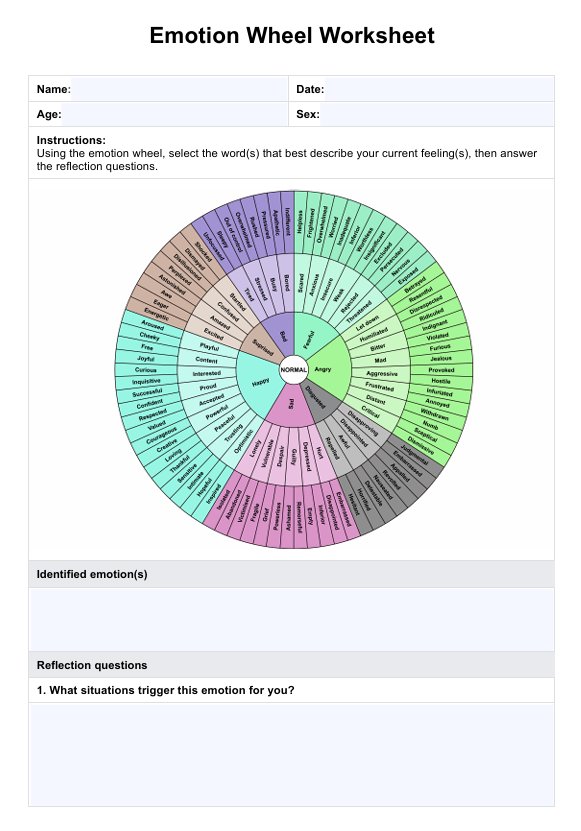
An emotion wheel is a powerful tool that provides a visual representation of one's emotional landscape. It is used by practitioners like mental health professionals, counselors, therapists, and even coaches to help individuals identify, understand, and express their emotions. The circular diagram is divided into segments labeled with a specific emotion or feeling, providing a comprehensive map of human emotions.
To elaborate, it has three different levels of emotion, from the highest level in the inner circle with core emotions/basic emotions/primary emotions like happiness, sadness, and anger, to more complex emotions like anxiety, confidence, or astonishment. The wheel has a rich emotional vocabulary, including both positive and negative emotions, so your patients can better pinpoint what they are feeling instead of resorting to naming an emotion close to what they are feeling.
There are numerous benefits to using an Emotion Wheel Worksheet and its template, such as:
- **Meeting your client's needs**: Not all of your clients will be at the same level in terms of being able to engage with and identify their emotions. Before you begin helping your clients with more advanced techniques, such as identifying and challenging cognitive distortions or brainstorming alternative behaviors in the face of maladaptive coping mechanisms, they must first be confident in naming and recognizing their emotions. This emotion wheel supports your clients who may have never actively engaged with their various emotions and need extra help naming their feelings
- **Universal emotional wheel design**: This emotion wheel is widely used and recognized worldwide. Your client can, therefore, benefit from becoming familiar with a commonly used therapeutic tool. However, they can also use this design as a guide to create their own wheel with certain emotions to better suit their personal emotional experiences.
- **Discussion starter**: Your clients' responses to this worksheet can serve as great discussion points in your sessions. Armed with the language they need to describe their emotions, this worksheet guarantees your clients' confidence in discussing their internal emotional landscape.
- **Gain valuable insights**: The questions in this worksheet are designed to give you greater insight into your client's ability to engage with their emotions and help you identify areas to focus on in their treatment.
With our Emotional Wheel Worksheet, your patients can accurately recognize and communicate their emotions. This is a crucial step in developing emotional intelligence, emotional awareness (Health, 2023), and improving their self-awareness and mental health (Therapy, 2025). Use the Emotion Wheel Worksheet as a conversation starter and help your clients name and engage with their emotions using an emotion wheel.
## **How to use this Emotion Wheel Worksheet**
The main feature of the printable Emotion Wheel Worksheet, also known as a feelings wheel worksheet, is an emotion wheel diagram, so let's run through how to use it now.
### **Step 1: Download the worksheet**
Get a copy of the Emotion Wheel Worksheet by clicking the "Use Template" button to open a fillable version in the Carepatron app. You can also click "Download" for a ready-to-print PDF version. Once you have the worksheet, your client just needs to follow the next steps.
### **Step 2: Use the emotion wheel to choose emotions**
The emotions wheel diagram is a tool for identifying and naming emotions. It can be used simply as a list of potential emotions or to zero in on the most precise word possible for an emotion.
To do this, your patient works their way outwards from the central circle of the wheel, which consists of seven emotions. Once they have chosen which of the seven broad emotions their emotion falls under, move out one layer to the second ring of the wheel.
The broader emotion will branch into several more detailed emotions so they can once again select the word that best matches their feelings. Their secondary emotion will then split once more into the final, most specific level of words in the outer ring of the circle. Then, they should choose the word that best matches their feeling for the last time to get their final emotion.
### **Step 3: Write down the final emotion(s) and reflect**
After selecting the word that best describes their emotion, they can write it in the space provided. This exercise can be repeated for different emotions or focused on just one. Once the emotion(s) are identified, they should reflect on and answer the accompanying questions to better understand and process their feelings. This activity can also be paired with a mood tracker worksheet for deeper emotional insight.
### **Step 4: Store the worksheet securely**
The last step is to ensure the worksheet is stored securely as it contains confidential patient health information.
## **Additional resources**
Need more worksheets to add to your practice that will help with sessions that may aid your patient with emotional regulation, awareness, etc.? Here are free resources you can download:
- **[SPANE Scale of Emotion](https://www.carepatron.com/templates/spane-scale-of-emotion/)**: Assess your client's emotional well-being using the SPANE Scale of Emotion to enhance treatment plans and interventions during sessions.
- **[Emotions Worksheet](https://www.carepatron.com/templates/emotions-worksheets/)**: Help your clients get in touch with their emotions and uncover how their feelings, thoughts, and behaviors are interconnected.
- **[List of Emotions](https://www.carepatron.com/templates/list-of-emotions)**: Enrich your patient's emotional vocabulary even further by providing them with a list of positive and negative emotions.
- **[Emotion Faces Worksheet](https://www.carepatron.com/templates/emotion-faces-worksheet/)**: Increase your patient's emotional intelligence in an engaging way.
## **References**
Health, C. (2023, September 28). Emotion Wheel: What It Is and How to Use It. Charlie Health. https://www.charliehealth.com/post/emotion-wheel-what-it-is-how-to-use-it#:~:text=An%20emotion%20wheel%20can%20be,and%20communication%20in%20interpersonal%20relationships.
Therapy, D. (2025, October 3). South Denver Therapy. South Denver Therapy. https://www.southdenvertherapy.com/blog/the-benefits-of-using-a-feelings-wheel
Commonly asked questions
To use the Emotion Wheel Worksheet, identify the word(s) that best match your feelings and write them down. Then, reflect on and answer the provided questions to better understand your emotions and how they influence your thoughts, behaviors, and physical sensations.
While anyone understanding how to use the emotion wheel diagram can use this worksheet, it is best suited to clients who may be earlier on in their therapy journey or who do not have lots of experience engaging with and giving language to their emotions. For clients adept at identifying and describing their emotions, the emotion wheel may be unnecessary to help them find the words they need.
The completed worksheet should be stored securely, as it contains confidential information about your client. We recommend using the worksheet's digital format and storing it in a secure, electronic health record system.