




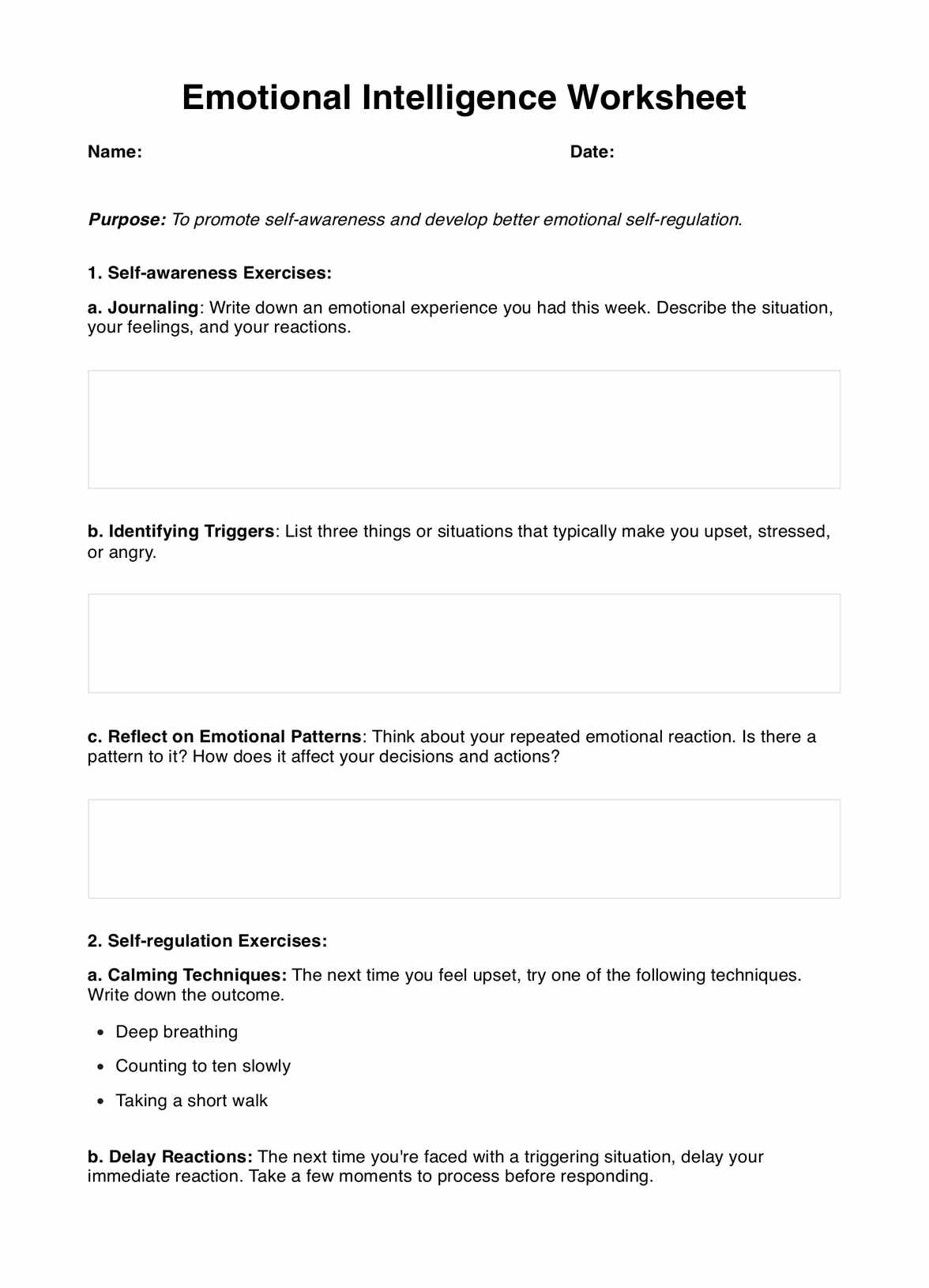



Emotional Intelligence Worksheets

Looking for a tool that can help you gauge your client's emotional intelligence? Read our guide to learn more about the importance of being emotionally intelligent and how it benefits one's mental health, then use our Emotional Intelligence Worksheet so your client can articulate themselves in light of their emotions during an emotional experience.
Emotional Intelligence Worksheets Template
## **What does it mean to be emotionally intelligent?**
Being emotionally intelligent means that one is attuned not only to their own emotions and feelings but also considerate of others' feelings. Being emotionally intelligent means that one can understand the factors that make them feel happy right now while also being aware of factors that could immediately shift their emotions to more negative ones.
Being emotionally intelligent can help one develop empathy, learn how to navigate how they feel and how others feel, and become adept at managing emotions in ways that prevent them from engaging in bad decisions or exhibiting otherwise unhealthy or maladaptive behaviors (Mosunic, 2024).
Here are traits/characteristics of someone who is emotionally intelligent, besides being aware of their emotions and being able to manage them (Cherry, 2023):
- They are able to have and show empathy to others.
- They are able to keep themselves motivated for anything they want to do or have to do.
- They can express themselves in productive, creative, and healthy ways.
- They are, whether introverted or extroverted, able to socialize well enough.
- They are perceptive enough to "read the room."
- They are able to manage various relationships (e.g., familial, friendships, romantic relationships, etc.) well enough,
- They can think clearly even when undergoing stressful situations.
Emotional intelligence is important for anyone and everyone, so it's important for you as a mental health professional to help clients or patients to assess patients in terms of their emotional intelligence. If they seem to have low emotional intelligence, then having them undergo emotional intelligence training can go a long way for them. By engaging in emotional intelligence exercises, they will learn valuable emotional intelligence skills that can help them grow as a person and maintain/improve their overall mental well-being.
Undergoing such training will help people learn to identify and understand different emotions; learn important social skills and communication skills (e.g., maintaining eye contact, active listening); manage stress without giving in to negative emotions like anger, fear, guilt, shame, etc.; mindfulness and relaxation exercises to help regulate emoitions; learn how to respond in non-detrimental ways to specific emotions, and more!
## **What is an Emotional Intelligence Worksheet?**
An Emotional Intelligence Worksheet is a well-structured, user-friendly tool that acts as both a mirror and a roadmap to an individual's emotional world. At its core, it's designed to enhance the four main pillars of Emotional Intelligence: self-awareness, self-regulation, self-motivation, empathy, and social awareness skills.
By working through the worksheet, individuals can reflect on their emotional responses, pinpoint reaction patterns, and develop strategies to manage and express their feelings more effectively. It's not just about identifying emotions; it's about understanding their origins, acknowledging their impact, and channeling them productively.
Essentially, this type of worksheet can help steer individuals towards greater emotional maturity and resilience, bridging the gap between raw emotion and coherent expression.
What to expect from Emotional Intelligence Worksheets
Emotional Intelligence Worksheets come in various forms, but they're mostly writing exercises. Writing exercises involve a lot of thinking, and they are a good way for clients to explore their thoughts and feelings at their own pace. They can also serve as a way for them to really reflect on themselves. Some might ask them to simply identify and discuss three emotions they constantly feel, some might take the form of journals, some might try to tap into their creativity, and some might serve as practice for engaging with actual children or adults.
There are even worksheets that ask clients what they will do when faced with distressing situations in the future, and ask what they plan on doing to make navigating such situations a success in terms of how they manage their emotions and responses.
In therapeutic settings, Emotional Intelligence Worksheets can be invaluable. Therapists can employ these worksheets to help clients dissect complex emotional reactions, decipher underlying patterns, and create effective coping mechanisms. By doing so, clients can navigate their daily lives with more clarity and emotional resilience.
Coaches and trainers can integrate EI worksheets into their training modules in corporate and sports settings. It helps team members understand the emotions of their peers, fosters effective communication, and cultivates a harmonious team environment. A team communicating with empathy and understanding can significantly enhance its overall performance.
Introducing students to emotional self-awareness early on can be transformative for educators, particularly those in social sciences, psychology, or counseling. By integrating the worksheet into their curriculum, educators can provide students with hands-on experience in self-reflection, empathy development, and effective emotional expression.
Beyond structured settings, anyone keen on self-improvement and personal growth can benefit. Whether navigating interpersonal conflicts, seeking clarity on emotional patterns, or simply wanting to improve relationships, the EI worksheet can help with that.
## **Why should I use it?**
Emotional Intelligence, as a concept, is not just about recognizing emotions but also about how these emotions are managed, both within oneself and in interactions with others. By engaging in emotional intelligence activities such as answering worksheets, individuals stand to gain many benefits beyond personal introspection, cascading into various aspects of their lives, such as self-confidence.
### **Enhanced self-awareness**
Understanding one's emotions and their triggers is the first step to emotional maturity. Individuals can anticipate emotional responses and navigate scenarios more effectively by identifying these triggers.
### **Improved self-regulation**
With emotional intelligence tools such as this type of worksheet, individuals can prevent emotional outbursts, make reasoned personal decisions, and maintain a balanced emotional state.
### **Boosted empathy**
Connecting with others on an emotional level deepens relationships. Enhancing empathy allows for a better understanding of others' feelings and viewpoints, fostering harmonious interpersonal interactions.
### **Effective communication**
The ability to convey feelings without conflict or misunderstanding is pivotal. The worksheet provides communication strategies prioritizing clarity, empathy, and mutual respect.
### **Conflict resolution skills**
Disagreements are inevitable. However, with skills learned from the EI worksheet, individuals can navigate these disagreements with mutual respect and understanding, often leading to constructive outcomes.
### **Personal Growth**
Beyond specific skills, the overarching benefit is personal growth. By consistently developing emotional intelligence principles, individuals can foster deeper relationships, achieve personal and professional milestones, and lead fulfilling lives.
## **How to use our Emotional Intelligence Worksheet**
To ensure your client maximizes the benefits of the Emotional Intelligence Worksheet, it's crucial to approach such a tool with the dedication to complete it. Here's how to use our specific worksheet:
### **Step 1: Download a copy**
You can obtain a copy of our PDF file by just clicking "Use Template" and Download."
### **Step 2: Remind your patient to be honest when writing**
Before you hand this worksheet to your patient, please remind them to be as honest and detailed as possible when writing. It's important so that both you and your patient can discover insights that might help with determining courses of action down the line, and also so you can provide meaningful feedback. If they write something like "I was angry." Tell them to expound on that and think about what made them angry and why.
### **Step 3: Explain each section to them**
It's also important to discuss each section of the worksheet so they know what they're supposed to do.
The first section is full of self-awareness exercises. For this part, they will do three things:
- **Journaling**: They will discuss a specific emotional experience they've had during the week or the past week. They will describe the situation, their feelings, and reactions.
- **Identifying triggers**: They will list three things or situations that made them upset, stressed, or angry.
- **Reflect on emotional patterns**: They will think about specific emotional reactions and see if there is a pattern whenever they have such reactions.
The second section has two parts that give them instructions on what to do when they undergo a distressing situation, plus calming techniques. It ends with a section where they write down three strategies to help prevent them from acting impulsively during emotional situations.
The third section is about setting goals and what emotions are tied to specific goals they have in mind. Then they will list specific strategies to help them achieve these goals.
The fourth and fifth sections revolve around learning to empathize with others and developing social skills so they can learn how to navigate dealing with other people, especially if their interactions are based on emotionally distressing situations.
### **Step 4: Discuss what's written and implement strategies**
Once you receive a fully accomplished worksheet, discuss each section with your client so both of you can get into the weeds of what has been written, find insights together, and formulate strategies that seem viable for them to follow. Remember that a fresh perspective or a shared experience can offer valuable insights.
### **Step 5: Revisit and reflect**
Emotional intelligence is an evolving trait. Thus, treat the worksheet as a living document. Have your client periodically return to it, assess their growth, and adjust their strategies. This can be especially helpful for those who are working on their mental health.
### **Step 6: Engage with other methods of promoting emotional intelligence**
Besides engaging with worksheets, here are two other ways that can help boost a person's emotional intelligence:
- **Practice mindfulness**: Mindfulness is all about recognizing and being in the present moment. By practicing this constantly, it can help lead to self-insights, reduce stress, and prevent emotional outbursts (Mindful Staff, 2020)
- **Undergoing cognitive behavioral therapy**: CBT is all about evidence-based thinking, so this form of therapy can teach various ways of regulating emotions to help reframe negative thinking patterns and develop ways to avoid stressors (Cognitive Behavioral Therapy Los Angeles, n.d.).
## **References**
Cherry, K. (2023, November 25). Habits of emotionally intelligent people. Verywell Mind. https://www.verywellmind.com/the-7-habits-of-emotionally-intelligent-people-2795431
Cognitive Behavioral Therapy Los Angeles. (n.d.). CBT treatment for emotion regulation. https://cogbtherapy.com/cbt-emotion-regulation
Mindful Staff. (2020, July 8). What is mindfulness? Mindful. https://www.mindful.org/what-is-mindfulness/
Mosunic, C. (2024, December 6). Here’s why emotional intelligence is so important. Calm Blog. https://www.calm.com/blog/why-is-emotional-intelligence-important
Commonly asked questions
Anyone keen on fostering emotional understanding and growth can utilize EI Worksheets, from therapists to educators to coaches, and simply individuals seeking personal growth.
They're employed as reflective tools, guiding individuals through exercises that enhance self-awareness, empathy, communication, and emotional regulation.
The worksheet aids in identifying emotional triggers, developing coping strategies, enhancing interpersonal skills, and fostering a deeper understanding of oneself and others.










EHR and practice management software
Get started for free
*No credit card required
Free
$0/usd
Unlimited clients
Telehealth
1GB of storage
Client portal text
Automated billing and online payments