








Introducing personality types
As practitioners committed to facilitating personal growth and fostering self-awareness in our clients, understanding and utilizing the Character Personality Test can be valuable to our toolkit.
Personality types refer to categorizing individuals based on specific characteristic patterns of thoughts, behaviors, and emotional responses. The idea is that people can be grouped into distinct categories or types, each associated with specific traits or tendencies.
Various psychological theories and frameworks have been developed to understand and describe personality types, each offering a unique perspective on how individuals differ. One widely recognized framework is the Big Five Personality Traits, the Five-Factor Model. These traits include:
Openness: Reflects creativity, curiosity, and openness to new experiences.
Conscientiousness: Describes the level of organization, responsibility, and reliability.
Extraversion: Relates to the degree of sociability, assertiveness, and comfort in social situations.
Agreeableness: Reflects traits such as kindness, empathy, and cooperation in interpersonal relationships.
Neuroticism (or emotional stability): Measures emotional stability, resilience, and the tendency to experience negative emotions.
For a deeper understanding and assessment of these traits, practitioners can also refer to the Big Five Personality Test.
What is the Character Personality Test?
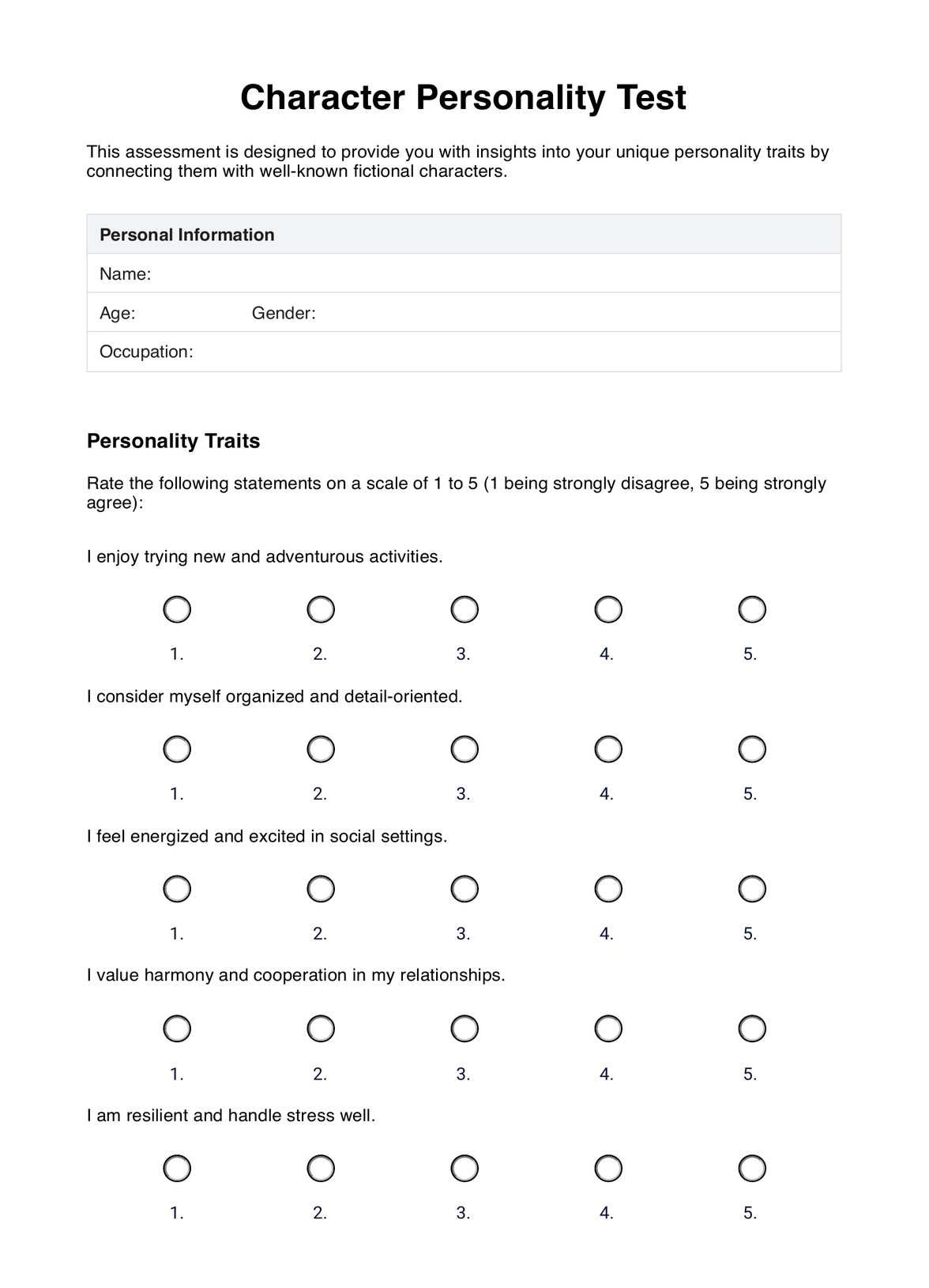
The Character Personality Test offers practitioners a nuanced understanding of their clients' personalities. It transcends traditional personality assessments by incorporating entertainment elements, making it a unique and engaging experience for clients seeking self-discovery.
One distinctive feature of the Character Personality Test is its incorporation of fictional characters into the assessment process. By aligning individuals with well-known fictional characters, the test bridges the gap between real-world personalities and those found in literature, movies, or other forms of fiction. This adds an entertaining aspect to the assessment and allows individuals to relate their personalities to fictional archetypes.
Practitioners can utilize the Personality Questionnaire to comprehensively explore personality through various angles, including fictional character alignment.
Additionally, in the realm of personality disorders, understanding specific conditions such as Avoidant Personality Disorder (APD) is crucial for effective therapy and support. For an assessment focused on identifying traits related to APD, the Avoidant Personality Disorder Test can be an invaluable resource.









