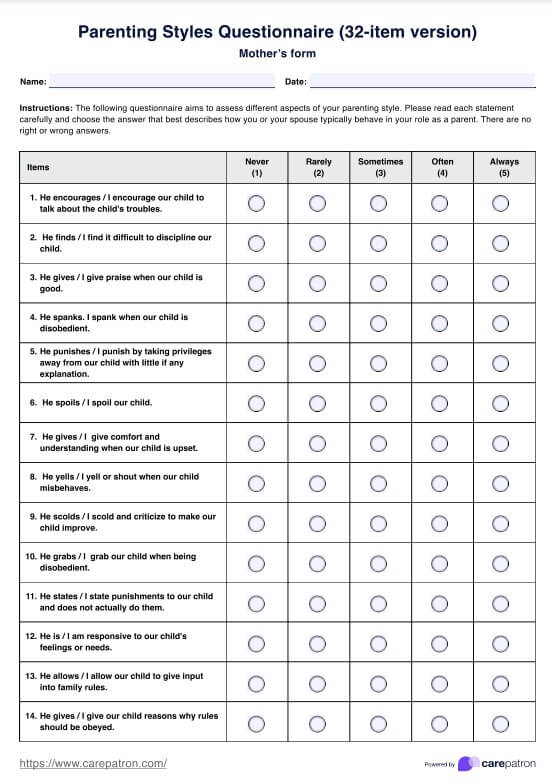
Looking for a practical tool to help clients understand their parenting styles? Read our guide to explore the different approaches and styles to parenting and use our Parenting Styles Questionnaire template to help parents gain self-awareness about how they raise and interact with their children.
This template features the 32-item-short-form version of the original Parenting Styles Questionnaire, designed to make the assessment quicker and more convenient for clinical use, research, or family counseling.
## **Common parenting styles and their impact**
Understanding the common parenting styles provides valuable insight into how different parenting practices shape a child's behavior, emotional growth, and overall development. Below are the most common parenting styles and their impact:
### **Authoritative style**
Parents who adopt an authoritative style combine high expectations with warm, responsive interactions. They set clear rules, involve children in discussions about discipline and consistently support their growth.
Research shows that this parenting style is strongly linked to positive outcomes in children, including better academic performance, stronger social skills, and higher emotional regulation (Kuppens & Ceulemans, 2019).
### **Authoritarian style**
The authoritarian style emphasizes strict rules, obedience, and little input from the child. Parents using this approach often rely on discipline without explanation or warmth. According to literature, children raised this way may obey rules in the short term, but often face worse outcomes in terms of internalized behavior problems, emotional distress and reduced child development measures (Sanvictores & Mendez, 2022).
The pros of this style are that it can minimize some immediate misbehavior, and provide a clear structure that may benefit some children.
### **Permissive style**
In the permissive style, parents show warmth and affection but impose few controls or expectations. They may avoid discipline or allow children to self-regulate freely. Research links this style to weaker self-control, less consistent academic involvement, and more behavioral issues (Kuppens & Ceulemans, 2019).
## **What is a Parenting Styles Questionnaire?**
The Parenting Style Questionnaire (PSQ), which was later developed into the Parenting Styles and Dimensions Questionnaire (PSDQ), is a self-report instrument used to assess parenting styles based on Baumrind’s 1971 framework. It measures three primary styles: authoritative, authoritarian, and permissive through statements that reflect different parenting practices, level of warmth, and approaches to discipline.
The PSQ was developed to measure authoritative, authoritarian, and permissive parenting practices using a structured self-report instrument. The measure was derived from an initial pool of 133 items, which was statistically refined to 62 items through principal axes factor analysis and varimax rotation to ensure clarity across dimensions of parenting behaviors.
The instrument was tested with more than 1,200 parents of preschool and school-aged children to establish reliability and validity (Robinson et al., 1995). A later 32-item short version (PSDQ-Short) was introduced in 2001 to make the assessment more practical for researchers and clinicians needing a brief, reliable measure of parenting styles (Robinson et al., 2001). The 32-item short version is what we have here.
The questionnaire can be used across a variety of clinical and research settings. In therapy, it helps identify parenting challenges that may influence a child's behavior or family dynamics. In family therapy or early childhood development contexts, this parenting practices questionnaire provides insight into how parental warmth, expectations, and discipline styles affect child development and academic performance.
Clinicians may also use the questionnaire to guide [parental interventions](https://www.carepatron.com/guides/parent-management-training/), helping parents recognize areas for improvement, unlearn unhelpful behaviors, and reinforce positive parenting practices that strengthen family relationships. Parents can develop healthier approaches that foster emotional resilience and growth in their children by understanding their perceived parenting style.
## **How does it work?**
Carepatron's Parenting Styles Questionnaire template includes the 32-item short form version of the original assessment. This version of the questionnaire is designed to provide a quick and reliable measure of an individual's or their spouse's parenting style preferences. Here's how to use the template:
### **Step 1: Access the template**
Download the Parenting Styles Questionnaire (32-item version) using the link in this guide or click “Use Template” on Carepatron to complete it digitally. You can also print the PDF for in-session completion.
### **Step 2: Explain how it works**
Explain to your client that the questionnaire contains 32 statements about parenting behaviors, and they’ll rate how much each applies to them on a 5-point Likert scale (1 = Never to 5 = Always).
Here are a few sample items from the questionnaire:
- “I encourage my child to talk about their troubles.”
- “I spank my child when they are disobedient.”
- “I give comfort and understanding when my child is upset.”
- “I punish my child by taking privileges away with little explanation.”
- “I allow my child to express opinions even when they disagree with me.”
Reassure them that there are no right or wrong answers—honesty gives the most accurate insight into their parenting approach.
### **Step 3: Allow time for completion**
Give your client enough time to read and answer each question thoughtfully. Remind them that there are no right or wrong answers, and they need to be honest with themselves.
### **Step 4: Interpret the results**
Once completed, calculate the mean scores for each parenting style using the item groupings in the template:
- Authoritative style → Average the responses to items 1, 3, 5, 7, 9, 11, 12, 14, 18, 21, 22, 25, 27, 29, and 31.
- Authoritarian style → Average items 2, 4, 6, 10, 13, 16, 19, 23, 26, 28, 30, and 32.
- Permissive style → Average items 8, 15, 17, 20, and 24.
Each parenting style receives a continuous score, not a categorical label. The highest mean score indicates the parent’s dominant parenting style, while the other scores reveal secondary tendencies.
**Interpretation guide:**
- **Authoritative** – Balanced warmth and structure; supportive yet firm parenting associated with positive child outcomes.
- **Authoritarian** – High control, low warmth; characterized by strictness and potential verbal or physical coercion.
- **Permissive** – High warmth, low control; indulgent or lenient, often with few boundaries or expectations.
### **Step 5: Discuss the implications**
Review the results with your client and discuss how their parenting style influences their child’s behavior, discipline patterns, and family communication. Highlight strengths, address potential challenges, and develop strategies to support a more balanced and effective parenting approach.
## **Common strategies for unlearning or improving parenting styles**
Understanding that different parenting styles can be reshaped over time, these strategies can help parents reflect on their behaviors, build healthier habits, and create more positive interactions with their children.
### **1. Identify your current parenting approach**
Using reliable tools such as the Parental Authority Questionnaire or other validated [family measurement techniques](https://www.carepatron.com/guides/structural-family-therapy-techniques/) helps a mother, father, or caregiver understand their current style and how it influences a child’s feelings, behavior, and response to demands. This step creates agreement between the parent and the professional on what areas need improvement.
### **2. Reflect before reacting**
Parents can begin to change by pausing before acting on bad behavior. Instead of responding impulsively or choosing to ignore the issue, they can explore the reasons behind the child’s actions, what emotion or need may be driving it, and adjust their response accordingly.
### **3. Practice small, consistent changes**
Encouraging parents to introduce one new activity or positive action each week (like shared reading time or calm discussion instead of reprimand) helps reshape parenting practices gradually. These new habits build stronger parent-child correlation in trust and communication.
### **4. Seek structured guidance**
Evidence shows that parents who participate in [behavioral training](https://www.carepatron.com/guides/behavior-modification-therapy) or [parent-management programs](https://www.carepatron.com/guides/parent-management-training/) demonstrate improved consistency, warmth, and reduced child misbehavior (Rune Zahl‐Olsen et al., 2023). Such interventions help participants reinforce healthy boundaries and emotional awareness in family interactions.
## **References**
Kuppens, S., & Ceulemans, E. (2019). Parenting styles: A closer look at a well-known concept. Journal of Child and Family Studies, 28(1), 168–181. National Library of Medicine. https://doi.org/10.1007/s10826-018-1242-x
Robinson, C. C., Mandleco, B., Olsen, S. F., & Hart, C. H. (1995). Authoritative, Authoritarian, and Permissive Parenting Practices: Development of a New Measure. Psychological Reports, 77(3), 819–830. https://doi.org/10.2466/pr0.1995.77.3.819
Robinson, C. C., Mandleco, B., Olsen, S. F., & Hart, C. H. (2001). The Parenting Styles and Dimensions Questionnaire (PSDQ). In J. Touliatos, B. F. Perlmutter, & M. A. Straus (Eds.), Handbook of family measurement techniques (Vol. 3, pp. 319–321). Sage Publications.
Rune Zahl‐Olsen, Severinsen, L., Jan Reidar Stiegler, Carina Ribe Fernee, Indra Simhan, Sondre Sverd Rekdal, & Bertelsen, T. (2023). Effects of emotionally oriented parental interventions: a systematic review and meta-analysis. Frontiers in Psychology, 14. https://doi.org/10.3389/fpsyg.2023.1159892
Sanvictores, T., & Mendez, M. D. (2022, September 18). Types of Parenting Styles and Effects on Children. Nih.gov; StatPearls Publishing. https://www.ncbi.nlm.nih.gov/books/NBK568743/?