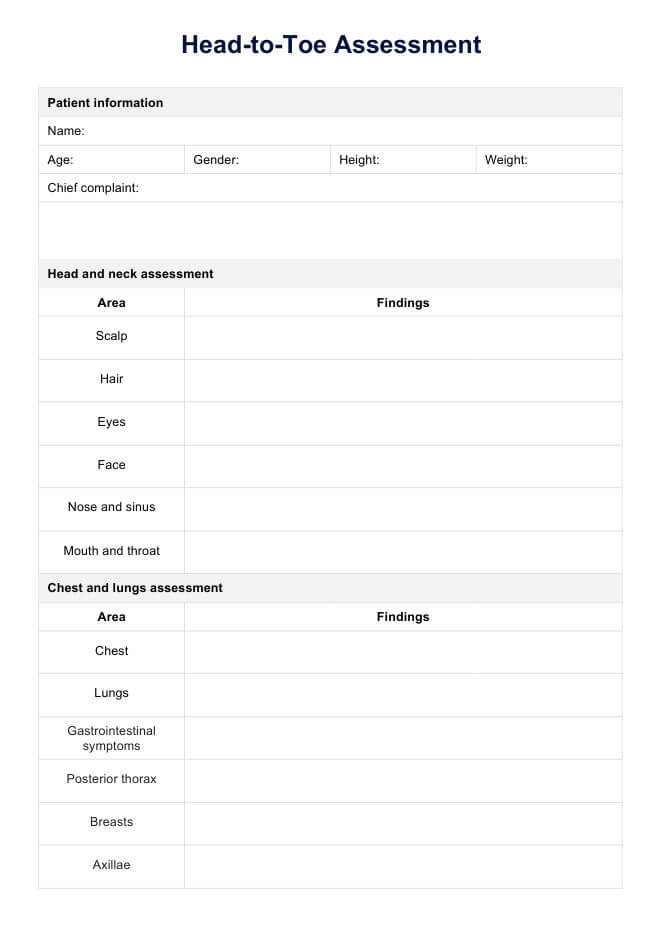
How to conduct a Head-to-Toe Assessment
Performing a Head-to-Toe Assessment is essential to a healthcare professional's job. Conducting a thorough and accurate physical assessment ensures that the patient receives the appropriate care and treatment.
Here, we'll go through the physical examination process and provide a step-by-step approach to performing a physical examination or Head-to-toe Assessment.
Step 1: Gather patient information and vital signs
Begin by gathering patient information, such as the patient's name, age, gender, height, weight, occupation, and the patient's chief complaint on the template. Record this information in the “patient information” section of the form. Additionally, include the patient's medical history to ensure a comprehensive understanding of their conditions, medications, allergies, and recent tests.
Step 2: Head and neck assessment
Start the assessment with the head and neck. Inspect the scalp for any signs of injury or abnormalities. Check the hair for cleanliness and grooming. Inspect the face for symmetry and signs of lesions or asymmetry. Check the eyes for clarity and reaction to light. Examine the ears for any signs of abnormalities. Palpate the lymph nodes in the head and neck for any swelling or tenderness caused by an enlarged thyroid gland. Inspect the nose for signs of congestion. Check the mouth and throat for any signs of infection. Document findings in the corresponding section.
Step 3: Chest and lungs assessment
Proceed with the chest and lungs assessment. Inspect the chest for standard shape and symmetry. Listen to the lungs using a stethoscope for any random or unusual sounds, such as wheezes or crackles. Take note of observations in the "chest and lungs assessment" section.
Step 4: Cardiovascular system assessment
Evaluate the cardiovascular system for any possible arterial or venous disease. Listen to the heart for murmurs or gallops. Check the peripheral pulses for strength and equality bilaterally. Examine the lower extremities for any signs of edema. Record your findings in the "cardiovascular system assessment" section of the form.
Step 5: Peripheral vascular system assessment
Gather information regarding the client's lifestyle and health factors that could potentially impact peripheral vascular health. Check for skin texture or coloration of the hands and arms. Observe the size and venous pattern of the arm. Inspect the distribution of hair in the leg area.
Step 6: Abdominal assessment
Continue with the abdominal assessment. Palpate the abdomen for any tenderness or distension. Listen to the bowel sounds for normalcy. Write down your findings in the "abdominal assessment" section of the form.
Step 7: Musculoskeletal system assessment
Evaluate the musculoskeletal system. Observe the gait and check for any signs of limping or difficulty walking. Check the range of motion in all joints and observe for any tenderness or deformities. Record your findings in the "Musculoskeletal system" section of the form.
Step 8: Neurological system assessment
Proceed with the neurological assessment. Evaluate the patient's mental status and alertness. Check the cranial nerves and reflexes. Document your findings in the “neurological system” section of the form.
Step 9: Genitourinary system assessment
Finally, evaluate the genitourinary system. Inspect the genital area for any signs of infection or abnormalities. Check the urine test for normalcy. Record your findings in the "Genitourinary System" section of the form.
Step 10: Document assessment findings
Review the assessment notes, discuss any abnormal findings or concerns with the patient, and develop a care plan as necessary. You can also refer to the Care Plan Template to outline specific interventions or identify a focused assessment, set goals, and track progress toward improving the patient's health and well-being. This structured approach ensures comprehensive and personalized care management for better health outcomes.