





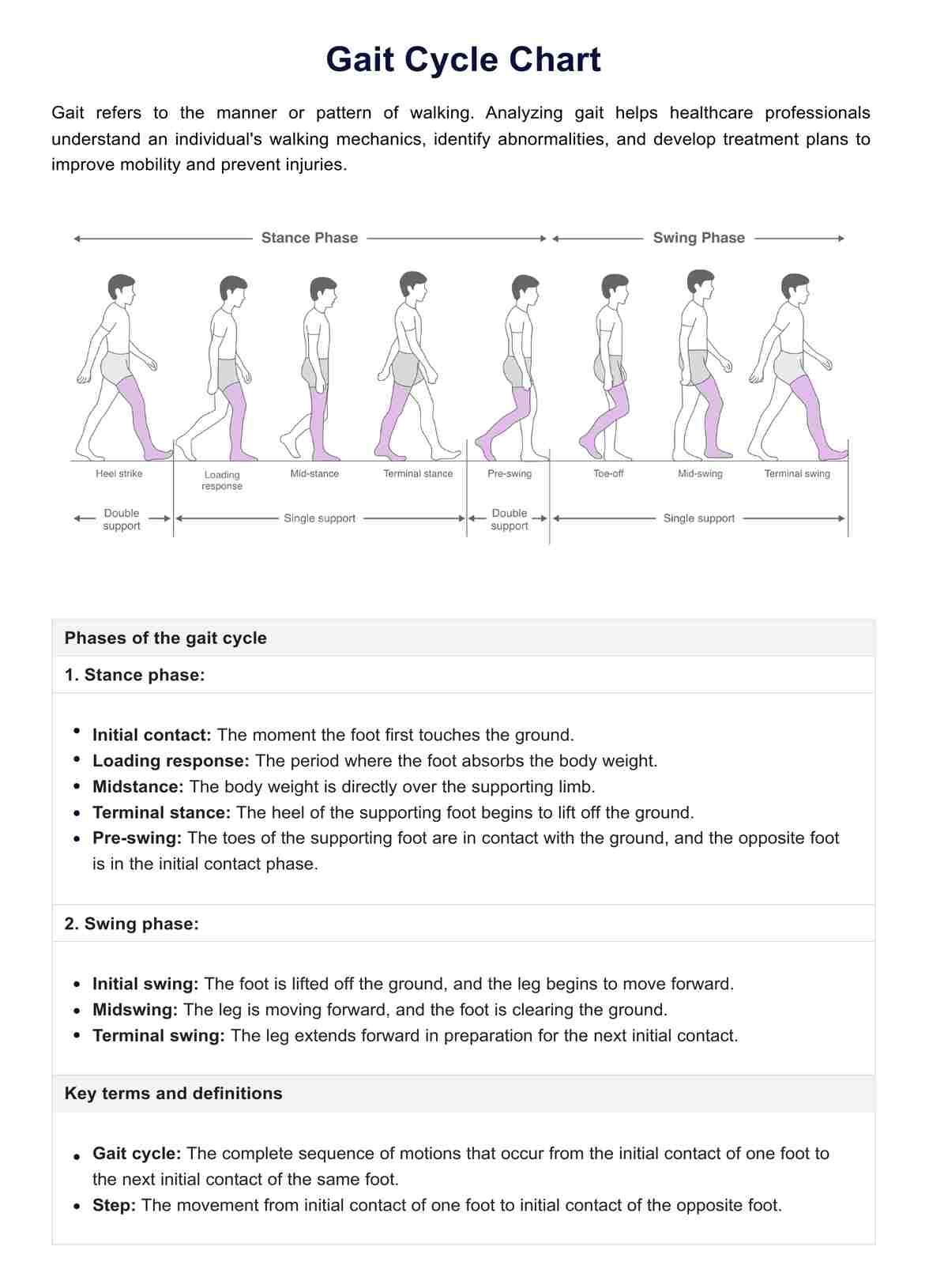




What is the gait cycle?
The gait cycle refers to the sequence of movements from when one foot touches the ground to when it touches the ground again. This fundamental concept in biomechanics provides insights into human locomotion. Early pioneers in biomechanics first analyzed the gait cycle extensively, recognizing its significance in understanding walking mechanics and diagnosing related disorders.
Understanding the gait cycle is crucial for healthcare professionals as it helps them assess and address walking abnormalities, which can indicate various medical conditions. By identifying deviations from the normal gait pattern, professionals can develop effective treatment plans to enhance patient mobility and quality of life.
Before we talk more about the gait cycle, here are some of its key terms and concepts:
- Gait speed: The rate of walking, typically measured in meters per second (m/s). It provides a general measure of mobility and function.
- Step: The movement from initial contact of one foot to initial contact of the opposite foot. It represents half of the gait cycle.
- Stride: The movement from initial contact of one foot to the next initial contact of the same foot, encompassing two steps. It represents a full gait cycle.
- Step time: The duration it takes to complete one step indicates rhythm and pace.
- Step width: The lateral distance between the midpoints of the heel of one foot and the heel of the other foot during walking, indicating stability and balance.
- Walking: A form of gait where at least one foot is in contact with the ground at all times. Walking involves periods of double support where both feet are on the ground.
- Running: A form of gait characterized by periods when both feet are off the ground simultaneously. Running has phases of double float where neither foot is on the ground.
The purpose of knowing the Gait Cycle Chart is to provide a visual and conceptual framework for analyzing walking patterns. It helps professionals detect abnormalities, understand the underlying causes, and plan interventions to improve walking efficiency and safety. Next, let's talk about all the gait phases.









