




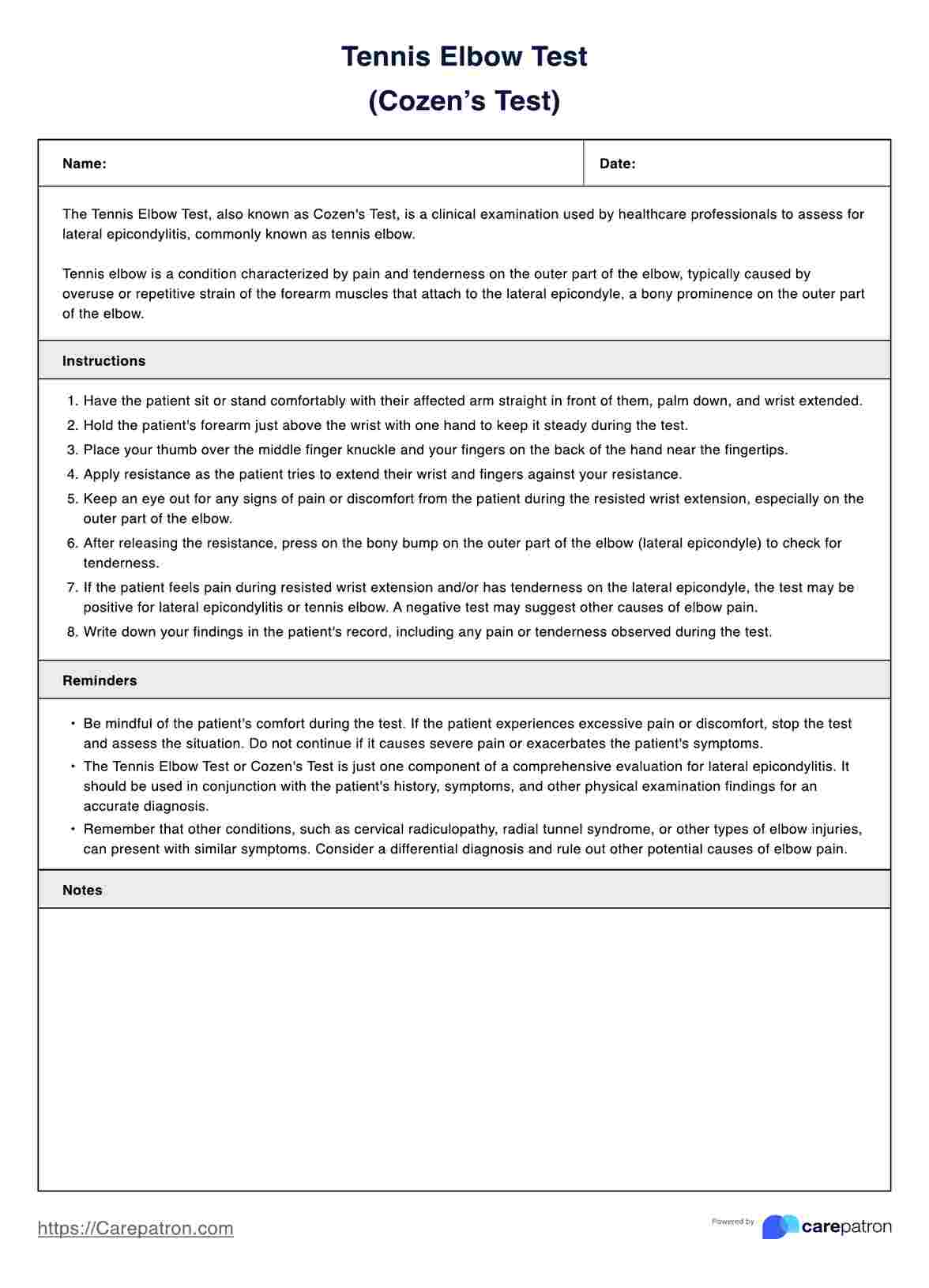




What is a Tennis Elbow Test?
A Tennis Elbow Test is a physical examination used to diagnose lateral elbow tendinopathy. This is also called the tennis elbow or lateral epicondylitis. This condition involves pain and tenderness around the bony prominence outside the elbow, called the lateral epicondyle. This condition is often associated with repetitive wrist extension activities, such as those performed in tennis, manual labor, or racket sports (Ma & Wang, 2020).
These kinds of tests aim to reproduce the patient's symptoms and identify the source of pain, helping differentiate it from other conditions affecting the elbow or forearm.
One of the most commonly used tests is the resisted wrist extension test, also known as Cozen's test. To do Cozen's Test, the patient's elbow flexion is set up to 90 degrees, with the forearm pronated and the wrist in a neutral position. The examiner applies resistance against the patient's wrist extension. A positive test, eliciting lateral elbow pain, suggests lateral tennis elbow (Karanasios et al., 2022).
Another test is Mill's test, in which the patient's elbow is extended and the forearm is pronated. The examiner applies resistance against the patient's radial deviation. Pain over the lateral epicondyle indicates a positive test and suggests lateral elbow tendinopathy (Ma & Wang, 2020).
Additionally, the examiner may compare the patient's grip strength between the affected and unaffected sides. A significant difference in grip strength on the weaker side may indicate lateral elbow tendinopathy. Conducting further tests is also important for a differential diagnosis and ruling out other concerns, such as chronic refractory lateral epicondylitis (CRLLE) and lateral epicondylalgia.









