







Coronary Calcium Score

## **What is a Coronary Calcium Score Test?**
A Coronary Calcium Score Test, commonly known as a Coronary Calcium Score Test, is a vital diagnostic procedure employed to evaluate an individual's susceptibility to coronary artery disease, a primary contributor to heart attacks and strokes (Brown et. al., 2023). This non-invasive assessment relies on a CT scan—often a cardiac CT for calcium or electron beam computed tomography—to quantify the extent of calcium deposits within the coronary arteries.
The detection of coronary calcium in these arteries serves as an indicative sign of potential plaque presence, a waxy and fatty substance capable of constricting or obstructing blood flow (Weaver, 2013). This pathological process leads to coronary artery calcification, substantially amplifying the risk of heart disease and risk for heart attacks. By swiftly and accurately identifying these calcifications, healthcare professionals can make informed decisions about prevention and intervention strategies, in line with clinical practice guidelines, thus enhancing patient care and cardiovascular health management.
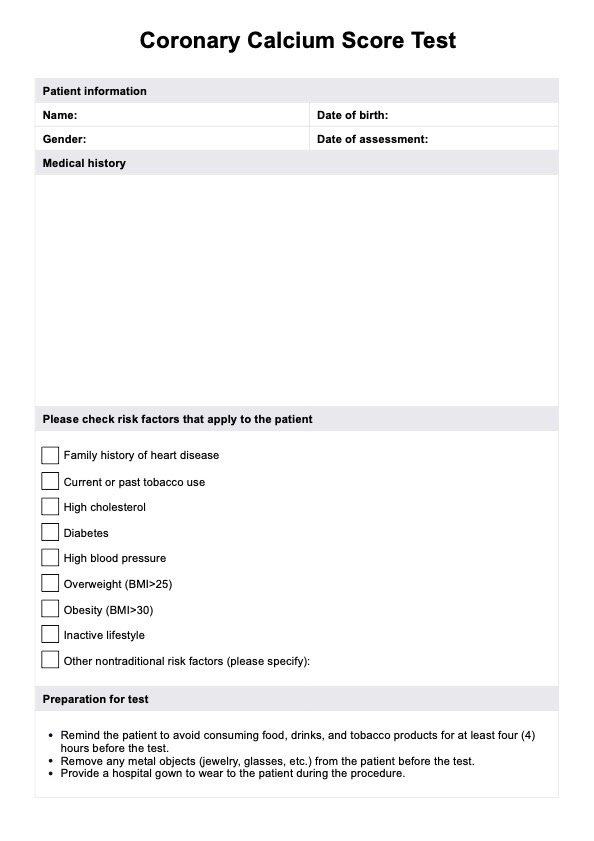
This resource is a comprehensive template designed for healthcare professionals to conduct and document the coronary artery calcium scoring tests effectively. It is a valuable tool for the health care team in efficiently gathering patient data and risk factors, ensuring that patients are adequately prepared for the coronary calcium scan, and facilitating clear clinical documentation of results and relevant notes for further evaluation and treatment decisions.
Coronary Calcium Score Template
## **How does it work?**
Here are the four steps to effectively use the Printable Coronary Calcium Score Test:
### **Step 1: Patient information**
Begin by filling in the patient's name, date of birth, gender, address, and phone number. Accurate patient information is crucial for documentation and follow-up.
### **Step 2: Medical history**
In this section, review the patient's medical history to identify risk factors for heart disease. Check the relevant risk factors, including family history of heart disease, tobacco use, high cholesterol, diabetes, high blood pressure, BMI, and any other nontraditional risk factors. If applicable, specify additional risk factors in the provided space.
### **Step 3: Preparation**
Educate the patient about the necessary preparations for the test. Advise them to abstain from food, drink, caffeine, and tobacco products for at least four hours before the test. Instruct the patient to remove metal objects like jewelry and glasses. Ensure they understand they will receive a hospital gown for the procedure.
### **Step 4: Results**
Leave this section blank for recording the patient's test results. A normal score is zero, while an abnormal score may indicate coronary artery disease. Use this space to document the results and any immediate comments or clinical notes.
## **When would you use this test?**
The coronary calcium scan resource is a valuable tool that can be effectively employed by a range of healthcare professionals in specific clinical scenarios. This resource finds its most appropriate use when assessing individuals who fall into the moderate risk category for coronary artery disease.
Health care teams, including cardiologists, primary care physicians, and nurse practitioners, can utilize this resource when dealing with patients aged 40 to 70 who exhibit risk factors but do not present any overt symptoms of heart disease. This may include individuals with a family history of heart disease, a past or present history of tobacco use, high cholesterol, diabetes, high blood pressure, an elevated BMI, obesity, or a sedentary lifestyle.
The resource is also useful for those with familial hypercholesterolemia under the age of 40. By deploying this tool in these situations, health care teams can better assess a patient’s cardiovascular risk and make informed decisions regarding preventive measures, such as statin therapy, lifestyle modifications, or further diagnostic tests like CT for calcium scoring, ultimately contributing to improved cardiovascular health management.
## **What do the results mean?**
The results of a Coronary Calcium Score Test play a key role in evaluating an individual’s heart disease risk and risk of heart attacks. The test measures the coronary calcium score—an indicator of the amount of calcium deposits that build up in the heart's arteries.
A score of 0 indicates that no detectable coronary artery calcium is present, corresponding to a low risk of coronary events in the near future. However, a zero score does not completely rule out the possibility of heart disease, as other factors such as lifestyle habits, age, and family history must also be taken into account.
Scores between 1 and 100 indicate minimal to mild coronary artery calcification, which suggests a moderate risk of cardiovascular issues. A score ranging from 101 to 300 reflects a moderate plaque burden and a higher risk of heart-related problems. If the score is above 300, this points to severe plaque accumulation and a high risk of heart attack or other serious coronary events.
These heart scan coronary calcium score results give healthcare professionals valuable information for making informed decisions about preventive care. Depending on the score, patients may be advised to implement lifestyle changes, start or adjust cholesterol-lowering medications, undergo further diagnostic tests such as cardiac CT, or receive closer medical monitoring to reduce future cardiac risks. Understanding your coronary artery calcium test result is a critical step toward proactive and effective cardiovascular health management.
## **Research & evidence**
The Coronary Calcium Score Test, or coronary artery calcium score test, was initially developed in the early 1990s primarily to assess the severity of coronary artery disease in individuals already diagnosed with the condition (George & Movahed, 2008). Over time, research demonstrated that it held promise as a predictive tool for future risk of heart disease in asymptomatic individuals, marking a significant shift in its utility (Tramontano et. al., 2022).
Research has consistently shown the predictive power of the coronary artery calcium scans (Mehta et. al., 2020). For instance, the Multi-Ethnic Study of Atherosclerosis (MESA) found that those with a coronary calcium score of zero had a notably low cardiovascular risk over the following decade (Osawa et. al., 2016). Conversely, individuals with coronary calcium scores of 400 or higher faced a substantial 25% risk of such events.
Moreover, the coronary calcium scan has proven invaluable in identifying high risk individuals, even without traditional risk factors (Neves et. al., 2017). Notably, it can help young adults with elevated CAC scores, who might not exhibit conventional risk factors, assess their future heart attack or stroke risk.
The American Heart Association and the National Heart, Lung, and Blood Institute endorse the use of coronary artery calcium scoring (Taron et. al., 2021). They recommend it for individuals at moderate risk for heart disease and those with a family history or additional risk factors like diabetes or chronic kidney disease. This endorsement underscores the vital role this test plays in guiding treatment decisions and improving cardiovascular health management.
## **References**
Brown, J. C., Gerhardt, T. E., & Kwon, E. (2023, January 23). Risk factors for coronary artery disease. StatPearls Publishing. https://www.ncbi.nlm.nih.gov/books/NBK554410/
George, A., & Movahed, A. (2008). Coronary artery calcium scores: Current thinking and clinical applications. The Open Cardiovascular Medicine Journal, 2(1), 87–92. https://doi.org/10.2174/1874192400802010087
Mehta, A., Pandey, A., Ayers, C. R., Khera, A., Sperling, L. S., Szklo, M., Gottesman, R. F., Budoff, M. J., Blaha, M. J., Blumenthal, R. S., Nasir, K., & Joshi, P. H. (2020). Predictive value of coronary artery calcium score categories for coronary events versus strokes: Impact of sex and race. Circulation: Cardiovascular Imaging, 13(8), e010153. https://doi.org/10.1161/circimaging.119.010153
Neves, P. O., Andrade, J., & Monção, H. (2017). Coronary artery calcium score: Current status. Radiologia Brasileira, 50(3), 182–189. https://doi.org/10.1590/0100-3984.2015.0235
Osawa, K., Nakanishi, R., & Budoff, M. (2016). Coronary artery calcification. Global Heart, 11(3), 287. https://doi.org/10.1016/j.gheart.2016.08.001
Taron, J., Lyass, A., Mahoney, T. F., Ehrbar, R. Q., Vasan, R. S., D’Agostino, R. B., Hoffmann, U., Massaro, J. M., & Lu, M. T. (2021). Coronary artery calcium score–directed primary prevention with statins on the basis of the 2018 American College of Cardiology/American Heart Association/Multisociety cholesterol guidelines. Journal of the American Heart Association, 10(1), e018342. https://doi.org/10.1161/jaha.120.018342
Tramontano, L., Punzo, B., Clemente, A., Seitun, S., Saba, L., Bossone, E., Maffei, E., Cavaliere, C., & Cademartiri, F. (2022). Prognostic value of coronary calcium score in asymptomatic individuals: A systematic review. Journal of Clinical Medicine, 11(19), 5842. https://doi.org/10.3390/jcm11195842
Weaver, J. (2013). Insights into how calcium forms plaques in arteries pave the way for new treatments for heart disease. PLoS Biology, 11(4), e1001533. https://doi.org/10.1371/journal.pbio.1001533
Commonly asked questions
These tests are typically requested by healthcare providers, such as cardiologists, to assess an individual's risk of heart disease.
The tests are used when an individual is at intermediate risk for heart disease, helping to make informed treatment decisions.
These tests involve a quick CT scan that measures calcium buildup in coronary arteries.
A Coronary Calcium Score Test usually takes about 10 to 15 minutes, with the CT scan itself lasting only a few minutes.










EHR and practice management software
Get started for free
*No credit card required
Free
$0/usd
Unlimited clients
Telehealth
1GB of storage
Client portal text
Automated billing and online payments