Looking for a way to help your veteran clients get their VA disability claims approved? Use our VA Nexus Letter Template to provide a clear, evidence-based medical opinion that links a veteran's current disability to their military service.
## **Understanding VA disability claims**
Healthcare professionals often assist veterans by providing medical evidence or expert opinions that strengthen their VA disability claims. A VA disability claim is submitted when a veteran believes a current medical condition stems from, or was worsened by, their military service. The U.S. Department of Veterans Affairs (VA) evaluates eligibility based on two key criteria: the veteran must have a current, diagnosable condition affecting their physical or mental health, and they must have served on active duty, active duty for training, or inactive duty training (U.S. Department of Veterans Affairs, 2020)
From there, the VA determines whether the condition is service-connected. To qualify, one of the following must apply:
- The illness or injury began during service.
- A preexisting condition was aggravated by service.
- A new condition developed after service but can be medically linked to active duty.
When supporting a veteran’s claim, clinicians play a critical role in [documenting medical evidence](https://www.carepatron.com/templates/va-doctors-note-template/) and writing the nexus letter—the formal medical opinion connecting the disability to military service. A well-supported claim typically includes:
- A current medical diagnosis, documented in detail and consistent with VA or DSM-5/[ICD-10 standards](https://www.carepatron.com/icd/).
- Objective evidence of an in-service event, illness, or injury, supported by service records, treatment notes, or credible witness statements (Hill & Poton, 2023).
- A nexus statement, articulating the likelihood that the condition is “at least as likely as not” related to service. This medical reasoning must be logical, evidence-based, and clearly worded.
- Comprehensive documentation, including treatment history before, during, and after service, showing continuity and clinical reasoning for causation or aggravation.
Common reasons claims are delayed or denied include a lack of clear nexus reasoning, incomplete medical evidence, or inconsistencies between the medical opinion and service records (Werner, 2023). For clinicians, understanding these gaps helps in drafting stronger, more defensible nexus letters that support both the veteran and the claims adjudication process.
## **What is a VA nexus letter?**
A VA nexus letter is a formal medical opinion written by a qualified medical professional that connects a veteran’s current disability to their military service or an already service-connected condition. It serves as a crucial piece of medical evidence in the VA claims process, helping establish the “nexus” or direct link required for VA disability benefits.
This letter typically comes into play when a veteran’s service records or prior documentation don’t clearly show how their condition developed or worsened during military service. In such cases, the nexus letter acts as a bridge between medical history and military service records, providing an independent medical opinion that supports the veteran’s claim (Hill & Poton, 2023).
A strong VA nexus letter typically contains:
- The author's credentials and qualifications (e.g., a board-certified medical doctor or nurse practitioner)
- The veteran's current diagnosed condition and supporting medical reports
- A clear description of the in-service event or exposure that led to or aggravated the condition
- A well-reasoned medical rationale supported by evidence
- Statement asserting at least as likely as not’ service connection
Beyond structure, the tone and reasoning of the letter carry a significant weight. A well-written nexus letter helps decision makers understand how the veteran's current medical condition logically follows from their military services.
Healthcare professionals often use a nexus letter when veterans face challenges proving service connection, such as when symptoms appear long after discharge or when prior documentation is incomplete. Both private and VA medical professionals can write nexus letters, though veterans often turn to independent medical experts for an honest medical opinion free from conflicts of interest.
While a nexus letter can significantly increase the likelihood of claim approval, it does not guarantee success. The VA still reviews all available medical evidence and service connection details. Weak rationale, vague statements, or a lack of medical review can reduce the letter’s credibility. However, when supported by a thorough medical rationale and professional expertise, a nexus letter remains one of the most effective tools for establishing service-connected disabilities and obtaining fair disability compensation.
## **How does the VA Nexus Letter Template work?**
Our VA nexus letter simplifies the creation process. Follow these steps with our free, customizable template:
### **Step 1: Download and open the template**
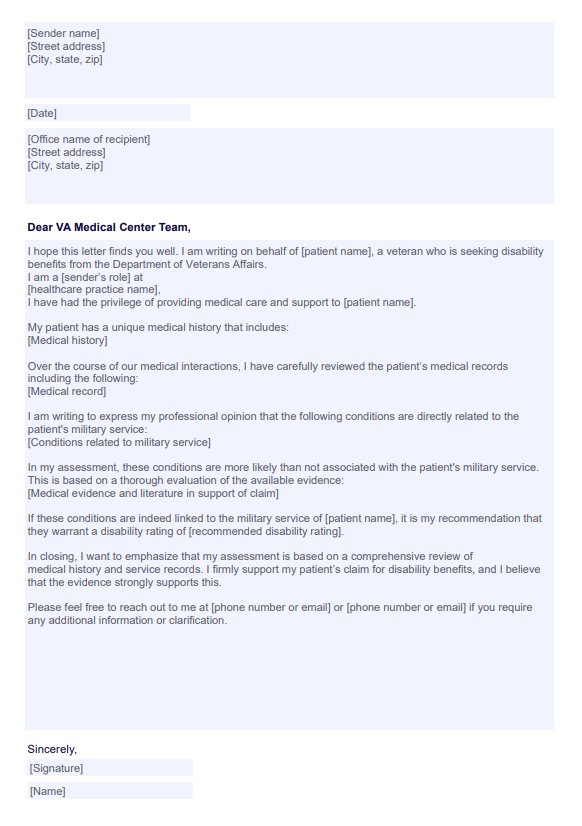
Click “Use Template” to access it in the Carepatron app. You can fill it out digitally, add an electronic signature, or print the PDF version for manual completion. The upper section already includes fields for your name, title, clinic, and address, ensuring the VA knows who authored the opinion and that the letter comes from a qualified medical professional.
### **Step 2: Enter patient information**
The section prompts you to describe the veteran’s medical history and provide context for their current diagnosed conditions. Summarize relevant treatment notes, diagnoses, and service-related exposures concisely and factually.
### **Step 3: Establish the service connection**
Next, identify the specific conditions you believe are service-connected, and explain the clinical relationship between the veteran’s medical condition and their military service. The template includes space for a paragraph that allows you to discuss both causation and supporting evidence.
This is where you apply your medical rationale, drawing from both clinical experience and relevant medical literature.
### **Step 4: Provide your medical opinion and suggested rating**
Clearly state your conclusion using VA-recognized language such as “at least as likely as not.” This step transforms your evaluation into a medical nexus opinion, a key factor in whether the VA recognizes a service-connected disability.
### **Step 5: Sign, finalize, and deliver the letter**
End the letter by reaffirming your professional support, signing it, and including your contact information for follow-up. Our template includes ready-made signature fields for your name, title, facility, phone, and email. Once finalized, provide the signed copy to the veteran to include in their VA disability claim package.
## **Tips on writing the perfect VA nexus letter**
A well-written nexus letter uses precise medical reasoning, refers to verified VA medical records, and delivers an honest medical opinion based on clinical evidence. Since many VA disability claims are denied due to unclear connections between service and condition, your letter should focus on clarity, accuracy, and strong supporting documentation.
Below are tips to help you write a nexus letter that strengthens your patient's VA disability claims:
### **1. Begin with professional credibility**
Begin by clearly outlining your qualifications, areas of specialization, and your relationship with the veteran. This establishes that your opinion comes from a qualified medical professional capable of offering an honest medical opinion based on training and clinical experience.
### **2. Reference and review all relevant VA medical records**
Before forming your conclusion, thoroughly review the veteran’s VA medical records, service treatment records, and any private medical reports. Reference these sources directly in your letter to demonstrate that your opinion is grounded in verified evidence rather than assumption. A well-written nexus letter cites credible data and provides enough context to help VA evaluators connect medical findings to service events.
### **3. Write an honest and medically supported rationale**
The core of a strong nexus letter lies in your medical rationale. Clearly explain how the veteran’s condition is “at least as likely as not” related to their service. Use medical reasoning, research evidence, or relevant clinical studies to justify your conclusion. A solid rationale separates a well-written nexus letter from one that lacks probative value.
### **4. Use clear, objective language**
Avoid emotional or vague statements like “I believe” or “it might be.” Instead, use assertive, evidence-based phrasing such as “it is at least as likely as not” or “the evidence strongly supports.” Objective wording lends your letter professional weight and enables reviewers to grasp your stance quickly.
### **5. Review a VA Nexus Letter Example**
If you’re unsure how to phrase specific sections, refer to our VA nexus letter example for structure and tone. A good model includes space for credentials, service connection evidence, and medical reasoning. Reviewing a sample can help ensure your own letter meets VA expectations while remaining concise and professional.
## **References**
Hill & Poton, P. A. (2023, June 29). How do I get my disability service connected? | Hill & Ponton, P.A. Hill & Ponton, P.A. https://www.hillandponton.com/va-service-connection/
Werner, A. (2023, November 10). Boca Raton Personal Injury Lawyer. Werner, Hoffman, Greig & Garcia. https://wernerhoffman.com/blog/most-common-reasons-va-disability-claims-are-denied/
U.S. Department of Veterans Affairs. (2020, June 22). Eligibility for VA disability benefits. https://www.va.gov/disability/eligibility/