How to use this template
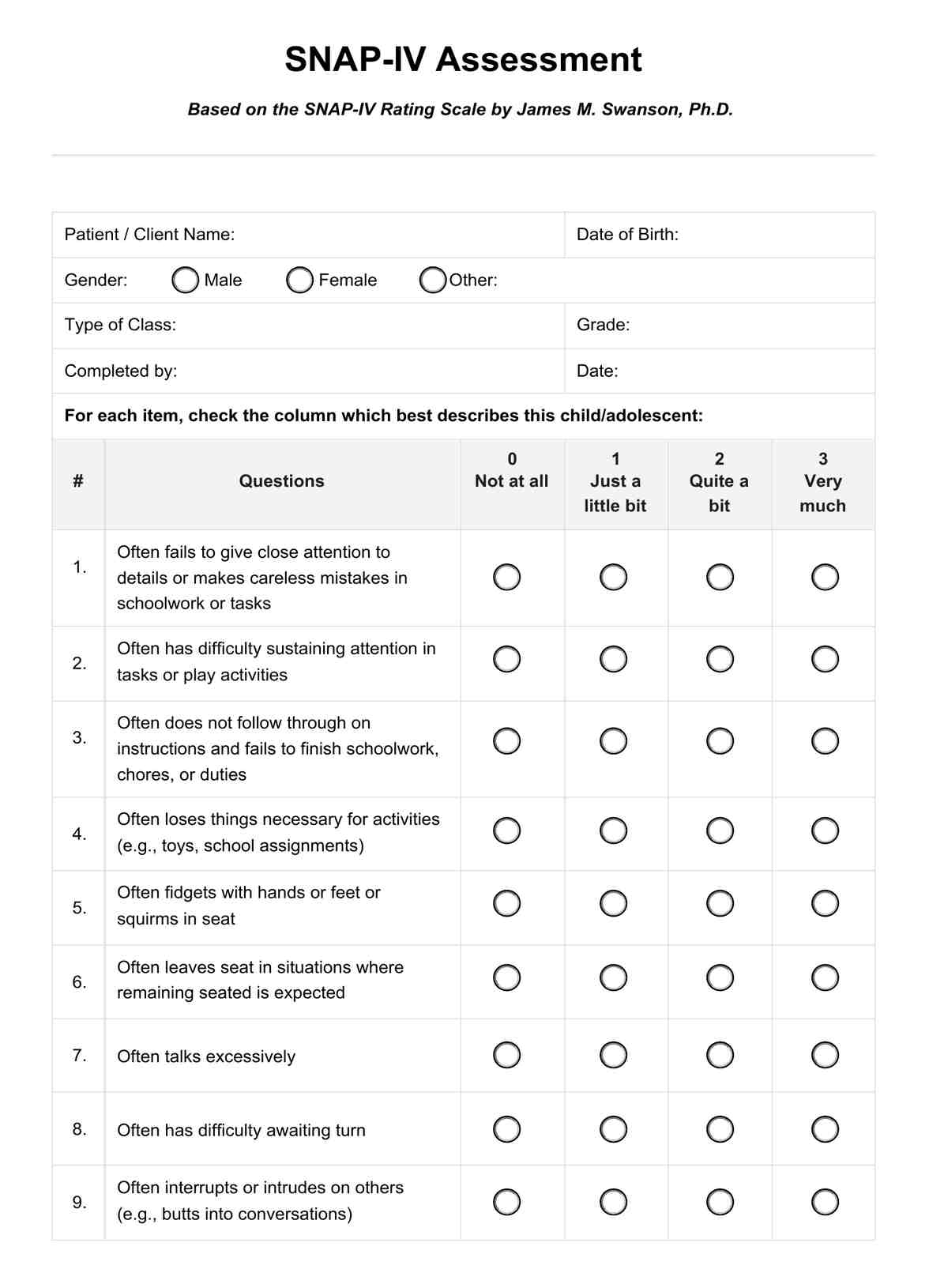
The SNAP IV Assessment, or the Swanson, Nolan, and Pelham IV Questionnaire, is commonly used to track ADHD symptoms in children, as observed by teachers and parents. This scale measures inattention, hyperactivity, and impulsivity symptoms based on DSM criteria. Here's a step-by-step guide on how to use it:
Step 1: Familiarize with the scale
The SNAP IV Assessment, also known as the Swanson, Nolan, and Pelham IV Questionnaire, can also be a support for an ADHD test in children through reports from teachers, peers, and parents. This scale gauges inattention, hyperactivity, and impulsivity symptoms according to DSM criteria. The scale comprises 26 items, split into sections for inattention and hyperactivity/impulsivity, with each item rated on a scale from 0 to 3.
Step 2: Distribute the forms
Begin by distributing the SNAP IV forms to the child's teachers and parents or caregivers. Ensure they grasp that their responses should reflect the child's behavior over the preceding six months.
Step 3: Provide clear instructions
Offer clear instructions to teachers and parents on completing the questionnaire based on their observations of the child's behavior. Stress the significance of accuracy in responding to each item, considering the child's conduct across various settings and scenarios.
Step 4: Gather and review
Once the forms and materials are completed, collect them from the teachers and parents. Review the responses for completeness and consistency, ensuring all items are addressed. Follow up on any unanswered items to ensure thorough completion.
Step 5: Score the responses
Record the scores provided by the first group of respondents for each item. Calculate the average score for each subscale (Inattention and Hyperactivity/Impulsivity) by summing the scores for the items within each subscale and dividing by the number of items.
Step 6: Interpret the scores
Compare the average scores against established cutoff points to gauge and measure the severity of symptoms. Higher scores indicate more severe symptoms, though diagnosis and treatment decisions should be made by a healthcare professional following a comprehensive clinical assessment.
Step 7: Discuss with healthcare provider
Discuss the results with the child's healthcare provider, who may recommend further evaluation, formal diagnosis, and a tailored treatment plan if necessary. Consider a holistic approach incorporating educational interventions, behavioral strategies, and potentially medication.
Step 8: Monitor progress
Utilize the SNAP IV Assessment periodically to monitor the child's symptoms and evaluate the effectiveness of interventions. Regular reassessment facilitates adjustments to the treatment plan to meet the child's evolving needs better.