






Full Scale Intelligence Quotient (FSIQ) Score ChartAI Template IconToolbar IconShare Icon

Full Scale Intelligence Quotient (FSIQ) Score Chart

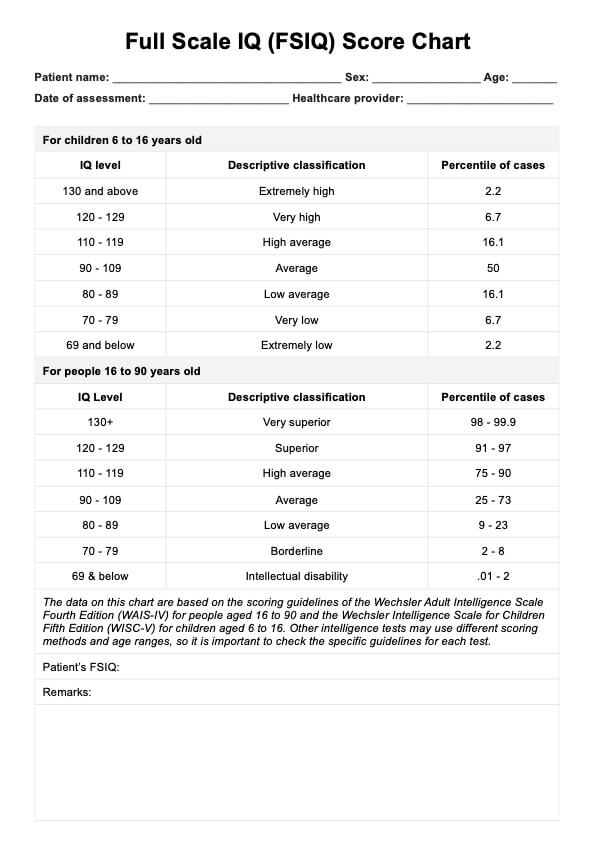
Explore how full-scale IQ (FSIQ) scores are interpreted using our FSIQ Score Chart, highlighting intellectual levels and their significance in assessments.

Ericka Pingol avatar

By Ericka Pingol on Aug 2, 2025.

Fact Checked by Nate Lacson.

Use Template

Full Scale Intelligence Quotient (FSIQ) Score Chart Template

Download PDF Template

Commonly asked questions

Calculating the full-scale IQ (FSIQ) score involves adding together the scores of specific subtests from a cognitive assessment, such as the WAIS-IV. The WAIS-IV has 10 core subtests that measure verbal comprehension, perceptual reasoning, working memory, and processing speed. Each subtest is scored separately, and the FSIQ score is then calculated by combining these individual scores. This combined score reflects overall cognitive ability compared to the general population.

IQ scores represent an individual's cognitive ability based on standardized IQ tests, while percentile ranks show how that IQ compares to the general population. For example, a score in the 75th percentile means the individual scored higher than 75% of people in their age group.

There is no specific "good" full scale IQ (FSIQ) score as it can vary based on individual factors and context. For example, a score of 110 may be considered average in the general population, but for someone with a learning disability or intellectual impairment, it could be considered above-average. Additionally, FSIQ scores should not be used as the sole measure of intelligence, as they do not capture other important aspects such as creativity and emotional intelligence.

EHR and practice management software

Get started for free

*No credit card required

Free

$0/usd

Unlimited clients

Telehealth

1GB of storage

Client portal text

Automated billing and online payments








