Looking for a practical tool to help your clients develop sustainable self-care habits? This guide explains how the Self-Care Wheel works as a structured framework for client assessment and care planning. You’ll learn how to use this visual tool to help clients identify neglected areas of well being, set boundaries, and build a personalized plan that addresses physical, emotional, mental health, and spiritual needs. Use our worksheet to guide clients through a comprehensive self assessment that defines what constitutes meaningful self care in their lives and creates actionable steps for better balance.
## **The importance of self-care to overall wellbeing**
Self care has become a clinical priority as research increasingly demonstrates its impact on both physical and emotional health outcomes (Riegel et al., 2021). Healthcare professionals recognize that clients who actively engage in self-care practices show improved stress management, better treatment adherence, and enhanced resilience when facing health challenges. When clients neglect their own needs while managing demanding responsibilities, they often experience burnout, compromised immune function, and deteriorating mental health.
Taking care of oneself is essential. Regular self-care practices strengthen the body’s stress response systems, support emotional regulation, and improve cognitive function. Clients who consistently practice gratitude, maintain a balanced diet, get enough sleep, and engage in regular exercise build a strong foundation for managing chronic conditions and navigating life transitions. Prioritizing self care helps clients maintain the energy and clarity needed to fulfill professional obligations, sustain stronger relationships, and pursue personal growth.
The cumulative effect of small, consistent self-care actions creates meaningful change in clients’ lives. When you guide clients to identify which areas need more attention, you help them create balance rather than adding overwhelming new routines to already full schedules. This approach acknowledges that self-care looks different for everyone—what restores one person may drain another. A structured assessment like the Self Care Wheel helps clients recognize patterns, find balance, and develop strategies that actually fit their daily life.
## **What is a Self-Care Wheel?**
The Self Care Wheel, originally developed by Olga Phoenix in 2013 (Phoenix, n.d.). Similar to other [self-care worksheets](https://www.carepatron.com/templates/self-care-worksheets/), this wheel is a visual assessment tool that helps healthcare professionals systematically evaluate how clients allocate time and attention across multiple dimensions of wellness.
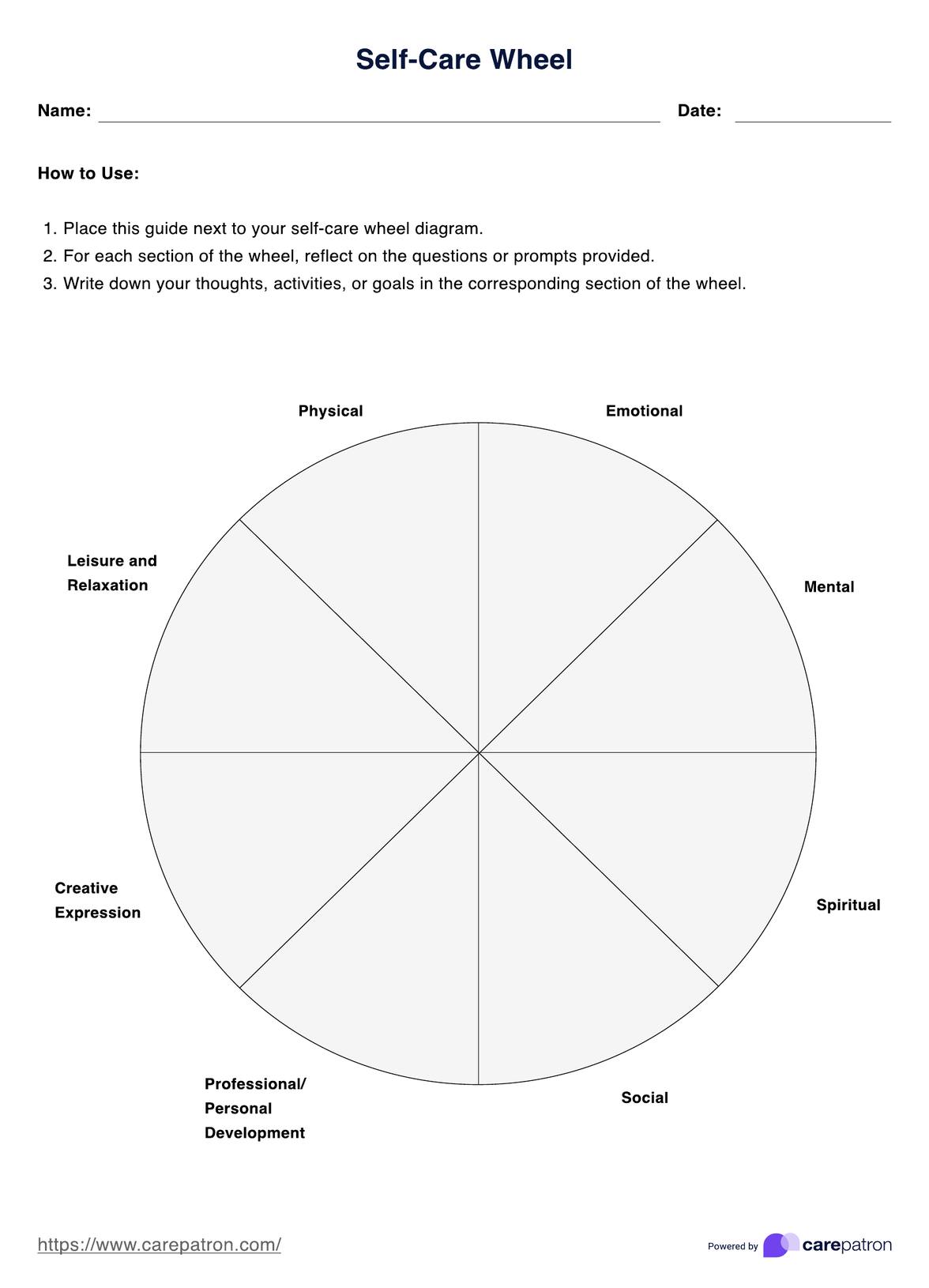
Rather than treating self-care as a single concept, the wheel divides it into distinct categories: physical self care, emotional well-being, mental health, spiritual practices, social connection, professional and personal development, creative expression, and leisure activities. This structure gives clients and therapists a shared framework for discussing gaps between current habits and desired outcomes.
The wheel works as both a diagnostic and planning instrument. You can use it to help clients quickly identify areas where they feel depleted or unsupported, then build targeted strategies for those specific dimensions. When a client reports feeling constantly overwhelmed, the wheel often reveals they’ve been neglecting one or two areas completely while over-focusing on others. They may be excelling professionally while abandoning social ties or physical activity. This visual approach makes imbalances obvious and gives clients permission to redistribute their efforts.
Using the care wheel improves self awareness without creating additional pressure. Instead of presenting self-care as another task to master, it helps clients see the big picture of how different life domains interact. Someone struggling with sleep might discover their evening routine lacks transition time from work mode. A client feeling socially isolated may realize they have friends and family available but haven’t been spending time with them intentionally. The wheel’s structured format guides this discovery process efficiently, making it particularly useful for therapists working with clients who feel stuck or don’t know where to start small.
The tool has gained widespread use among mental health professionals, life coaches, and wellness practitioners precisely because it addresses a common clinical challenge: clients often recognize they need better self-care but don’t know how to assess their current state or prioritize next steps. The Self-Care Wheel provides that clarity. It turns vague intentions into specific, manageable self-care activities that support long-term health and resilience.
## **How does it work?**
Our Self-Care Wheel template divides self-care into eight essential components instead of the original six, each representing a distinct aspect of wellbeing that contributes to overall health and life satisfaction. Understanding these components helps you guide clients through a meaningful [self-care assessment](https://www.carepatron.com/templates/self-care-assessment/) process.
- **Physical health**: It addresses the body’s basic needs: movement, nutrition, sleep, and medical care. Clients reflect on whether they’re getting regular exercise, eating nutritious meals, resting adequately, and attending to health concerns. This section often reveals practical barriers like scheduling constraints or lack of a safe space to exercise.
- **Emotional health**: This focuses on how clients process and express feelings. Questions here help clients identify whether they have healthy outlets for emotions, can recognize and name what they’re feeling, and respond to emotional distress constructively rather than avoiding or suppressing it.
- **Mental health**: It examines cognitive and psychological patterns. Clients consider how they manage stress, challenge negative thoughts, and maintain mental clarity. This section addresses practices like meditation, cognitive reframing, and whether clients feel mentally overwhelmed or capable of focusing on tasks.
- **Spiritual health**: This explores connection to meaning and purpose. This isn’t necessarily religious. Clients may reflect on what gives their life significance, whether they feel part of something larger than themselves, and how they cultivate inner peace or contentment. Practices might include spending time in nature, contemplative practice, or engaging with personal values.
- **Social health**: This aspect evaluates relationship quality and connection. Clients assess who provides genuine support, which relationships feel nourishing, and whether they’re investing enough time in meaningful social interaction. This section often uncovers isolation patterns clients hadn’t recognized.
- **Professional/personal development**: This dimension addresses growth and learning. Questions focus on skill development, career satisfaction, work-life balance, and whether clients feel they’re progressing toward professional or personal goals. This helps identify when work consumes disproportionate energy or when clients have abandoned learning interests.
- **Creative expression**: This examines outlets for individuality and self-expression. Many clients neglect this dimension entirely, not recognizing how creative activities—whether art, music, writing, cooking, or problem-solving—restore energy and provide satisfaction beyond functional tasks.
- **Leisure and relaxation**: Finally, this addresses rest and enjoyment. Clients consider whether they regularly take time to relax without guilt, have activities they genuinely enjoy, and can disconnect from responsibilities periodically to rejuvenate.
The Self Care Wheel is an interactive tool serving as a personal wellness roadmap. Here's how you can effectively use it:
### **Step 1: Introduce the framework**
Once you get a copy of this template, you can begin to introduce it to clients. Explain that the wheel helps create a comprehensive picture of their current self-care practices across different areas of life. Emphasize that this isn’t about judgment or adding burden but about understanding where they already invest energy and where gaps might exist.
### **Step 2: Facilitate self-assessment**
Guide clients through each section, using the reflection questions provided in the template. For each dimension, clients rate their current satisfaction or fulfillment level. Some therapists have clients shade or color sections to represent how well each area is currently supported. This creates a visual representation that makes patterns immediately apparent.
### **Step 3: Identify patterns and priorities**
Review the completed wheel together. Look for sections with notably low ratings, areas clients struggle to answer questions about (suggesting neglect), and dimensions that receive disproportionate focus. Help clients articulate which one or two areas feel most urgent to address.
### **Step 4: Establish SMART Goals**
For the priority areas identified, work with clients to create Specific, Measurable, Achievable, Relevant, and Time-bound goals. Rather than vague intentions like “exercise more,” aim for concrete commitments: “Walk 20 minutes three times weekly after work.” Ensure goals feel manageable within their current life circumstances.
### **Step 5: Build action steps**
Start small actions clients can implement immediately. If a client realizes they’ve abandoned all creative expression, start with 15 minutes weekly rather than expecting a dramatic lifestyle shift. Help clients identify specific timing when incorporating self-care activities. When during their routine will these activities happen? What barriers might interfere? How can they protect this time?
### **Step 6: Create regular review points**
Personal self care needs evolve as life circumstances change. Schedule periodic check-ins to reassess the wheel as clients also evolve into their future self. Quarterly reviews might work well for most clients. This allows them to spend time acknowledging progress, adjusting goals that no longer fit, and addressing new areas as previous ones stabilize. The ongoing process reinforces that balance is dynamic, not a fixed destination.
## **Common self-care practices to teach clients**
When clients identify areas needing attention, they often need concrete examples of what self-care actually looks like in each dimension. The following are some examples to get started:
### **Physical self care practices**
Encourage clients to establish consistent sleep schedules, aiming for 7-9 hours nightly. Regular exercise doesn’t require gym memberships. Walking, stretching, dancing, or gardening all count. A balanced diet with regular meals prevents energy crashes that undermine other self-care efforts. Schedule preventive medical and dental appointments rather than waiting for problems.
### **Emotional health practices**
Help clients develop emotional literacy. This involves naming specific emotions rather than broad categories like “bad” or “stressed.” Journaling provides a safe outlet for processing feelings without judgment. Practice self compassion when clients make mistakes instead of harsh self-criticism. Teach that emotional expression is healthy, whether through conversation with trusted friends, creative outlets, or working with a therapist.
### **Mental health strategies**
Practice mindfulness through brief daily exercises. Even five minutes of focused breathing counts. Teach clients to notice and challenge cognitive distortions rather than accepting every anxious thought as fact. Limit exposure to overwhelming news or social media when it contributes to stress. Encourage learning activities that engage the mind constructively, whether puzzles, reading, or skill development.
### **Spiritual connection approaches**
This highly personal dimension might include meditation, prayer, spending time in nature, practicing gratitude, engaging with philosophy or literature, or participating in community gatherings aligned with personal values. What matters is that practices connect clients to a sense of meaning and perspective beyond immediate daily concerns.
### **Social wellness habits**
Quality matters more than quantity. Help clients identify which relationships genuinely provide support and mutual care versus those that deplete energy. Set boundaries around interactions that consistently feel draining. Prioritize spending time with people who accept clients as they are. Recommend them to schedule regular connection times such as weekly calls with distant friends, monthly gatherings, or daily family rituals.
### **Creative expression outlets**
Many clients believe they’re “not creative,” but creativity includes any activity where they express individuality such as cooking, gardening, organizing spaces, problem-solving, crafts, music, writing, or visual arts. The goal isn’t mastery; it’s engagement with the process. Twenty minutes weekly on a creative activity many clients have abandoned can restore surprising amounts of happiness and energy.
### **Leisure and relaxation time**
Normalize rest as productive rather than lazy. Help clients identify activities they find genuinely restorative—reading, watching films, hobbies, baths, napping, listening to music. Create permission to say no to obligations sometimes simply to rest. Teach that sustainable productivity requires regular parts of the schedule dedicated to doing nothing particularly useful.
The most effective self-care plan includes practices from multiple categories. It is in acknowledging that physical, emotional, mental, and spiritual health interact continuously. When clients strengthen one or two areas, they often see benefits ripple across other dimensions—better sleep improves emotional regulation, social connection reduces stress, creative expression clarifies thinking. This interconnection is precisely why the Self Care Wheel functions as such a powerful tool: it makes visible how caring for yourself in one or two areas supports everything else.
## **Reference**
Phoenix, O. (n.d.). Self-care wheel. https://olgaphoenix.com/self-care-wheel/
Riegel, B., Dunbar, S. B., Fitzsimons, D., Freedland, K. E., Lee, C. S., Middleton, S., Stromberg, A., Vellone, E., Webber, D. E., & Jaarsma, T. (2021). Self-care research: Where are we now? Where are we going?. International Journal of Nursing Studies, 116, 103402. https://doi.org/10.1016/j.ijnurstu.2019.103402