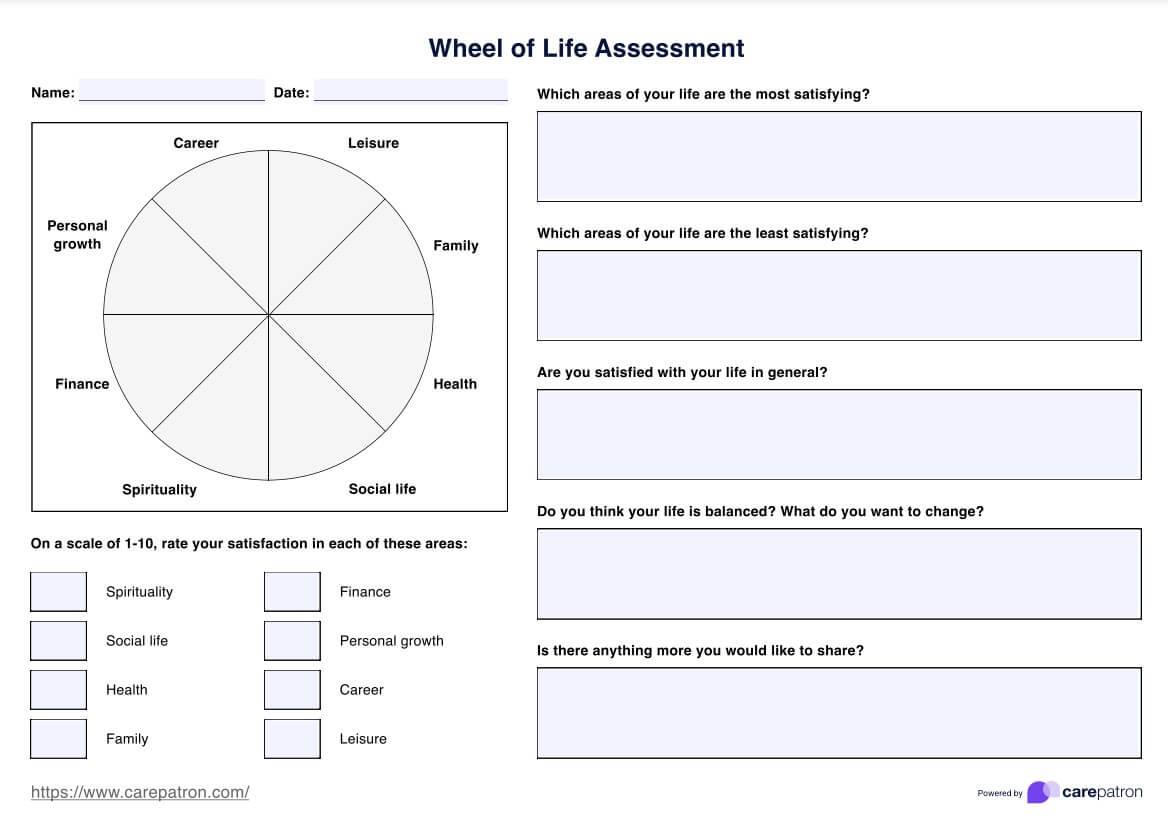
Looking for a tool that can help your clients examine themselves and see if they are satisfied with their lives so far? Read our guide to learn about the wheel of life concept and use our Wheel of Life Worksheet to help your clients learn how to become more aware of what they love and don't love about their lives right now.
## **What is the Wheel of Life?**
A wheel of life is a versatile tool used by life coaches, counselors, and healthcare practitioners to help individuals assess their overall well-being and life satisfaction across various domains. It is a circular diagram divided into distinct sections, each representing a key area of life, such as work, health, relationships, spirit/self, and family/friends (Byrne, 2005).
At the center of the life wheel is a numerical scale, typically ranging from 0 to 10, which allows individuals to rate their level of satisfaction or fulfillment in each life area. By visually representing these ratings on the corresponding sections of the wheel and into a spider web, individuals raise their awareness and understanding and, as a result, can easily identify thriving areas and those that may require more attention or improvement (Swart, 2022).
The wheel of life typically talks about how a balanced life involves harmony within the following life categories/key life areas:
- **Family and friends category**: Assessing the quality of family and other relationships and the level of satisfaction derived from family life
- **Partners and love category**: Reflecting on the quality and importance of romantic connections
- **Growth and learning category**: Thinking about areas for personal growth and self-improvement, including spiritual growth
- **Spirituality category**: Reflecting on spiritual or religious beliefs and the sense of inner peace and purpose
- **Finance category**: Assessing financial security and satisfaction with financial management and goals (e.g., financial health, financial freedom, etc)
- **Career category**: Considering job satisfaction, work environment, career growth, work-life balance, and professional fulfillment
- **Health category**: Evaluating physical well-being and health, fitness, and overall well-being
- **Fun and recreation category**: Evaluating the quality and quantity of leisure time and recreational activities
Do note that the presence of the areas may vary depending on the life wheel life coaching template or the one completing the wheel of life.
## **Why is the Wheel of Life used as a life coaching tool?**
The Wheel of Life is a great life coaching tool that provides a comprehensive and visual representation of an individual's overall life satisfaction across multiple domains. Here are some key reasons why this life coaching wheel is widely employed by life coaches (Richter et al., 2021):
### **Holistic perspective**
This life balance wheel covers various life areas, such as career, health, relationships, personal growth, self-care, and finances. This holistic approach allows life coaches to understand clients' situations and personal issues and identify neglected areas.
### **Visual clarity**
The life balance wheel's circular format presents information clearly and concisely, making it easier for clients to comprehend and recognize potential imbalances or areas for improvement.
### **Self-awareness**
Completing the Wheel of Life assessment encourages clients to reflect on their own lives, current circumstances, and priorities, fostering greater conscious awareness and conscious decision-making.
### **Progress tracking**
This life balance wheel can be revisited periodically, allowing coaches and clients to track progress, celebrate achievements, and adjust their action plans toward a fulfilling life and to find balance in all their life areas.
After working on this wheel, clients can leverage the [Action Plan Template](https://www.carepatron.com/templates/action-plan) to outline and organize the steps necessary to achieve their goals. This tool helps break down complex objectives into manageable tasks, assign responsibilities, and establish deadlines.
## **What is a Wheel of Life Assessment?**
A Wheel of Life Assessment is a valuable resource that utilizes the Wheel of Life visual to help clients self-reflect, rate, and discuss their current level of life satisfaction.
Usually, such assessments will ask clients to rate themselves between 1 and 10 for each key life area. After that, they will usually answer some guiding questions so they can elaborate on their ratings and discuss what they find to be the most satisfying and least satisfying aspects of their life, as well as their overall thoughts on life in general.
These are basically written exercises that life coaches and even mental health professionals can take advantage of because they serve as self-reports. They will become aware of the specific key life areas that need to be improved, and the necessary coaching plans can be developed from there.
### **For goal setting and post-major life changes**
Conducting the Wheel of Life Assessment at the start of a life coaching or counseling process provides a baseline understanding of the client's current life situation and areas that may require focus or improvement. It can also be (re)used during or after major life transitions, such as starting a new job, relocating, or experiencing a significant personal event, which can be opportune times to reassess life balance and priorities using the life balance wheel.
It can also be used for goal setting. When setting new goals or evaluating progress toward existing goals, the life balance wheel can help identify areas of strength and areas that may need additional attention or adjustment. Moreover, if an individual feels stuck or dissatisfied with their current circumstances, the Wheel of Life Assessment can provide valuable insights into areas contributing to these feelings and help identify potential solutions.
Periodically revisiting the life balance wheel template, perhaps annually or biannually, can help individuals monitor their overall life satisfaction and make necessary adjustments to maintain a balanced and fulfilling lifestyle.
## **How to use this Wheel of Life Assessment**
Using our free Wheel of Life template is quick and straightforward. Check out the instructions to know how to proceed with the assessment:
### **Step 1: Download the assessment**
To obtain a copy of our free assessment template for the Wheel of Life, please click "Use Template" or "Download." You can choose to use this digitally (it has interactive sections), or you can print it and hand it to your patient during an in-person session.
### **Step 2: Give your client a copy**
Provide your client with a copy of the assessment or life balance wheel to complete. Spend time clearly explaining what you're using to evaluate their satisfaction in different areas of life.
### **Step 3: Let the client complete the life wheel assessment**
This assessment is designed so that individuals can efficiently work on it independently. Before starting, explain the purpose of the Wheel of Life worksheet. Guide them throughout the assessment and encourage them to consider how they would like their lives to be in the future.
The first thing they need to do is rate the following key life areas from 1 to 10:
- Spirituality
- Social life
- Health
- Family
- Finance
- Personal growth
- Career
- Leisure
After that, they will answer the following guide questions as honestly and with as much detail as they can:
- Which areas of your life are the most satisfying?
- Which areas of your life are the least satisfying?
- Are you satisfied with your life in general?
- Do you think your life is balanced? What do you want to change?
- Is there anything more you would like to share?
### **Step 4: Review the assessment**
Once the client feels satisfied with their wheel, review it with them and identify areas that need improvement or areas they are satisfied with. During these coaching sessions, you can identify and agree on priorities for future exploration and goal-setting.
## **Taking action from the Wheel of Life Assessment**
After completing the wheel of life exercise, the next steps involve a thoughtful and strategic approach to personal development. Based on the exercise results, clients can start by prioritizing the areas of their lives that require more focus and improvement.
Encourage them to establish SMART goals for each prioritized aspect, breaking them down into manageable steps. Help them identify actions they need to take, outline potential obstacles, and share their goals with family and a support network for accountability.
Clients can also explore relevant resources, tools, and positive habits to aid their journey. They can adjust the action plan as needed and embrace continuous learning to stay informed about effective strategies. Also, encourage them to practice self-compassion, acknowledging that personal growth is dynamic until they are fully satisfied with their life balance.
Lastly, remind them to celebrate achievements to maintain motivation and reinforce positive changes. Remember, the Wheel of Life is a dynamic tool, and these steps can be revisited to assess progress and set new goals as you begin to continue your personal development journey.
## **Other similar tools you can use**
Besides the Wheel of Life Assessment, here are similar/related tools you can use to enrich your life coaching program for your clients:
- **[SMART Goals Worksheet](https://www.carepatron.com/templates/smart-goals-worksheet)**: This worksheet can help your clients set goals based on which key life areas they need or want to improve. Through the SMART acronym, they will create goals that are well-defined and clear. These goals must have tangible criteria that they can meet, the goals must be attainable and should align with their values, and they must have deadlines to ensure accountability on the part of the client.
- **[Action Plan](https://www.carepatron.com/templates/action-plan)**: This template is similar to the SMART Goals Worksheet because it uses SMART Goals as well. This one is slightly different, though, because this plan is meant to be used for specific actions that they must do. The SMART Goals Worksheet is primarily for goal setting, but this plan specifically asks for task breakdowns, responsible parties, resources needed, and actual due dates. If your client has specific projects they must do to improve key life areas, consider using this template.
- **[Self-Reflection Questions](https://www.carepatron.com/templates/self-reflection-questions)**: This might be a good choice to hand to your patient first before the Wheel of Life Assessment and the SMART Goals Worksheet. The Self-Reflection Questions worksheet lets clients really think about their values, strengths, weaknesses, how they respond to certain situations, if they're living according to their values, etc. It's good for them to be cognizant of all of these before assessing key life areas and setting SMART goals because only by being cognizant of these will they be able to truly determine what they need to unlearn, improve on, and what to pursue.
## **References**
Byrne, U. (2005). Wheel of life: Effective steps for stress management. Business Information Review, 22(2), 123-130. https://doi.org/10.1177/0266382105054770
Richter, S., van Zyl, L. E., Roll, L. C., & Stander, M. W. (2021). Positive psychological coaching tools and techniques: A systematic review and classification. Frontiers in Psychiatry, 12, 667200. https://doi.org/10.3389/fpsyt.2021.667200
Swart, J. (2022). The wheel of life is a coaching tool to audit life priorities. ResearchGate. Retrieved from https://www.researchgate.net/profile/Joan-Swart