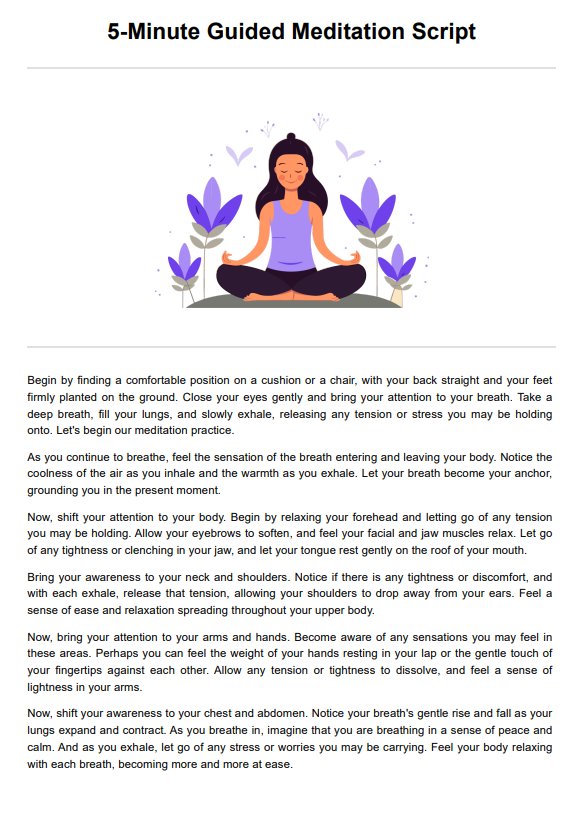
Looking for a 5-minute meditation script you can use right away? Learn how five-minute meditations are structured, when to use them with clients, and what makes them effective for building a sustainable daily meditation practice. Download our free script to guide quick meditation sessions or hand it to patients so they can practice mindfulness on their own.
## **What are 5-Minute Guided Meditation Scripts?**
In our current world, where time feels increasingly scarce, 5-minute meditation scripts offer a practical solution for incorporating mindfulness into patient care. Unlike longer meditation sessions that might explore multiple techniques or deeper states of awareness, 5-minute scripts focus on essential mindfulness elements. They typically focus on deep breath meditation, awareness of physical sensation, or simple present-moment attention exercises.
These abbreviated scripts serve multiple purposes in healthcare settings. They provide structured guidance for practitioners who may be new to teaching meditation. For patients, these scripts offer an accessible entry point to mindfulness exercises that feel manageable within their daily routines.
Research supports that mindfulness meditation can reduce stress, improve emotional regulation, and promote better sleep (American Psychological Association, 2019; Rusch et al., 2019). With a flexible script, you can adapt this for chronic pain management, anxiety reduction, pre-procedure centering, or as take-home practices patients can use anytime.
And because clinicians are often pressed for time, a five-minute script respects both your schedule and the patients' capacity to engage. It removes the barrier of "I don't have time to meditate" while still delivering meaningful benefits to well-being.
## **How does it work?**
Our free Five-Minute Guided Meditation Script typically follows a structured approach to lead the practitioner through the meditation practice.
The template includes clear cues for breath focus, a signal to relax their bodies, and a gentle return to awareness. You can use it as-is or adapt the language to suit your client's needs.
Here's a step-by-step outline of how you can guide clients through their meditation journey.
### **Step 1: Access the script**
From the template preview, click "Download" to get a PDF copy of the script. You can also click "Use template" to open and edit the template within the Carepatron platform.
### **Step 2: Setting the environment**
Before starting, ensure the space is quiet and free from distractions. Instruct your client to settle into a comfortable position—sitting in a chair with feet flat on the floor, or on a cushion with their spine upright but not rigid. The goal is to feel supported and at ease.
### **Step 3: Grounding and breath focus**
Begin by guiding your client to close their eyes and bring attention to their natural breath. Encourage a few deeper breaths to release tension and stress, then let the rhythm settle. Using the breath as an anchor is a foundational mindfulness technique that helps practitioners return to the present moment when the mind wanders.
### **Step 4: Body scan and deep relaxation**
Lead your client through a progressive body scan, moving from the head to the belly, down to the feet. In the interest of time, you can adjust the pacing here and focus on major areas instead. Prompt them to notice areas of tension and release muscle tightness with each exhale. This helps activate the relaxation response and supports better sleep and overall healing.
### **Step 5: Mindfulness and visualization**
As the script progresses, encourage your client to stay aware of physical sensations and the rhythm of their breath. If their brain starts to wander, remind them that this is natural. Meditation isn't about doing it perfectly. They can gently bring their attention back without judgment.
You can also incorporate brief visualizations (like imagining cool air entering the lungs or warm energy spreading through the body) or affirmations to deepen the sense of peace and calmness.
### **Step 6: Transitioning out and integration**
As the session closes, guide your client to take a few deeper breaths, gently open their eyes, and reconnect with their surroundings. Encourage them to carry this sense of calm into their daily activities and to listen to their body when they feel overwhelmed or tense.
## **Other strategies to enhance 5-minute meditations**
While a standard body scan and breath focus are effective on their own, you can layer in additional techniques to address specific needs or deepen the practice. Here are a few approaches that fit well within five minutes:
### **Grounding through the senses**
Guide your client to notice five things they can see, four they can touch, three they can hear, two they can smell, and one they can taste. This technique helps redirect attention away from anxiety or worry and anchors them in the present moment. It's especially useful before procedures or during moments of acute stress.
### **Loving-kindness or self-compassion cues**
If appropriate for your client, include a brief phrase of self-love or gratitude during the closing. For example: "May I be at peace. May I be free from suffering." This adds an emotional dimension and intention to the meditation and can support patients working through challenges or difficult emotions.
### **Visualization for calm or healing**
Invite your client to visualize a safe, calm place. It might be a beach, forest, or quiet room. Encourage them to notice details, the colors, sounds, and sensations. Visualization can help shift the nervous system into a rest state and is particularly helpful for patients managing chronic pain or anxiety.
## **References**
American Psychological Association (2019, October 30). Mindfulness meditation: A research-proven way to reduce stress. https://www.apa.org/topics/mindfulness/meditation
Rusch, H. L., Rosario, M., Levison, L. M., Olivera, A., Livingston, W. S., Wu, T., & Gill, J. M. (2019). The effect of mindfulness meditation on sleep quality: a systematic review and meta-analysis of randomized controlled trials. Annals of the New York Academy of Sciences, 1445(1), 5–16. https://doi.org/10.1111/nyas.13996