
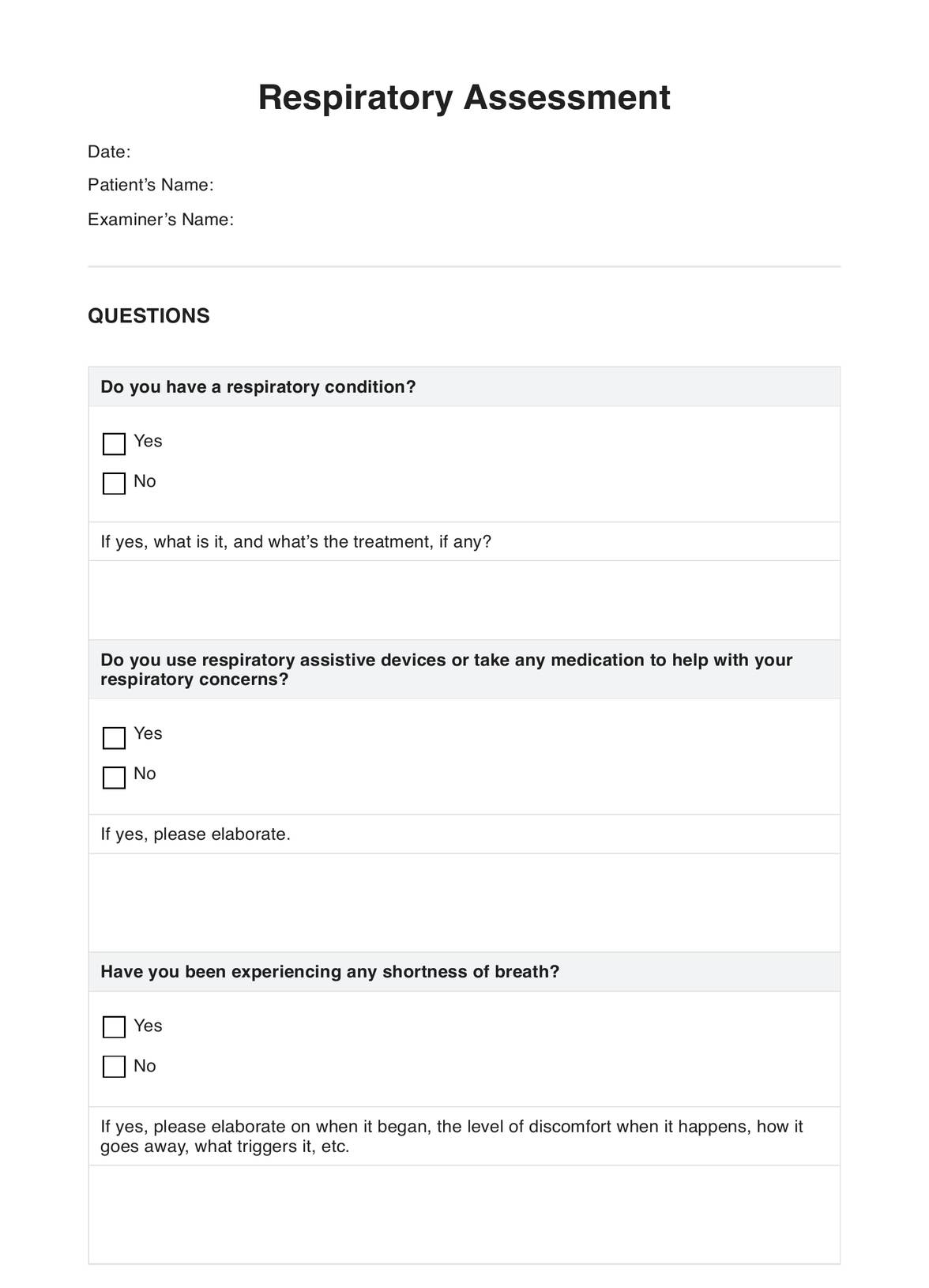




What is a Respiratory Assessment?
A Respiratory Assessment examines a patient’s thorax and lungs to check for respiratory problems before they worsen. Practitioners can also use a Respiratory Assessment to examine an inpatient’s status and look for indications that will aid them in formulating the next steps for treatment.
Just like any other clinical examination, the Respiratory Assessment or respiratory exam will begin with the healthcare practitioner asking about the patient's medical history. Afterwards, the respiratory exam will go as follows:
Hands
- The practitioner inspects the hands for cyanosis, thinned skin, clubbing, tremors/asterixis, and erythema.
- They also palpate the patient’s arms to check their temperature, heart rate, and respiratory rate.
Face, eyes, and mouth
The practitioner assesses the patient’s jugular venous pressure (JVP) and inspects the face, eyes, and mouth for cyanosis, pallor, Horner’s syndrome, poor dentition, oral candidiasis, nasal flaring, and more.
Chest and trachea
- The practitioner begins the assessment of the chest by inspecting it for any chest wall deformities, skin changes, abnormal breathing patterns like labored breathing, use of abdominal accessory muscle, or scars.
- Normal breath sounds are heard over the lung surfaces, or lung sounds clear bilaterally.
- They palpate the chest to check for a displaced apex beat and the trachea for any deviation or abnormal criscosternal distance.
- Assessing the patient’s chest rise and lung expansion requires inspection and palpation of the anterior and posterior thorax.
- The final steps are percussing and auscultating the anterior and posterior chest wall to check percussion notes, vocal resonance, breath sound quality, and volume. It should also be documented if, on auscultation, bilateral coarse crackles, and if there is any pursed lip breathing noted.
- During the test, observe if the patient reports coughing up blood-tinged, green sputum. Look for signs of an intermittent productive cough during the assessment.
Lymph nodes and other parts
- Before the practitioner switches to the anterior or posterior chest walls, the practitioner will palpate the lymph nodes for lymphadenopathy.
- When all the tests mentioned above are completed, the practitioner will also palpate other parts of the patient’s body to check for sacral and pedal edema, deep vein thrombosis, and erythema nodosum.
Once all the involved body parts have been checked, the practitioner usually concludes a Respiratory Assessment by summarizing their findings.









