Benefits
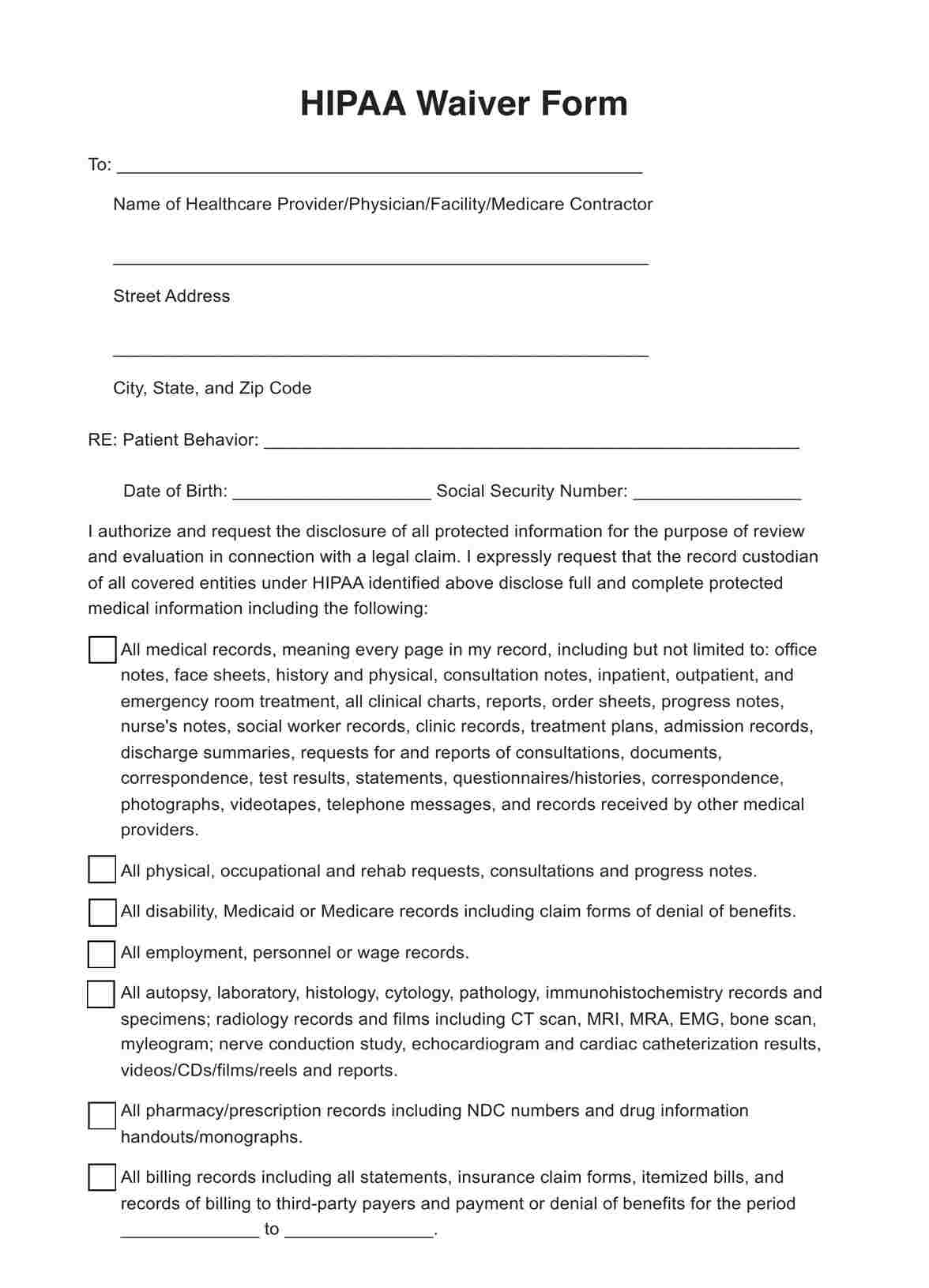
Navigating the complex world of health information privacy can be a daunting task. However, the process becomes much more manageable with tools such as the HIPAA waiver forms. These forms provide a clear, legal pathway for healthcare providers to access and utilize essential protected health information (PHI) when direct patient authorization is not feasible.
This has major implications for advancing research, managing public health crises, and improving overall patient care.
Here are the benefits of using HIPAA waiver forms for both healthcare providers and patients:
1. Standardization
Free HIPAA Waiver Forms provide a standardized process for requesting access to PHI without individual authorization. This uniformity simplifies the procedure, ensures consistency across different scenarios, and makes educating staff and patients about the process easier.
2. Compliance
HIPAA regulations require healthcare providers to obtain patient authorization before disclosing their PHI. However, HIPAA waiver forms provide a legal pathway to bypass this requirement in specific situations. By using these forms, healthcare providers can ensure they remain compliant with the law while still accessing necessary PHI.
3. Facilitates Research and Public Health Initiatives
HIPAA waiver forms facilitate essential activities like research and public health initiatives. By granting researchers and public health officials access to PHI, these forms support advancing medical knowledge and managing public health crises.
4. Transparency and Trust
Though HIPAA waiver forms allow healthcare providers to access PHI without patient authorization, they still promote transparency. The forms clearly state who is accessing the information and why, helping to maintain trust between healthcare providers and patients.
5. Efficiency
HIPAA waiver forms contribute to operational efficiency. In scenarios where obtaining individual authorizations is impractical, time-consuming, or potentially impossible, these forms expedite the process. They allow healthcare providers, researchers, and public health officials to focus on their primary objectives, such as patient care, advancing medical research, or managing public health crises, without being unduly burdened by administrative procedures.
This efficiency can lead to faster results in research findings or responses to public health emergencies.