Everyone has a story to tell, and here we share and celebrate those who chose care as their life's work.
These are their words, their work and we're grateful to share them.
Elizabeth and Dennis handed their billing to Carepatron and grew My Therapeutic Concepts from five clients to seventy in two months, without losing their evenings.
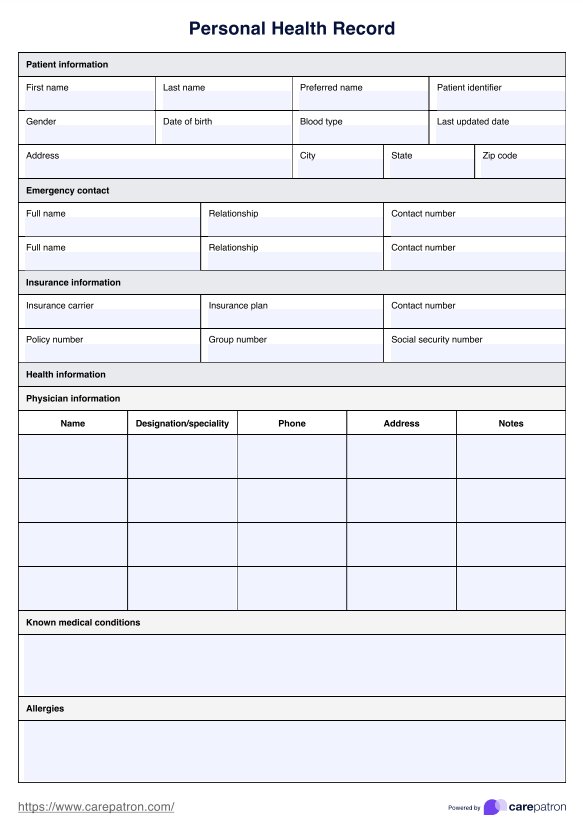
Looking for a tool that can help your patients prepare their personal health records before getting a check-up or being treated? Read our guide about the importance of encouraging patients to have personal health records on hand. Then, give them a copy of our template so they can fill it out and give it to their referring physician when needed.
## **Why should patients have Personal Health Records (PHR)?**
Encouraging patients to maintain a Personal Health Record (PHR) at all times is essential for promoting patient empowerment/engagement, improving care coordination, and ensuring patient safety (Assistant Secretary for Technology Policy, 2025). A comprehensive PHR (personal health record) system, whether physical or electronic, is a self-reported, self-recorded health record that contains information on the patient, such as family medical history, health issues, treatments, vital signs, and nutritional data (Sarwal & Gupta, 2024).
Having continuous, portable access to personal medical information, such as in patient portals, is invaluable in situations like emergencies. It can also be beneficial when seeing new specialists/changing healthcare providers, and managing chronic conditions, as it reduces the risk of medical errors, prevents redundant testing, and allows patients to easily track progress of their health goals.
## **What is a Personal Health Record Template?**
You are not always at your patient's side whenever they need their health record or [documentation](https://help.carepatron.com/en/collections/6831698-documentation). Thus, having a personal health record within their reach can be particularly practical, especially for patients with multiple specialist providers, complicated health concerns or conditions, the aging population, or those with impairments that prevent them from managing their medical records.
While a medical record is the full, comprehensive document comprising a patient's personal health information, past medical treatments, progress notes, test results, and all their other medical encounters, a personal health record, or PHR, is a tool for a patient to manage their own medical documentation and record details relating to their past medical care.
This may include their current medical conditions, medication schedules, and any important contact details, as well as emergency contacts, to ensure this information is accessible in case of emergency situations. The goal of the personal health record is to be a single, go-to reference for patient details.
Electronic medical records (EMRs) or electronic health records ([EHRs](https://www.carepatron.com/feature/electronic-patient-records)) are similar to PHRs but are more extensive and comprehensive because they are managed and controlled by healthcare professionals, clinics, or healthcare facilities.
A Personal Health Record Template can help your patients record their important medical information in a simple format that is easy to share among healthcare providers, including geriatricians, primary care physicians, specialists, mental healthcare providers, and nurse practitioners. Not only is our template clearly formatted for easy search, but it also has a dedicated space for the last updated date and additional notes.
## **How to use this free Personal Health Record Template**
It's simple to get started using this Personal Health Record Template. Just follow this step-by-step guide to help your patients create their own personal health records.
### **Step 1: Download the template**
The first step is to download the Personal Health Record Template. You can download the free PDF version using the link on this page or alternatively access this template and many others from within Carepatron.
### **Step 2: Provide it to your patient**
The next step is to provide your patient or their guardian/representative with a copy of this template. This may be either digital, or you can print it out and provide them with a paper copy. For elderly patients or those with impairments that prevent them from being able to manage their own health information, you should provide the template to the patient's caregiver or legal representative.
### **Step 3: Assist your patient in filling out the template**
If necessary, offer to fill in any parts of the personal health record that relate to you—e.g., your name and designation as their healthcare practitioner. For some patients, you can simply provide them with the template and perhaps highlight a few of the different sections that would apply to them. Store the record in a platform like Carepatron to maintain HIPAA compliance.
## **Personal Health Records and HIPAA compliance**
The application of the Health Insurance Portability and Accountability Act (HIPAA) to Personal Health Records (PHRs) is conditional, as a PHR itself is not automatically considered a HIPAA-covered entity. It only applies when it is offered by or on behalf of a HIPAA-covered entity, such as a health care provider or health plan, and contains Protected Health Information (PHI) (U.S. Department of Health and Human Services, 2008).
Do note that regardless of the PHRs' coverage, HIPAA grants individuals the right to request their covered entity to send their PHI directly to a third party, like a PHR application, thereby enabling the patient to control and share their comprehensive health data.
## **References**
Assistant Secretary for Technology Policy. (2025). What are the benefits of personal health records. https://www.healthit.gov/faq/what-are-benefits-personal-health-records
Sarwal, D., & Gupta, V. (2024, September 10). Personal Health Record. StatPearls Publishing. https://www.ncbi.nlm.nih.gov/books/NBK557757/#:~:text=Several%20commercial%20applications%20are%20available,charge%20of%20their%20own%20health.
U.S. Department of Health and Human Services. (2008). Personal health records and the HIPAA Privacy Rule. https://www.hhs.gov/sites/default/files/ocr/privacy/hipaa/understanding/special/healthit/phrs.pdf
Commonly asked questions
An electronic health record (EHR) comprises all the documentation of a patient's health history stored by a particular provider. The provider maintains the EHR for reference, legal, and billing purposes. The personal health record (PHR) is a record maintained by the patient themselves for their personal reference. A PHR will not necessarily be as comprehensive as the EHR and may prioritize certain types of information depending on the patient's needs.
This Personal Health Record Template can benefit patients who want to organize all their key medical information into a single, easy-to-read document. Patients who may find this template particularly useful are those who usually struggle to recall details of their medical history, who see multiple specialists, or who are seeing a new practitioner for the first time and need to convey key medical information to a new provider.
Not necessarily. Your patient may have some of their medical information available, but they may be unsure about certain points and need assistance from you on some details. For emergency contact details and the personal information section, you should leave this to your patient or their representative to fill out.