Everyone has a story to tell, and here we share and celebrate those who chose care as their life's work.
These are their words, their work and we're grateful to share them.
Elizabeth and Dennis handed their billing to Carepatron and grew My Therapeutic Concepts from five clients to seventy in two months, without losing their evenings.
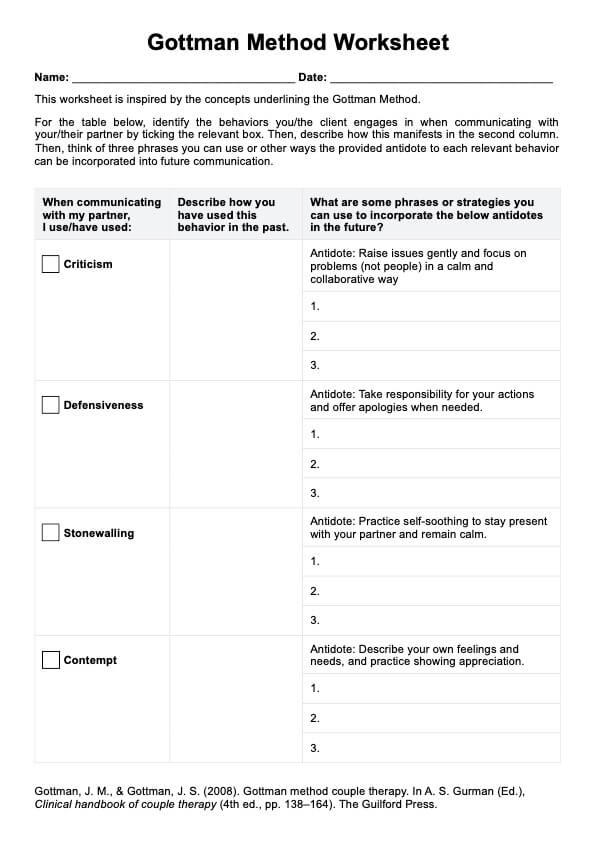
Looking for a Gottman Method Worksheet to help your clients work through the "four horsemen" of detrimental relationship behaviors? If you're seeking free Gottman exercises, read our guide to learn more about the Gottman Method and download our worksheet that makes use of its principles!
## **What is the Gottman Method?**
The Gottman Method is a particular approach to couples' therapy that was developed by Dr. John Gottman and Dr. Julie Gottman, which is rooted in decades of research and observing interactions between couples, and the patterns such interactions reveal that ultimately end in divorce. The theory that serves as the foundation for this method is the Sound Relationship House theory, which posits that there are nine levels that make up a strong and fulfilling relationship/a healthy and thriving relationship (The Gottman Institute, 2020):
- There should be trust
- There should be commitment
- They should build love maps
- They should share fondness and admiration
- They must turn towards each other instead of turning away
- They must adopt positive perspectives
- They should be able to manage conflicts
- They should work to make life dreams come true
- They should work to create shared meaning
To further support this foundation, they also developed the concept of the "four horsemen" of relational behaviors that are detrimental to the goal of creating a strong and lasting relationship, and these are considered signals of the end of a relationship. These become the primary targets of Gottman Method couples therapy/Gottman Method couples counseling (Lisitsa, 2024):
- **Criticism**: For the Gottmans, criticism is the first of the four horsemen. Instead of having a calm, intimate conversation with sound arguments, some people will resort to criticizing the entire being of their partner, which can lead to resentment and building walls that prevent both from actually talking and reasoning things out. This one also sets the stage for the other horsemen to enter.
- **Contempt**: Contempt is the second horseman, and it stems from criticism. A relationship that has declined could lead to a point where arguments go beyond criticism, and lead to fighting, verbal fighting fits where they actively mock, ridicule, and disrespect each other, often adopting sarcastic tones.
- **Defensiveness**: Defensiveness is the response to criticism, where the person being criticized will look for excuses as a means to deflect, play innocent, and get away from conversations.
- **Stonewalling**: This one is an extreme version of defensiveness and is a response to contempt. This horseman usually reveals itself when the relationship and communication have devolved to the point that the person will just start isolating themself from the other, ignoring them completely, and shut down whenever they're in proximity with each other.
Do note that a relationship is not automatically doomed if you and your clients recognize one or more of these horsemen; it just means that some antidotes are required to prevent the relationship apocalypse.
### **How do couples therapists address these four horsemen?**
Couples therapists/counselors who use the Gottman Method for their work will resort to exercises and tools that take advantage of the method. The most valuable Gottman exercises/Gottman couples therapy exercises and tools seek to address these four horsemen.
An example would be the Gottman Love Maps Exercise, which is a way for couples to be informed about each other's worlds. Think of it as some kind of relationship quiz where couples answer prompts or questions like the following (Lisitsa, 2012):
- What is your partner's fondest unrealized dream?
- Name your partner's favorite hobby.
- What normally stresses your partner?
- Name your partner's two closest friends.
This Gottman therapy exercise is a great way for one to learn about their partner's positive qualities and quirks and foster a deeper connection with one another. Maintaining a healthy relationship is always an ongoing project, and so is knowing your partner. Gottman couples therapy provides various methods, practical techniques inspired by the work of John and Julie Gottman, tools, and opportunities to ensure that couples navigate conflict well and become proactive with being involved in and/or aware of each other's worlds so they can continue working to build a resilient and loving partnership.
Another way to help your clients reflect on their partner and how they engage with them is by using Gottman Method Worksheets.
## **What are Gottman Method Worksheets?**
Gottman Method Worksheets are practical tools used in relationship counseling/therapy to help individuals and couples identify communication patterns and improve relationship health. Based on the Gottman Method of couple therapy, these worksheets are designed to address problematic behaviors and provide structured strategies to enhance communication and emotional connection.
Using a Gottman Method Worksheet provides therapists with a simple yet effective tool to help clients improve their relationship health. It focuses on key behaviors that may be contributing to communication breakdowns or emotional disconnect, giving clients the framework they need to recognize these issues and work toward positive change.
Such worksheets can help your clients learn to take responsibility for their part in their relationship conflicts by practicing self-reflection. Coming up with specific instances of times they have engaged in one or more of the relationship horsemen will motivate them to acknowledge their past behavior and move forward differently.
They can help clients develop clear and actionable strategies to improve their communication. By focusing on the antidotes to destructive behaviors, clients are encouraged to create specific solutions they can immediately apply in their relationships. This ensures that the work they do in therapy leads to practical and measurable progress.
### **A great couple's therapy exercise**
One of the key benefits of such worksheets is that they promote healthy "conversation starters." Clients are encouraged to reflect on the behaviors they've exhibited and develop new, healthier ways to initiate conversations. This not only helps resolve conflicts but also fosters deeper emotional connections between partners.
By identifying their communication patterns and working on antidotes through these worksheets, clients are encouraged to practice active listening. This is a critical skill in relationships and helps improve understanding between partners, ensuring that both parties feel heard and valued, and in turn, improves their communication skills, mutual understanding, and emotional intimacy.
## **How to use this Gottman Method-inspired worksheet template**
While we've kept our worksheet simple and focused on one concept from Gottman relationship therapy, we have still packed a lot into a single page. To ensure you are confident in getting the most out of our Gottman Method Worksheet in practice, just follow the step-by-step guide provided here:
### **Step 1: Access the template**
To get started with this template, click the "Use template" button to access it through the Carepatron app. Once inside the app, you can customize and complete the worksheet, save it, or share it digitally. Alternatively, you can click the "Download" button to save a non-customizable PDF version, which you can print and fill out manually.
### **Step 2: Add your client's details**
Next, add your or your client/s's name and the date at the top of the page. Adding the date is useful for both keeping your clinical documentation organized, but also for monitoring your client/s's progress over time.
### **Step 3: Check off the Horsemen**
Explain the four horsemen and check off any that your client recognizes as being something they have used in their relationship. After explaining the concept, you can start ticking off the boxes yourself or have your client complete the worksheet themselves. Not everyone will have engaged in all four horsemen, so be sure to only check off those that you know they have experienced.
### **Step 4: Describe what this horseman looks like**
In order to help your client/s quickly identify when they are using this horseman in the future, the next activity is to think of examples of when your client has used this horseman in the past. These might be phrases they have used when communicating with their partner or patterns of behavior they have developed when faced with conflict in their relationship.
### **Step 5: Plan how to incorporate the antidote into the relationship**
The last exercise in this worksheet is to brainstorm ways to incorporate the antidote to all of the horsemen checked off. These antidotes might be alternative phrases, behaviors, or soothing activities.
### **Step 6: Have your client discuss responses**
This worksheet is best use with a couple, and it can be beneficial to have the couple help each other create antidotes to the horsemen that have unwittingly become part of their communication. Ensuring the couple are aware of the antidotes the other will be trying to incorporate in the future can also help ensure the success of these interventions.
## **References**
Lisitsa, E. (2012). The Sound Relationship House: Build Love Maps. The Gottman Institute. https://www.gottman.com/blog/the-sound-relationship-house-build-love-maps/
Lisitsa, E. (2024). The Four Horsemen: Criticism, Contempt, Defensiveness, and Stonewalling. In The Gottman Institute. https://www.gottman.com/blog/the-four-horsemen-recognizing-criticism-contempt-defensiveness-and-stonewalling/
The Gottman Institute. (2020, November 30). What is The Sound Relationship House? The Gottman Institute. https://www.gottman.com/blog/what-is-the-sound-relationship-house/
Commonly asked questions
The three main components of the Gottman Method include Gottman Method couple therapy, interventions based on research with real couples, and strategies to improve emotional connection. These components help couples navigate conflict and build a stronger, more resilient relationship.
Yes, the Gottman Method is worth it for many couples seeking to build or maintain a healthy relationship. By using evidence-based strategies like the Gottman couples' worksheets, couples can improve their communication, resolve conflicts, and strengthen their emotional connection.
Completing this worksheet is a great way for your clients to learn to take responsibility for their part in their relationship conflicts by practicing self-reflection. Coming up with specific instances of times they have engaged in one or more of the relationship horsemen will motivate them to acknowledge their past behavior and move forward in a different way.