Relationships can be sources of deep joy, comfort, and growth—but they can also bring confusion, doubt, or emotional strain. For many clients, making sense of mixed emotions or uncertainty in a relationship can feel overwhelming. The Relationship Pros and Cons Worksheet offers a clear, structured way to explore both the positive and challenging aspects of any connection, encouraging balance and self-awareness.
## **Understanding the importance of knowing the pros and cons in relationships**
Recognizing both the positive and negative aspects of a relationship allows couples to develop a balanced, realistic understanding of their connection. Recent studies highlight that relationship satisfaction depends not just on the presence of positive qualities but also on how couples navigate and interpret the negatives.
A 2024 study by Bartle-Haring et al. found that while affection, appreciation, and support improved overall well-being, unresolved conflict and criticism significantly weakened these benefits, suggesting that positivity is most protective when negative dynamics are managed rather than ignored. This interplay shows that understanding the full emotional picture, both good and bad, strengthens relationship resilience and helps couples handle stress more effectively.
Research on relationship ambivalence further supports the importance of understanding both sides of a relationship. Zoppolat et al. (2024) explored the experience of mixed emotions in romantic partnerships. They found that individuals who acknowledged both love and frustration were more reflective, engaged in more open dialogue, and showed stronger motivation to resolve issues compared to those who suppressed negative feelings. Similarly, earlier research by Joel, MacDonald, and Plaks (2021) found that people experiencing ambivalence about whether to stay or leave a relationship had daily mood fluctuations tied to this uncertainty, demonstrating how unaddressed mixed feelings can affect emotional stability and satisfaction.
By identifying both the pros and cons, couples gain clarity about what sustains their relationship and what needs attention. This balanced awareness encourages empathy, honesty, and deliberate decision-making—key factors in fostering long-term relationship satisfaction and resilience.
## **What is a Relationship Pros and Cons Worksheet?**
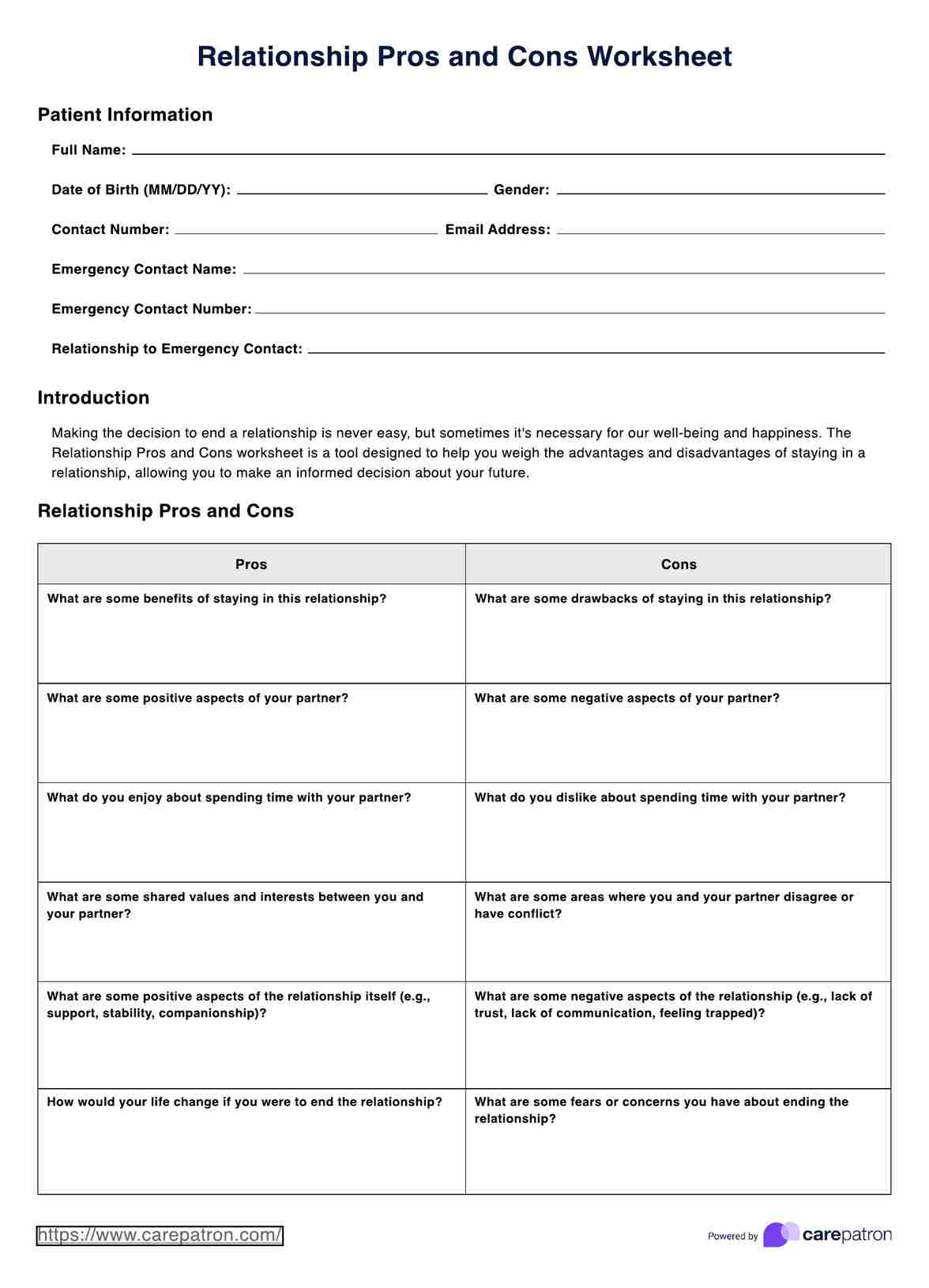
A Relationship Pros and Cons Worksheet is a structured tool that helps clients reflect on the strengths and challenges within their relationships. It invites them to look at both the positive and negative sides by side, so they can make choices that align with their emotional well-being and long-term goals.
For healthcare professionals, especially therapists and counselors, this worksheet serves as a practical aid in guiding conversations about relationship patterns, decision-making, and self-awareness. It’s useful for clients who feel uncertain about whether to continue, adjust, or end a relationship—whether that’s romantic, familial, or platonic.
Using this worksheet encourages mindful reflection rather than impulsive decision-making. It helps clients gain perspective, reduces emotional overwhelm, and supports more balanced thinking. Writing things down can make complex feelings more concrete and easier to talk through during sessions. While this worksheet offers valuable insight, it should not replace professional judgment or deeper therapeutic work. Clients may still need ongoing support to unpack emotional patterns or trauma that influence their relationships. It’s most effective when paired with open discussion and guided exploration from a clinician.
Mental health professionals, relationship coaches, and social workers can use this worksheet with clients navigating major life or relationship transitions. It’s also beneficial in CBT or DBT settings where identifying thought patterns around attachment, communication, and self-worth is part of treatment.
## **How does this Relationship Pros and Cons Worksheet work?**
Relationships can be deeply fulfilling, but they can also be complicated. When emotions run high, it’s easy for clients to lose perspective or feel stuck between conflicting thoughts. A structured reflection tool like Carepatron’s Relationship Pros and Cons Worksheet helps them slow down, sort through their feelings, and see both the positives and challenges of a relationship side by side.
### **Step 1: Introduction**
Introduce the worksheet to the client by explaining that it is a tool designed to help them weigh the pros and cons of their relationship. Encourage them to use the worksheet to explore their thoughts and feelings about their relationship.
### **Step 2: Identify the current relationship**
Have the client write down the name of the relationship they are considering on the worksheet. This could be a romantic partner, best friend, family member, or work colleague.
### **Step 3: List the pros**
Have the [client list](https://www.carepatron.com/templates/client-list) all the positive aspects of the relationship under the "Pros" column. Encourage them to think about what they appreciate about the other person, what makes the relationship valuable, and what brings them joy.
### **Step 4: List the cons**
Have the client list all the negative aspects of the relationship under the "Cons" column. Encourage them to spend time together to think about what they find challenging about the other person, what causes stress or conflict in the relationship, and what they would like to change.
### **Step 5: Rate the importance**
Have the client rate the importance of each pro and con on a scale of 1-5, with 5 being the most important. This will help them see which aspects of the relationship are most significant and less critical to them.
### **Step 6: Evaluate the relationship**
Have the client look at the overall balance of pros and cons and consider what it means for the relationship. Ask them to reflect on how the worksheet has helped them gain insight into their relationship and whether it has helped clarify their thoughts and feelings.
### **Step 7: Take action and make informed decisions**
Encourage the client to use the information they have gained from the worksheet to make decisions about their relationship. They can use the worksheet to start a conversation with the other person, seek out professional counseling, or take steps to improve the relationship.
### **Step 8: Revisit the worksheet**
Encourage the client to revisit the worksheet periodically to see if their thoughts and feelings about the relationship have changed. This will help them stay mindful and reflective about their relationship and make any necessary adjustments.
## **Helping clients build healthier, more intentional relationships**
Building a lasting relationship requires more than compatibility; it calls for balance, communication, and a shared commitment to growth. As clients learn to navigate the highs and lows of connection, you can guide them in developing awareness, resilience, and empathy.
### **Encourage balance between connection and personal space**
Relationships flourish when both partners honor their need for personal space alongside shared experiences. Encourage clients to maintain independence through individual hobbies, friendships, and routines that nurture personal development. This balance prevents emotional strain and ensures that each person feels whole outside the relationship. Remind clients that while they may share a deep connection, they remain the only person responsible for their own emotional well-being.
### **Help clients communicate emotional needs clearly**
Many relationship challenges arise when emotional needs go unspoken or misunderstood. Teach clients to express what they need, whether reassurance, time, or emotional support, in a calm, direct way. Healthy communication helps one partner understand the other’s perspective, reducing tension during tough times.
### **Guide couples to identify shared values and goals**
Encouraging clients to discuss their shared values like honesty, respect, or long-term vision can bring clarity and alignment. Ask them to explore how these values shape their decisions in romantic relationships and everyday life. When partners have common interests and a shared sense of purpose, they build a stronger foundation for a lasting relationship that can withstand challenges and transitions.
### **Promote intentional connection and shared experiences**
Relationships are sustained through effort and genuine care. Encourage clients to prioritize sharing life in meaningful ways. These moments help both partners feel valued and remind them why they chose to build a life together. Regularly expressing appreciation and checking in emotionally can make all the difference between feeling distant and feeling deeply connected.
## **More tools to help clients reflect and grow**
Beyond the Relationship Pros and Cons Worksheet, Carepatron offers several other resources that help clients explore patterns of connection, assess relationship health, and strengthen their emotional awareness. These tools can complement your sessions by providing structured reflection exercises that promote healthier communication, clearer boundaries, and stronger self-understanding.
Here are a few related worksheets you can use in practice:
- [Circles of Relationship Worksheet](https://www.carepatron.com/templates/circles-of-relationships-worksheet/) – Helps clients visualize the people in their lives, identify levels of closeness, and clarify where emotional energy is being directed.
- [Healthy Relationships Worksheet](https://www.carepatron.com/nb-NO/templates/healthy-relationships-worksheets) – Guides clients in distinguishing between healthy and unhealthy dynamics, setting boundaries, and understanding what mutual respect looks like.
- [Couple Communication Worksheet](https://www.carepatron.com/templates/couple-communication-worksheet/) – Supports couples in improving dialogue by helping them express thoughts and emotions clearly, listen actively, and respond with empathy during challenging conversations.
## **References**
Abele, A. E., & Yzerbyt, V. (2020). Body posture and interpersonal perception in a dyadic interaction: A big two analysis. European Journal of Social Psychology. https://doi.org/10.1002/ejsp.2711
Bartle-Haring, S., Hu, J., Mion, L., & Ash, M. (2024). The interaction of positive and negative relationship characteristics and their association with relationship and individual health outcomes in older couples. Behavioral Sciences, 14(11), 1017. https://doi.org/10.3390/bs14111017
Giulia Zoppolat, Righetti, F., Đurić, M., Balzarini, R., & Slatcher, R. (2024). It’s complicated: The good and bad of ambivalence in romantic relationships. Emotion. https://doi.org/10.1037/emo0001340