




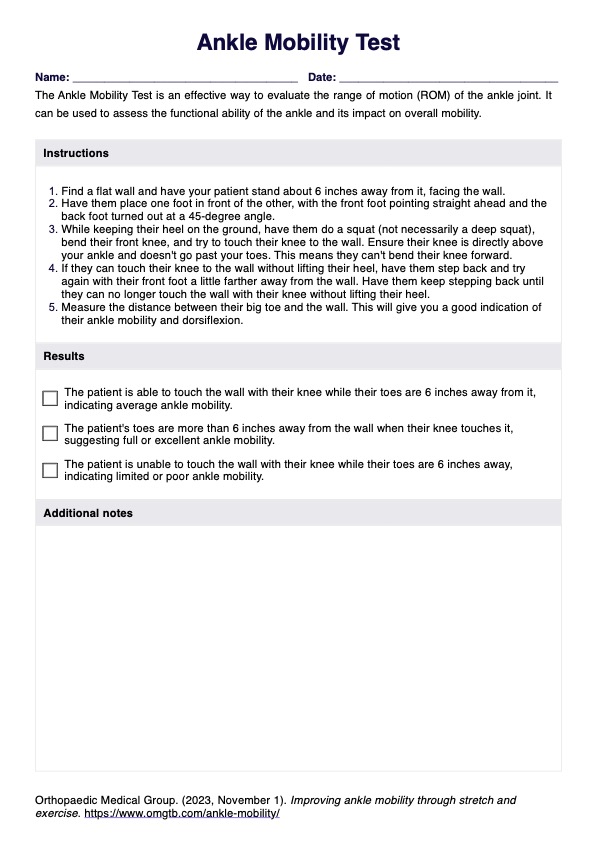



Ankle Mobility Test

## **What is an Ankle Mobility Test?**
The ankle is a critical joint of the body, providing mobility and stability to the lower extremity. Various issues may arise without proper ankle functioning, such as difficulty walking or severe pain.
The Ankle Mobility Test assesses the ankle joint's range of motion and flexibility. It is a quick, easy test that can help provide valuable information about how well the ankle functions. It can also provide insight into whether further assessment or treatment is needed. It's a nifty tool for professionals to identify potential ankle mobility issues in their patients and find ways to restore proper ankle mobility.
Patients are instructed to stand with one foot in front of the other, with the front foot pointed straight ahead and the back foot turned at a 45-degree angle to perform the test. Keeping their heel on the ground, they should try to bend their front knee and touch it to the wall.
The test administrator, usually a physical therapist, ensures the patient's knee is directly above their ankle and not going past their toes. If they can touch the wall without lifting their heel, the patient steps back and try again with the front foot a little farther away from the wall. The distance between the patient's big toe and the wall is then measured and recorded.
The Ankle Mobility Test is similar to the Knee to Wall Test. Both assessments involve the patient bending their knee and attempting to touch the wall. Clinicians can also use the Lower Extremity Functional Scale to assess the ankle's function and condition.
Ankle Mobility Test Template
## **How does this Ankle Mobility Test work?**
This free Ankle Mobility Text provides a comprehensive guide on performing the assessment. Follow these steps to get started with the template:
### **Step 1: Download the test**
Access the Ankle Mobility Test using the link provided on this page. You can also get a copy from the Carepatron app or our handy resources library.
### **Step 2: Provide the patient with a copy**
Hand a copy to your patient. You can give them a printout or a digital copy of the assessment. Explain the test's purpose and answer any questions they may have.
### **Step 3: The patient performs the test**
Using the steps laid out in the Ankle Mobility Test form, ask your patient to do the assessment. Guide them throughout the process and take note of the distance between their big toe and the wall. Here are the steps:
- Find a flat wall and have your patient stand about 6 inches away from it, facing the wall.
- Have them place one foot in front of the other, with the front foot pointing straight ahead and the back foot turned out at a 45-degree angle.
- While keeping their heel on the ground, have them do a squat (not necessarily a deep squat), bend their front knee, and try to touch their knee to the wall. Ensure their knee is directly above your ankle and doesn't go past your toes. This means they can't bend their knee forward.
- If they can touch their knee to the wall without lifting their heel, have them step back and try again with their front foot a little farther away from the wall. Have them keep stepping back until they can no longer touch the wall with their knee without lifting their heel.
- Measure the distance between their big toe and the wall. This will give you a good indication of their ankle mobility and dorsiflexion.
### **Step 4: Assess and analyze**
Evaluate your patient's results and analyze any discrepancies. This will help you decide if further assessment or treatment is necessary. Here are the potential results:
- If their knee can touch the wall while their toes are 6 inches away from it, they have average ankle mobility.
- If the patient's toe is over 6 inches away from the wall, they have great or full mobility in their ankle.
- If they are unable to touch the wall with their knee while their toes are 6 inches away from the wall, they may have limited/poor ankle mobility.
## **When to use this Ankle Mobility Test?**
You can use the Ankle Mobility Test to assess and monitor ankle mobility in various conditions. Medical professionals often use this tool to:
### **Determine the range of motion and flexibility of the ankle joint**
The Ankle Mobility Test can help you evaluate your patient's ability to move their ankle. This assessment can be used to start a treatment plan, track progress over time, or identify any restrictions that may require further intervention.
### **Assess joint function in patients**
Patients with arthritis, tendonitis, or bursitis often benefit from this test. It can help you identify any abnormalities in the joint function that may need to be addressed.
### **Monitor post-operative rehabilitation**
After surgery, you can use this assessment to measure and monitor your patient's progress. The assessment can help you determine if their joint mobility improves during recovery.
### **Assess the effects of an ankle sprain or fracture on mobility**
If your patient has suffered an ankle injury or if they have stiff ankles, the Ankle Mobility Test can help you observe their progress and determine how much mobility they have regained. Having good ankle mobility is important because good mobility helps with absorbing stress and shock whenever we walk, run, or jump. If stress and shock are not absorbed by the ankle, the smaller structures in our legs will feel the shock and stress, which increases the risk of them breaking or becoming inflamed.
## **Who is this printable Ankle Mobility Test PDF for?**
This free Ankle Mobility Test PDF worksheet is suitable for heaps of medical professionals, including:
- Physical therapists
- Occupational therapists
- Chiropractors
- Nurses
- Physicians
- General practitioners
- Sport coaches
- Personal trainers
- Athletic trainers
- Weight-loss counselors
- Nutritionists
It can also be used in various medical settings like hospitals, rehabilitation centers, and private clinics.
## **Benefits of testing Ankle Mobility**
The free Ankle Mobility Test provides numerous benefits for clinicians and patients. Some of the key advantages include the following:
### **Time-saving**
The test is quick and easy to perform, allowing you to assess a patient's ankle function in minutes. This means you can save time and resources while providing an objective assessment.
### **Consistent**
This test can help you accurately and consistently measure ankle mobility. You can track your patient's progress over time and measure improvements.
### **Entirely digital**
The Ankle Mobility Test is available in both paper and digital formats, making it easy to access from anywhere.
### **Comprehensive**
This assessment tool provides a thorough step-by-step guide on how to perform the Ankle Mobility Test. It also includes an example assessment that you can reference if needed.
### **Versatile**
You can use this free test on various settings and for various conditions. Plus, the tests suit most age groups – from children to adults. It can even be used to monitor patient progress to check for any significant difference between results.
These can help professionals determine plans to help with injury prevention, determine the best body weight to prevent ankle mobility issues from arising, and determine the best exercises that result in increased mobility.
Commonly asked questions
The Ankle Mobility Test is designed to assess and monitor ankle mobility in various conditions. Medical professionals often use this tool to determine the ankle joint's range of motion and flexibility.
The Ankle Mobility Test doesn't have a scoring system. Instead, it compares the patient's current range of motion and flexibility to their pre-injury state.
The Ankle Mobility Test measures patients' ability to move their ankle joints in different directions. It can also help identify any restrictions that may require further intervention.










EHR and practice management software
Get started for free
*No credit card required
Free
$0/usd
Unlimited clients
Telehealth
1GB of storage
Client portal text
Automated billing and online payments