
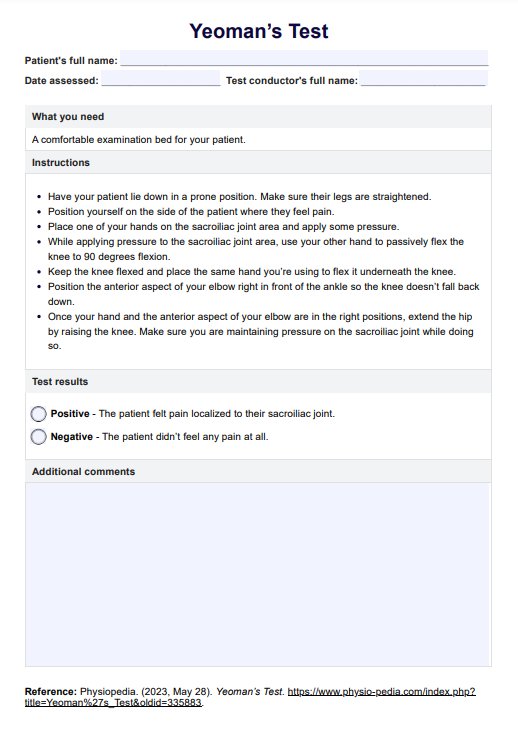




What is the Yeoman's Test?
Before discussing the Yeoman's Test, let's talk about sacroiliitis. Sacroiliitis is an inflammation of the sacroiliac joint characterized by axial pain. This pain can be felt in the lower back or the buttocks. If left unattended for too long, it can develop into a problem where the pain becomes radicular and can affect the patient's groin, one or both legs and even their feet!
If you have a patient who sets up an appointment with you to consult about aches in the body, and they specifically talk to you about lower back pains, it would be prudent to ask them if they feel pain or if their pain is aggravated when doing the following:
- Adjust their positions while in bed, like rolling over
- Sitting up after lying down
- Standing up from a sitting position
- Standing up (especially for extended periods)
- Bearing more weight on one leg
- Walking (especially for extended periods)
- Running (especially for extended periods)
- Taking long strides while either walking or running
- Climbing stairs
If they confirm that they feel pain or if the activities above aggravate their pain, then you should administer the Yeoman's Test to gauge the patient. This test is a physical examination technique designed to determine the possibility of sacroiliitis in a person.
This test is sometimes included in an orthopedic physical assessment of the hip joint as one of several sacroiliac provocation tests. While it's not a diagnostic test, it can aid diagnostic tests by narrowing down potential problems (e.g., sacroiliac joint pain, sacroiliac joint dysfunction, anterior sacroiliac ligament pathology, anterior thigh paresthesia, etc.). This is a valuable test for orthopedists, physical therapists, and similar healthcare professionals.









