## **What is a Public Health Intervention Wheel?**
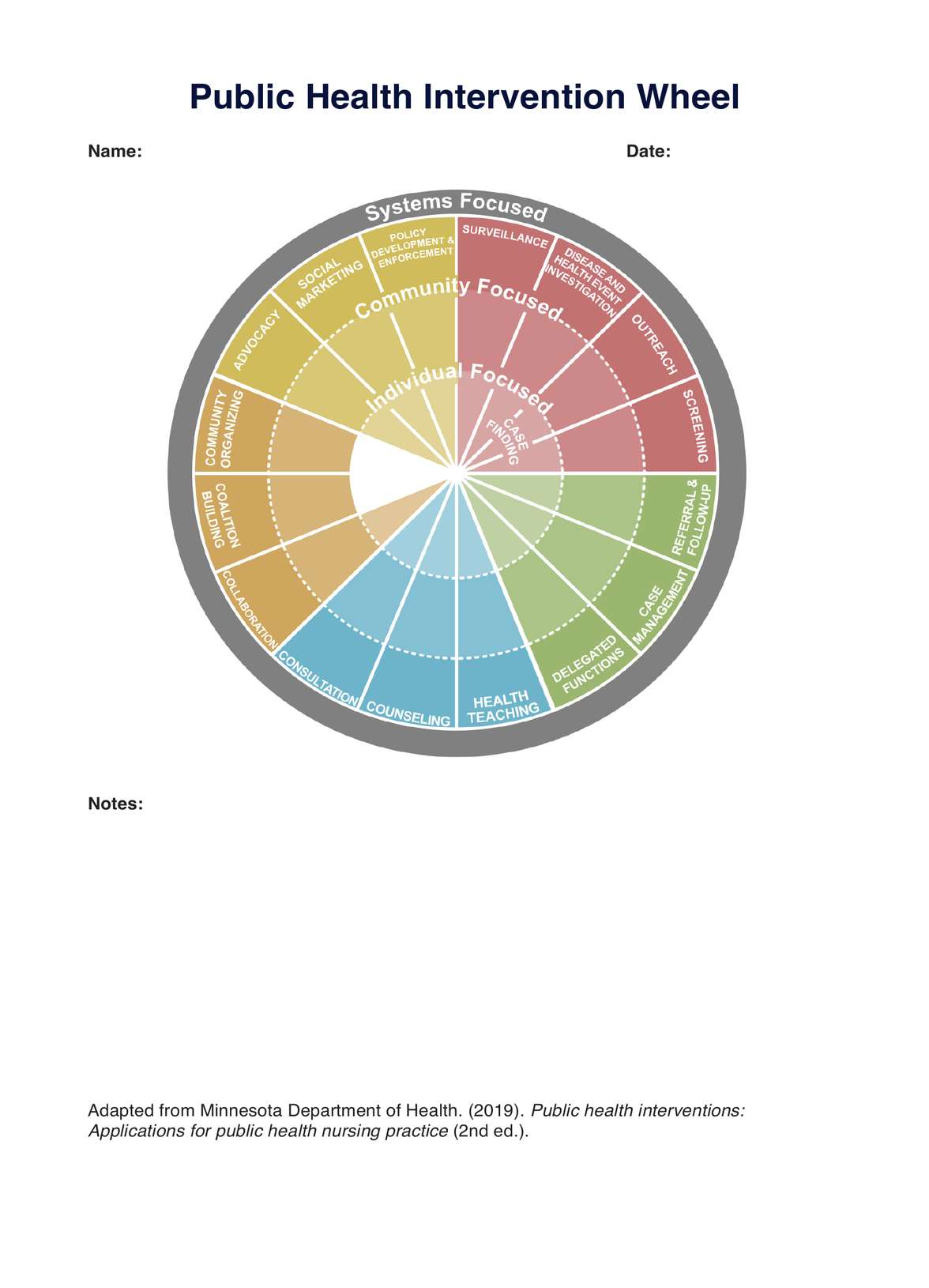
Developed by the Minnesota Department of Health, the Public Health Intervention Wheelvisualizes the various strategies and approaches available to address public health issues.
The Public Health Intervention Wheel identifies 17 public health practitioner interventions at three levels: individual-based, population-based, and systems-based. These interventions form a comprehensive population-based practice model to guide public health professionals in planning and implementing interventions to improve population health (Schaffer & Strohschein, 2004; Schaffer et al., 2021).
The public health intervention model emphasizes collaboration and a multi-faceted approach to public health challenges. Public health professionals can use the wheel to systematically assess, plan, and implement interventions at different levels, ensuring a comprehensive and evidence-based approach. Recent research also highlights how the wheel helps standardize population-based practice and supports consistent planning and documentation across settings (Anderson et al., 2018).
By incorporating various strategies, such as education campaigns, policy changes, and environmental modifications, the wheel enables practitioners to tailor interventions to specific community needs. The Public Health Intervention Wheel ultimately serves as a practical guide for promoting health and preventing diseases within populations, reflecting a holistic and dynamic perspective on public health practice.
## **What does the Public Health Intervention Wheel contain?**
The public health wheel is divided into 16 wedges, with only the 17th intervention (case finding) in the inner circle.
The outermost circles, systems and community-focused, encompass 16 of the 17 interventions, while the innermost circle, individual-focused, encompasses 15 of the 17 interventions.
Additionally, two interventions are not shown in the inner circle. These are “coalition-building” and “community organizing”, as these interventions can not be implemented at the individual level.
As well as the levels of focus, the interventions are divided by color into similar interventions. These are:
- **Red** - surveillance, disease and other health investigation, outreach, screening, case finding
- **Green**- referral and follow-up, case management, delegated functions
- **Blue**- health teaching, consultation, counseling
- **Orange**- collaboration, coalition building, community organizing
- **Yellow**- advocacy, social marketing, and policy development and enforcement
## **When would you use this template?**
Our Public Health Intervention Wheel template can be used by public health practitioners, including epidemiologists, health educators, policymakers, community organizers, and healthcare providers.
Epidemiologists may use it to design and implement strategies for controlling disease outbreaks, while health educators can employ it to develop targeted health promotion campaigns. Policymakers may find the wheel helpful in crafting evidence-based policies, and community organizers can utilize it to mobilize and engage communities in health initiatives. Healthcare providers may integrate it into clinical practice to enhance preventive care.
The versatility of the Public Health Intervention Wheel makes it applicable across various disciplines within the public health sector, fostering collaboration and ensuring a comprehensive approach to address communities' complex challenges. Its utility spans from local health departments to international organizations, serving as a guide for practitioners committed to improving population health outcomes.
## **What are the benefits of our template?**
Beyond being a visual reference, this tool helps align your interventions with established public health standards, ensuring you deliver high-quality care that is both consistent and effective. Here are some ways this template can directly benefit your work:
### **Enhances clinical and community planning**
The template gives you a structured way to plan interventions at the individual, community, and systems levels. This makes it easier to prioritize actions, allocate resources, and design programs that target the most pressing health needs.
### **Supports interdisciplinary collaboration**
By providing a shared framework, the wheel helps you communicate more effectively with colleagues across disciplines. Whether you’re working with epidemiologists, policymakers, or community organizers, it ensures everyone is aligned on goals and strategies.
### **Improves documentation and evaluation**
The template allows you to document interventions clearly and consistently. This makes it easier to evaluate outcomes, demonstrate impact, and report progress to stakeholders such as health departments or funding bodies.
### **Streamlines patient and stakeholder education**
The full-color, accessible format makes it a practical teaching tool for patients, staff, and community partners. It helps explain complex public health concepts in a way that is easy to understand, which can increase buy-in and support for initiatives.
### **Keeps your practice up to date**
This resource is based on the most recent version of the intervention wheel, ensuring that your work reflects the latest evidence and practice standards in public health nursing.
In addition to the template itself, using the Carepatron platform provides further benefits to your practice, including automated SMS reminders for clients, a customizable calendar, secure storage, billing and payment processing features, and an AI scribe to save time on clinical note-taking. Click the "Use template" button to try it.
### **References**
Anderson, L. J. W., Schaffer, M. A., Hiltz, C., O'Leary, S. A., Luehr, R. E., & Yoney, E. L. (2018). Public health interventions: School nurse practice stories. The Journal of School Nursing, 34(3), 192-202. https://doi.org/10.1177/1059840517721951
Schaffer, M., & Strohschein, S. (2004). Public health interventions: Applications for public health nursing practice (Second edition).
Schaffer, M., Strohschein, S., & Glavin, K. (2021). Twenty years with the public health intervention wheel: Evidence for practice. Public Health Nursing, 39, 195–201. https://doi.org/10.1111/phn.12941