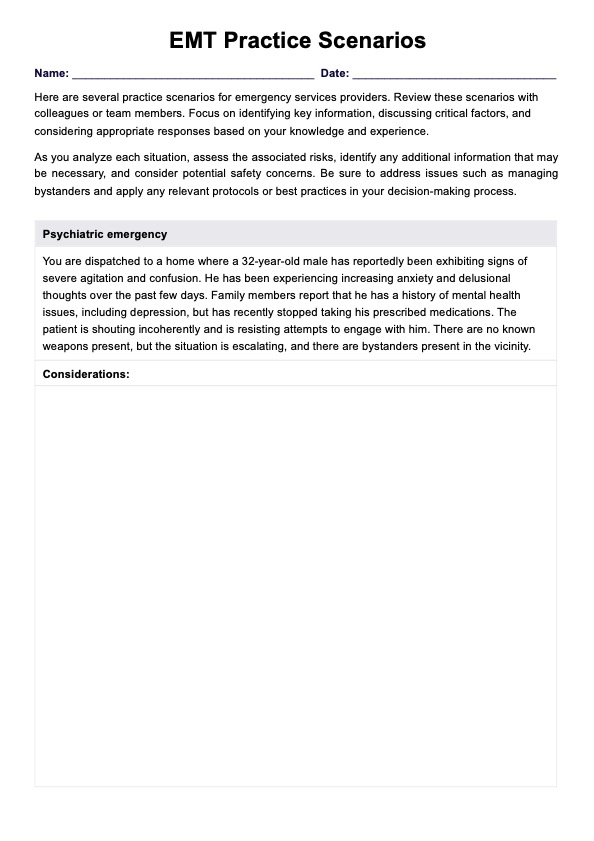
Practice scenario examples for EMT professionals
EMT professionals must be prepared to respond effectively to various medical and trauma-related situations. These exercises allow EMTs to simulate and respond to various emergencies, enhancing their ability to assess, treat, and manage patients under pressure. Here are both the cardiac and psychiatric emergencies included within this template:
Cardiac emergency
You are dispatched to a 55-year-old male who is experiencing severe chest pain, shortness of breath, and dizziness while at his home. The patient reports that the chest pain first began approximately 30 minutes ago while he was mowing the lawn. He describes the pain as a heavy pressure in the center of his chest, radiating to his left arm and jaw. He is sweating profusely and appears to be in significant distress. He has a history of hypertension and high cholesterol and takes medication for both. The patient is conscious but anxious and is requesting medical help.
Key aspects that EMTs might consider for completing this scenario are:
- Administering oxygen to the patient
- Monitoring vital signs
- Preparing for advanced interventions
- Transport to a facility equipped to manage cardiac emergencies
Psychiatric emergency
You are dispatched to a home where a 32-year-old male has reportedly been exhibiting signs of severe agitation and confusion. He has been experiencing increasing anxiety and delusional thoughts over the past few days. Family members report that he has a history of mental health issues, including depression, but has recently stopped taking his prescribed medications. The patient is shouting incoherently and is resisting attempts to engage with him. There are no known weapons present, but the situation is escalating, and there are bystanders present in the scene and vicinity.
Key aspects that EMTs might consider for completing this scenario are:
- Communication
- De-escalation
- Preparing for advanced interventions
- Managing bystanders
The scenarios included within this template cover a broad spectrum of situations, including trauma, medical emergencies, and specialized care. This ensures that EMTs are well-equipped to handle various calls they may encounter in the field. Each scenario requires careful assessment, prioritization of assessment, and intervention and is intended to challenge the ability to apply EMS protocols in real-world situations.