How does this Neuro Check Form work?
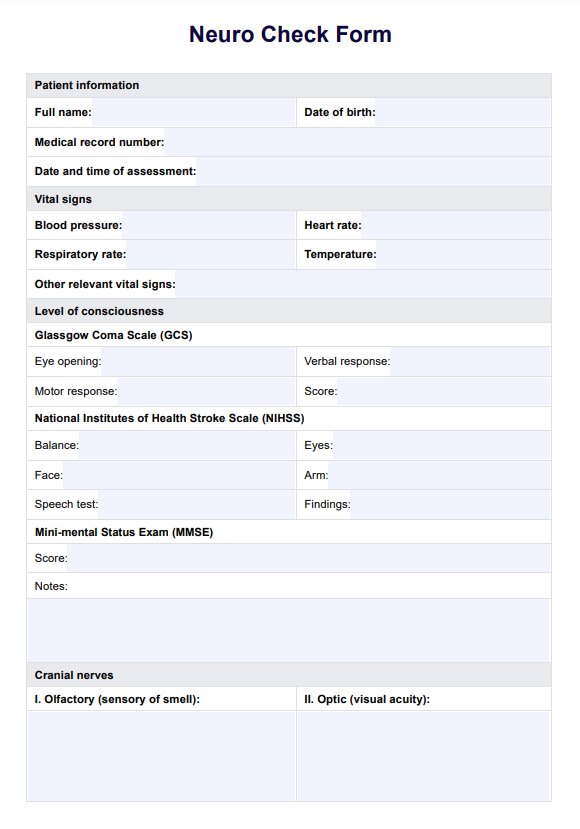
After obtaining a copy of our free printable neuro check sheet, here are the steps you can take to make the most out of the template when conducting a neuro check:
Access the Neuro Check Form template
Click on "Use template" to access and customize this form within the Carepatron platform, or click "Download" for a fillable PDF copy.
Patient information
Collect essential patient details such as name, date of birth, medical record number, and the date/time of assessment to ensure accurate identification and documentation.
Vital signs
Record the patient's vital signs, including blood pressure, heart rate, respiratory rate, and temperature, providing a baseline understanding of their physiological status.
Level of consciousness
Utilize the Glasgow Coma Scale (GCS) to assess the patient's responsiveness, including eye-opening, verbal, and motor responses. The cumulative score provides an objective measure of consciousness. Also, use the National Institutes of Health Stroke Scale (NIHSS) to assess stroke severity and neurological functioning when applicable.
Mental status
Evaluate the patient's mental clarity, orientation to person, place, and time, and responses to verbal and painful stimuli, offering insights into their cognitive functioning.
Motor function
Assess muscle strength in both upper and lower extremities using a standardized scale. Conduct coordination exams, such as rapid alternating movements and the finger-to-nose test, to evaluate fine motor skills.
Sensory examination
Test the patient's bilateral response to light touch and painful stimuli, providing information about their sensory perception and responsiveness.
Cranial nerve assessment
Systematically evaluate each cranial nerve, from cranial nerve I, cranial nerve II, cranial nerve III, all the way to cranial nerve XII, checking for normal functioning in smells, visual acuity, eye movements, facial expressions, hearing, and balance.
Reflexes
Assess deep tendon reflexes using a standardized scale, including the biceps, triceps, brachioradialis, patellar, and Achilles reflexes. Evaluate the plantar reflex for signs of neurological integrity.
Other observations
Document pupillary responses, checking for size, equality, and reactivity to light. Note any abnormal movements, posturing, or signs of focal cortical functioning.
Next steps
Once you have completed the printable Neuro Check Form, several crucial next steps are essential to ensure comprehensive patient care and appropriate management. These next steps include analyzing the results, planning or initiating appropriate interventions, monitoring patients, and continuously evaluating the patient's response to treatment so that adjustments may be made if needed.