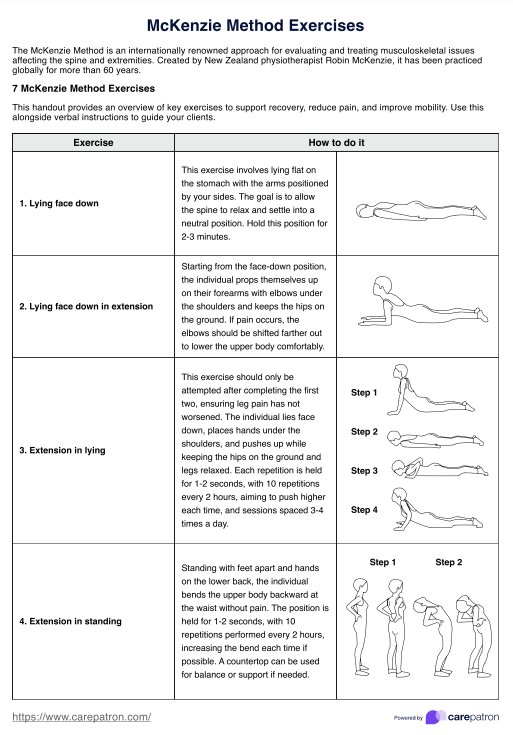
Looking for exercises to teach clients or guide them through rehabilitation for their back and neck pain? Read our guide to learn about the McKenzie Method and the various exercises that use it, then use our handout to practice it yourself until you can teach it to your clients. Feel free to hand it to your clients so they can practice at home too!
## **What is the McKenzie Method?**
The McKenzie Method, also known as Mechanical Diagnosis and Therapy (MDT), is a widely recognized system of physical therapy developed by New Zealand physiotherapist Robin McKenzie. According to the McKenzie Institute International (n.d.), the method is used to assess and treat various musculoskeletal conditions, with a particular focus on the spine and extremities. It is particularly effective for addressing extremity pain, but specifically, neck pain and chronic lower back pain, especially mechanical spinal pain caused by poor posture or repetitive stress, like postural syndrome.
A key component of the McKenzie Method is its emphasis on repeated movements and exercises that help patients achieve significant pain relief. Through these targeted movements, patients can experience pain and disability reduction, leading to lasting relief from chronic low back pain and other issues.
## **Limitations of the McKenzie Method**
The McKenzie Method, also known as Mechanical Diagnosis and Therapy (MDT), has several recognized limitations despite its widespread use. A primary concern is its limited applicability; it's generally contraindicated for serious pathologies like spinal tumors, infections, recent acute trauma, or severe spinal cord/nerve compression syndromes like cauda equina, necessitating a thorough initial medical screening (Ullrich, 2025).
In trials comparing patients undergoing the McKenzie Method with a manual therapy group, participants reported experiencing better short-term relief with manual therapy (Mann et al., 2020).
Furthermore, the evidence base is sometimes inconsistent or of moderate quality, with some systematic reviews concluding MDT is not significantly superior to other rehabilitation interventions for acute low back pain or that the reported benefits may not be clinically significant (Lam et al., 2018).
## **McKenzie Method Exercises**
There are several McKenzie Method Exercises, but here are the common ones designed to relieve lower back pain and improve mobility (Nunez, 2019; Physiopedia, n.d.; Ullrich, 2024):
### **Lying face down**
The individual lies flat on their stomach with arms by their sides to relax the spine and settle into a neutral position. This position is held for 2-3 minutes and can be repeated up to 8 times a day as recommended by a healthcare provider.
The benefit is allowing the lumbar spine to passively relax into a neutral or slightly extended position, which can immediately unload pressure on irritated spinal structures.
### **Lying face down in extension**
In this variation, the individual supports their upper body on their forearms while keeping the hips grounded. If pain arises, adjusting the elbow position can help lower the body to a more comfortable level.
The benefit is gently encouraging the disc material to move back toward its normal position, which may reduce nerve root compression, assuming extension is the patient's directional preference.
### **Extension exercises**
Extension exercises aim to improve spinal extension and mobility, strengthening the muscles along the back while alleviating tension. For example, after conducting the first two lying face-down exercises, an extension in lying and standing is usually followed.
These repetitive, active movements aim to promote centralization, meaning radiating pain moves from the extremities back toward the spine's midline, which is a positive prognostic sign (May & Rosedale, 2019).
### **Flexion exercises**
Flexion exercises focus on promoting spinal flexion and stretching the back muscles, which can enhance flexibility and relieve tightness. They are beneficial for individuals with back pain related to stiffness or muscle tension. Exercises include flexion in lying, sitting, and standing.
For more detailed instructions on performing these exercises, please refer to the handout, which includes helpful illustrations.
## **Goals of the McKenzie Method Exercises**
The primary goal of the McKenzie Method is to empower patients to manage and alleviate their pain independently through patient education and prescribed exercises. By working closely with a physical therapist, individuals can address a variety of conditions, such as neck pain, back pain, forward head posture, and dysfunction syndrome. One key focus of the McKenzie Method is to reduce a patient's symptoms through repeated movements and positions that help restore function and mobility.
The McKenzie Method empowers patients to self-manage their conditions with minimal or no reliance on medication, surgery, or passive treatments. By emphasizing patient education, it encourages individuals to take charge of their rehabilitation and manage flare-ups using straightforward techniques, such as deep breathing and adhering to prescribed exercises.
## **How to use the McKenzie Method Exercises handout**
The McKenzie Method Exercises handout outlines specific exercises and serves as a quick reference for both healthcare providers and patients. Here's how to effectively use the handout:
### **Step 1: Access the handout**
This guide includes the McKenzie Method Exercises handout. It provides a comprehensive template for healthcare professionals to outline prescribed exercises and instructions. This ensures that both the provider and patient have clear guidance on the recommended self-treatment techniques.
### **Step 2: Introduce the handout to the patient**
After an initial assessment and physical examination, when introducing the handout, explain to the patient how the McKenzie Method works. Clearly outline how these exercises can help alleviate their pain and improve their overall condition, ensuring they feel confident and motivated to engage with the exercises provided.
### **Step 3: Provide patient education**
Along with the handout, educate the patient on the importance of following the prescribed exercises correctly. Discuss how each exercise targets specific symptoms like lower back or leg pain and how regular practice can lead to significant improvements. Patient education ensures they understand the purpose of each exercise.
### **Step 4: Discuss next steps**
After introducing the handout and educating the patient, discuss the next steps. Schedule follow-up appointments to monitor progress and adjust the exercises as needed based on their response. Encourage the patient to communicate any changes in symptoms as they perform the McKenzie Method Exercises.
## **Tips for doing the McKenzie Method Exercises effectively**
To maximize the effectiveness of McKenzie exercises and ensure safe practice, healthcare professionals should guide patients with the following detailed tips:
### **Ensure supervised initiation**
Patients should begin McKenzie therapy under the supervision of a certified physical therapist trained in Mechanical Diagnosis and Therapy (MDT). This approach ensures exercises are tailored to individual conditions and performed correctly, enhancing effectiveness and minimizing injury risks.
### **Monitor patient response**
Encourage patients to pay close attention to their body's response to each exercise. Advise them to discontinue the exercise and consult with their therapist if they experience an increase in pain, especially if it radiates further from the spine. The objective is to achieve pain centralization, where pain moves closer to the spine and diminishes in intensity.
### **Emphasize consistency**
Stress the importance of regularly practicing McKenzie exercises as prescribed. Help patients set a routine schedule for performing these exercises to maintain consistency. Improvements are often observed with steady, continual practice.
## **Additional resources**
Looking for more exercises that can either help or motivate your patient to move their body? Here are free physical or occupational therapy resources you can access and download:
- **[Exercise Worksheet](https://www.carepatron.com/templates/exercise-worksheet/#template-pdf-preview)**: An Exercise Worksheet can be used to help your clients reflect on their fitness routines.
- **[Home Exercise Program](https://www.carepatron.com/templates/home-exercise-program-pdf/#app-chapter-two)**: The Home Exercise Program PDF allows healthcare professionals to easily create personalized patient exercise plans.
- **[Workout Planner](https://www.carepatron.com/templates/workout-planner/#template-pdf-preview)**: A well-designed Workout Planner template ensures effective fitness planning. It starts with patient information to personalize the plan, including key details like weight, height, and fitness goals.
- **[Physical Therapy Exercises List](https://www.carepatron.com/templates/physical-therapy-exercises-list/#app-chapter-one)**: Design a PT session tailored for your client with the help of a Physical Therapy Exercises List
## **References**
Lam, O. T., Strenger, D. M., Chan-Fee, M., Pham, P. T., Preuss, R. A., & Robbins, S. M. (2018). Effectiveness of the McKenzie method of mechanical diagnosis and therapy for treating low back pain: Literature review with meta-analysis. The Journal of Orthopaedic and Sports Physical Therapy, 48(6), 476–490. https://doi.org/10.2519/jospt.2018.7562
Mann, S. J., Lam, J. C., & Singh, P. (2020). McKenzie back exercises. PubMed; StatPearls Publishing. https://www.ncbi.nlm.nih.gov/books/NBK539720/
May, S., & Rosedale, R. (2019). An international survey of the comprehensiveness of the McKenzie classification system and the proportions of classifications and directional preferences in patients with spinal pain. Musculoskeletal Science and Practice, 39, 10–15. https://doi.org/10.1016/j.msksp.2018.06.006
Nunez, K. (2019, May 23). McKenzie exercises for back pain. Healthline. https://www.healthline.com/health/mckenzie-exercises#standing-flexion
Physiopedia. (n.d.). McKenzie method. https://www.physio-pedia.com/Mckenzie_Method
The McKenzie Institute International. (n.d.). What is the McKenzie method? https://mckenzieinstitute.org/patients/what-is-the-mckenzie-method/
Ullrich, N. (2024, February 13). 7 McKenzie method exercises for back pain and sciatica. Spine-Health. https://www.spine-health.com/wellness/exercise/7-mckenzie-method-exercises-back-pain-and-sciatica
Ullrich, N. (2025, November 3). When to avoid McKenzie method exercises: 5 potential risks. Spine-Health. https://www.spine-health.com/blog/when-avoid-mckenzie-method-exercises-5-potential-risks
Commonly asked questions
Yes, McKenzie's exercises have been widely proven to be effective, particularly for individuals with mechanical spinal pain like chronic lower back pain or neck pain. The exercises focus on self-management and can provide significant pain relief by improving spinal mobility and posture.
To perform the McKenzie method, follow prescribed exercises that target specific areas of the spine, such as lying face down or extending the spine. Each exercise should be repeated several times throughout the day for optimal results, following the guidance of a trained physical therapist.
McKenzie exercises should be avoided if the patient experiences severe or worsening pain or if there's an underlying condition like a spinal fracture. Always consult a healthcare professional before starting if there are concerns about injury or if symptoms don't improve.