









What is a modifier in medical billing?
In medical billing, a modifier is a two-character code attached to a procedure code. It clarifies how a service was performed differently from its standard description. These codes are crucial for accurate reimbursement by providing additional details to insurance payers.
Here's what modifiers can tell us:
- Location: Modifiers pinpoint the exact location for procedures performed on unspecified body parts (e.g., left knee vs. right knee).
- Frequency: Modifiers indicate if a service was performed multiple times on the same day (e.g., treating both legs).
- Provider involvement: They clarify if multiple doctors were involved, or the procedure was performed alongside another service.
- Complexity: Modifiers signal if a procedure is significantly more straightforward or complex than usual, impacting reimbursement rates.
- Special circumstances: These codes account for situations requiring additional time, supplies, or modifications due to the patient's condition.
Furthermore, accurate modifier use directly affects how much a healthcare provider is reimbursed. Incorrect modifiers can lead to underpayment, overpayment, or even claim denials. Therefore, providers and medical coders must stay updated on proper modifier usage according to the American Medical Association (AMA) and the Centers for Medicare & Medicaid services (CMS) guidelines.
CPT modifiers
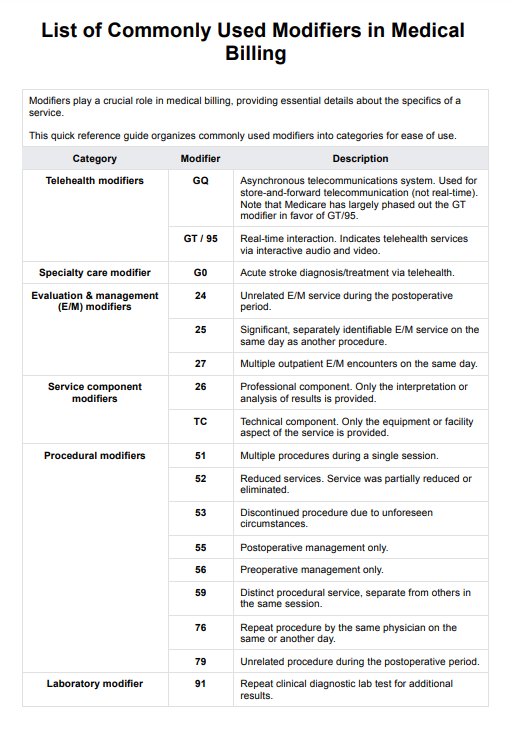
CPT modifiers provide extra information about a medical procedure or service. They are two digits long and are added to current procedural terminology (CPT) codes. Modifiers help explain certain circumstances surrounding the service provided.
For example, if it was performed by a different provider, if multiple procedures were performed, or if the service was altered somehow. They can impact reimbursement, ensure accurate billing, and provide necessary context for the procedures documented.
In medical coding, there are several modifiers used to convey specific circumstances. Understanding and applying these modifiers correctly for accurate billing and documentation in healthcare settings is essential. By doing so, medical professionals can ensure that they provide precise and detailed information.
HCPCS level II modifiers
Like CPT modifiers, HCPCS Level II modifiers are coded healthcare providers use to provide extra information about a medical service or procedure. However, these codes are focused on helping to standardize the billing process. Modifiers are two-character codes that providers add to the regular service or procedure code. They help identify specific circumstances that may affect reimbursement or give additional details about the service. They can indicate things like:
- Bilateral procedures.
- Multiple procedures are performed in the same session.
- The professional or technical component of a service.
- Services are provided in different locations.
- Services provided under unusual circumstances.
- Services provided by different providers.
These modifiers help ensure accurate billing and reimbursement and provide additional service information. They are essential for preventing billing errors and ensuring that healthcare providers are reimbursed appropriately.









