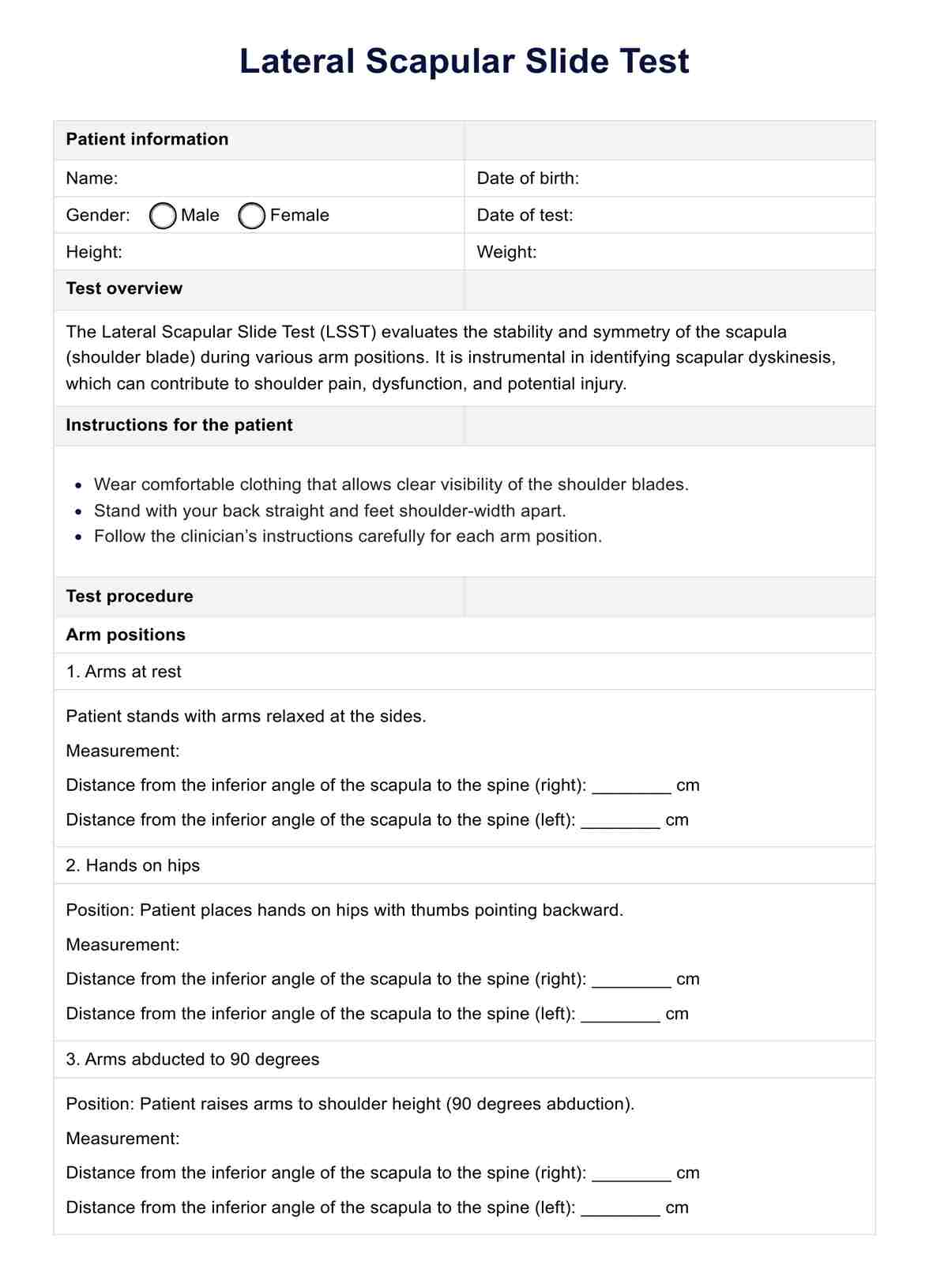
How to perform the Lateral Scapular Slide Test
Follow these steps to perform the Lateral Scapular Slide Test accurately. First, download or print our PDF template for easy documentation.
Step 1: Download and prepare the template
Download or print our PDF file of the Lateral Scapular Slide Test template. This template will help you accurately document patient information, measurements, and interpretations throughout the test.
Step 2: Prepare the patient
Ensure the patient wears comfortable clothing that allows clear visibility of the shoulder blades. Have the patient stand with their back straight and feet shoulder-width apart. Proper preparation is crucial for obtaining accurate measurements and ensuring the patient's comfort throughout the test.
Step 3: Arms at rest
Instruct the patient to stand with their arms relaxed at their sides. Measure the distance from the scapula's inferior angle to the spine's horizontal plane on both the right and left sides. Record these measurements on the template. This initial measurement provides a baseline for comparing the scapula's position with other arm positions.
Step 4: Hands on hips
Ask the patient to place their hands on their hips with their thumbs pointing backward. Measure the distance from the inferior angle of the scapula to the spine on both sides again. Document these measurements on the template. This test position helps assess any changes to determine scapular position with minimal arm movement.
Step 5: Arms abducted to 90 degrees
Instruct the patient to raise their arms to shoulder height, achieving approximately 90 degrees of shoulder abduction, full shoulder internal rotation, and full radioulnar supination. Measure the distance from the inferior angle of the scapula to the spine on both the right and left sides to determine the scapular position. Record these measurements on the template. This position evaluates scapular stability and symmetry during more significant arm movement.
Step 6: Record measurements
Use our Lateral Scapular Slide Test template to document each arm position's measurements accurately. The template ensures that all necessary fields for patient information, measurements, and interpretations of test position are included, promoting organized and reliable record-keeping.
Step 7: Interpret the results for scapular position asymmetry
Evaluate the recorded measurements to determine whether the scapulae are symmetrical or asymmetrical. Symmetrical findings, where differences in measurements between sides are within 1-1.5 cm, suggest normal scapular positioning and stability. Asymmetrical findings, with differences greater than 1.5 cm, may indicate scapular dyskinesis, which can be associated with shoulder pain or dysfunction.
Step 8: Provide recommendations
Based on the test results, provide appropriate recommendations. For symmetrical findings, advise the patient to continue with regular shoulder exercises and monitor for any future changes or symptoms. For asymmetrical findings, refer the patient for physical therapy targeting scapular stabilization and strengthening. Consider additional diagnostic tests or specialist referrals for significant asymmetry or persistent pain.