





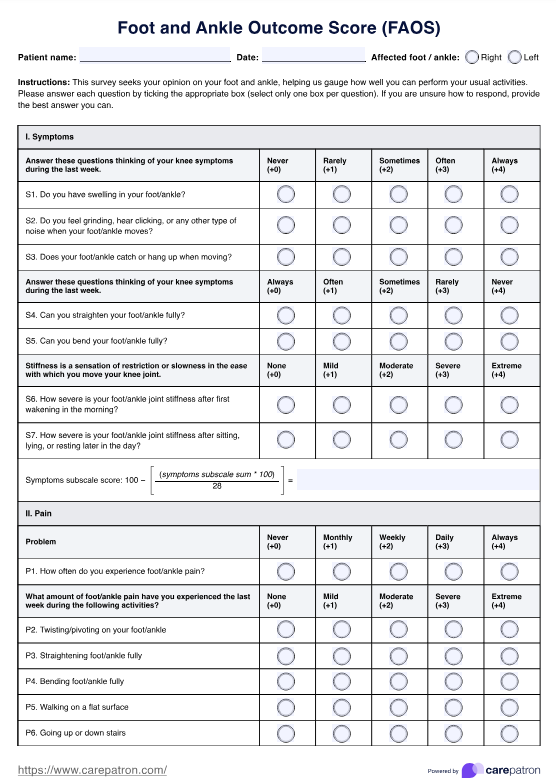




What is the Foot and Ankle Outcome Score (FAOS)?
The Foot and Ankle Outcome Score (FAOS) is a detailed, patient-reported outcome measure designed to evaluate the condition and functionality of the foot and ankle. It assesses various aspects of foot and ankle health, helping healthcare providers gauge the impact of foot and ankle disorders on a patient's quality of life. Commonly used in clinical settings and research, the FAOS is invaluable for tracking patients' progress undergoing treatments like ankle ligament reconstruction or recovering from foot and ankle conditions.
The FAOS consists of five subscales:
- Pain
- Other symptoms (such as swelling or stiffness)
- Activities of daily living (ADL)
- Sports and recreational activities
- Quality of life related to foot and ankle health
Each subscale offers insights into different facets of foot and ankle health, providing a comprehensive overview of the patient's condition and how it affects their daily life and mobility.
How is it scored?
Similar to the knee injury and osteoarthritis outcome score (KOOS), scoring the FAOS involves evaluating responses on a Likert scale from 0 to 4, where 0 indicates no problems, and 4 represents extreme issues. The scores for each item within a subscale are summed up and then normalized to a 0-100 scale, with 100 indicating no disability and 0 representing maximum disability. This scoring method allows for a nuanced understanding of a patient's foot and ankle function, helping to tailor treatments and track recovery progress effectively.
Next steps after using this score
Upon obtaining the FAOS scores, health professionals can:
- Compare the scores to baseline or previous results to assess progress or deterioration.
- Use the data to modify ongoing treatment plans or rehabilitation exercises.
- Discuss the results with patients to help them understand their condition and the effectiveness of their treatment.









