## **What is an Echo Stress Test?**
An Echo Stress Test, or a stress echocardiogram, is a non-invasive procedure to assess the heart's function and blood flow under stress conditions (Kosaraju et al., 2021). It involves performing an echocardiogram (ultrasound of the heart) before and after exercise to evaluate how the heart responds to increased workload.
There is no single official standardized Echo Stress Test protocol universally applied, but the procedure is commonly conducted in a standardized manner involving either physical exercise or pharmacologic stress, depending on the patient's ability to exercise. Stress echocardiography is often used to identify reduced blood flow through the coronary arteries during increased stress.
Two main types of stress echocardiograms exist:
- **Exercise stress echocardiogram**: The patient exercises on a treadmill or bicycle to increase heart rate and stress the heart. Echocardiogram images are taken at rest, immediately after peak exercise, and sometimes during recovery. This test evaluates how well the heart muscle and valves function under stress. A blood pressure cuff is used during the test to monitor vital signs.
- **Dobutamine stress echocardiogram**: For patients unable to exercise sufficiently, a medication called dobutamine is given intravenously to stimulate the heart to beat faster and harder, mimicking exercise effects. Echocardiogram images are taken throughout to assess heart function under stress. This method helps evaluate cardiac output and ejection fraction, particularly in those with suspected diastolic dysfunction or systolic dysfunction.
Patients typically prepare for an Echo Stress Test by wearing comfortable clothing and avoiding certain medications that may interfere with the results. During the test, the patient is connected to an electrocardiogram (ECG) machine to monitor their heart rhythm and blood pressure. They will walk on a treadmill or pedal an exercise bike while the healthcare provider conducts the echocardiogram. Ultrasound imaging and sound waves are used to capture heart pictures through an ultrasound wand, often placed on the left side of the chest.
The procedure takes about 30 minutes to an hour, including the resting echocardiogram and the exercise portion. After the test, patients are often advised to resume their normal activities. The stress test is influenced by the patient’s age and fitness level and may reveal abnormalities in the left ventricle or aortic root.
Healthcare professionals perform this examination to assess for coronary artery disease, heart valve problems, and other cardiac conditions, mainly when there are concerns about chest pain, shortness of breath, or abnormal heart rhythms. The test can also help monitor the effectiveness of treatments for existing heart conditions, such as pulmonary hypertension or systolic function decline.
## **How does it work?**
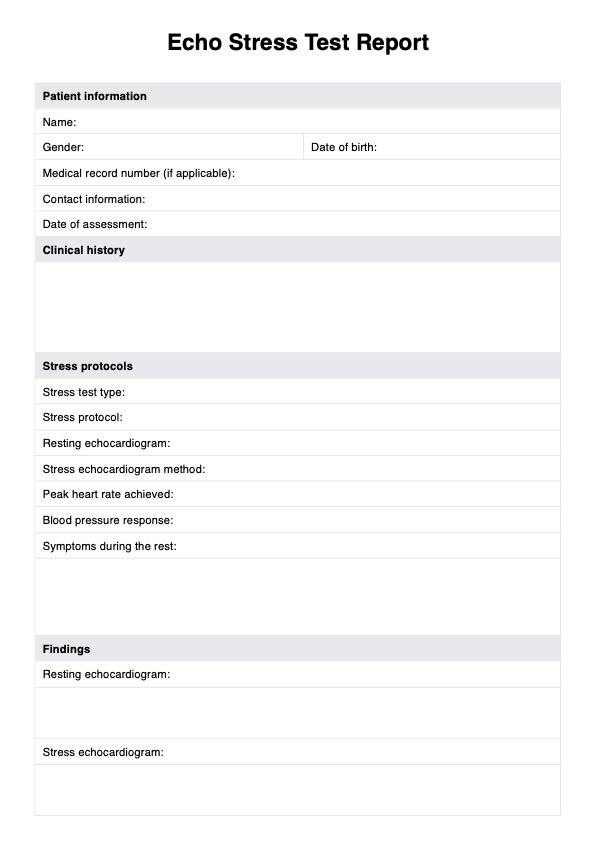
Our printable Echo Stress Test Report helps you document your patient's results with ease. Follow these steps to get started:
### **Step 1: Get a copy of the template**
Access the free Echo Stress Test Report template using the download link on this page. You may also get a copy from the Carepatron app or our resources library.
### **Step 2: Document patient details**
Enter the patient's personal information, including name, date of birth, and medical history, into the designated fields. This will ensure the report is accurately linked to their electronic health records.
### **Step 3: Record test information and add images**
Input the date of the test, as well as any necessary medications or diagnostic tools used during the procedure. Also, append any relevant images from the Echo Stress Test, such as echocardiogram results or other relevant scans.
### **Step 4: Interpret results**
Interpret the test results and provide a summary of the findings. This may include noting any abnormalities or changes from previous tests, as well as any relevant clinical observations.
### **Step 5: Share findings with your patient**
Discuss the results with your patient and provide them with a copy of the report for their records. You can also use the report to create a treatment plan or make necessary adjustments to their care.
## **When would you use this template?**
You can use our Echo Stress Test Report template to document the results of your patients' Echo Stress Tests. This report benefits patients with suspected heart conditions or those undergoing cardiac rehabilitation, as it provides a detailed overview of their heart function and overall cardiovascular health. Additionally, you can use this template to:
### **Track changes in your patient's heart health over time**
Our Echo Stress Test Report template allows you to document previous test results and compare them with current findings. This lets you monitor changes in your patient's heart function, including ejection fraction and left ventricle performance, making it easier to identify potential issues and develop an appropriate treatment plan.
### **Share information with other medical professionals**
The Echo Stress Test Report is designed to be easily shared with other medical professionals involved in your patient's care. By using this template, you can ensure that all relevant parties have access to the same detailed information, including notes on coronary arteries, blood vessels, or aortic valve issues—leading to better communication and more coordinated care.
### **Improve patient outcomes**
Using our Echo Stress Test Report template, you can give your patients a thorough and accurate assessment of their heart function. This can help identify any potential issues early on, such as reduced cardiac output or abnormal ventricular systolic pressure, allowing for prompt treatment and improved patient outcomes.
### **Organize your documentation process**
Clinical documentation doesn't have to be complicated. You can utilize our template to simplify and streamline your documentation process. This will save you time and effort, allowing you to focus on providing high-quality care to your patients, especially those experiencing medical problems involving the heart.
## **What do the results mean?**
The results of the Echo Stress Test can provide valuable insights into your patient's heart health and indicate the presence or absence of heart disease. Here's what the different results may mean:
- **Normal results**: If the test shows no significant changes in heart function, it is considered a normal result. The heart pumps enough blood, and the left arm blood pressure readings remain stable during stress echo.
- **Positive results**: If there are abnormalities or irregularities noted during the test, further investigation may be needed to determine the cause—such as coronary artery disease—and the appropriate treatment plan.
- **Inconclusive results**: In some cases, the results of an Echo Stress Test may be inconclusive, requiring further testing or evaluation to reach a diagnosis, particularly in patients with borderline stress echocardiography outcomes.
It is crucial to interpret the results in conjunction with your patient's medical history and other diagnostic tests.
## **References**
Kosaraju, A., Muppidi, V., & Makaryus, A. N. (2021). Stress echocardiography. StatPearls Publishing. https://www.ncbi.nlm.nih.gov/books/NBK448062/