




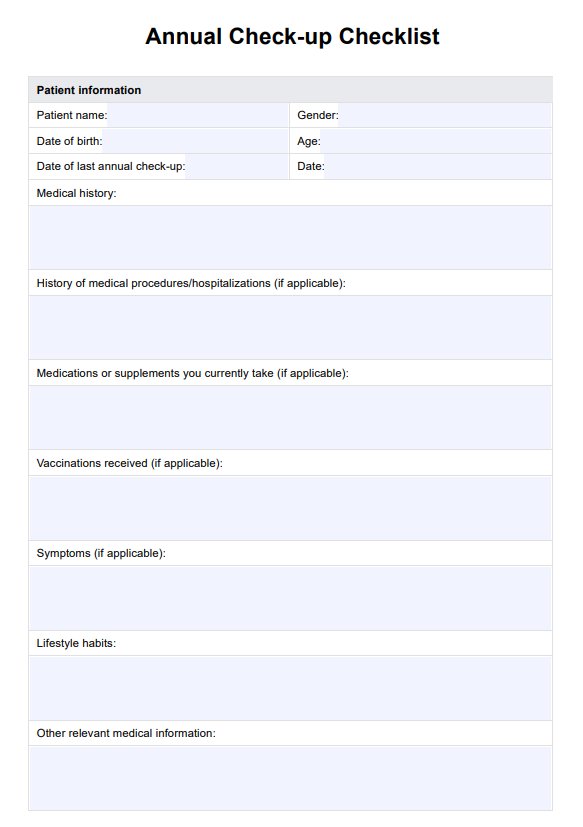




What is an Annual Check-Up Checklist?
An annual check-up is crucial to maintaining a patient's overall health and well-being. This comprehensive examination is a preventive measure that allows you to detect and address potential health issues early on. To ensure that your patient gets the most out of their annual check-up, following a well-structured checklist for annual physical exam is essential.
The following elements typically constitute a comprehensive Annual Check-Up Checklist:
- Vital signs evaluation: This is an assessment of vital signs, including core body temperature, heart rate, blood pressure, and respiration rate, among others. The values obtained are compared to age-appropriate standards to establish a baseline for your overall wellness.
- Visual and physical checks: To detect any signs of concern, a thorough visual and physical examination is conducted. This includes observing one's general appearance and response to physical activities to assess mobility. Other tests may also be requested to examine one's heart, lungs, abdomen, brain, ear, nose, throat, skin, and extremities.
- Sex-specific physical exams: Depending on the patient's gender, specific examinations are performed. For men, this may involve testicles, hernias, and prostate checks, while women undergo breast and pelvic exams.
- Laboratory screenings and tests: While not typically part of the annual physical, a checklist may also have essential screenings like complete blood count (CBC), blood chemistry, urinalysis, and other blood tests.
Aside from the elements mentioned above, a healthcare practitioner may also request updates on one's vaccine/booster and medical history and ask about one's lifestyle habits, past surgeries, medication, allergies, etc.









