





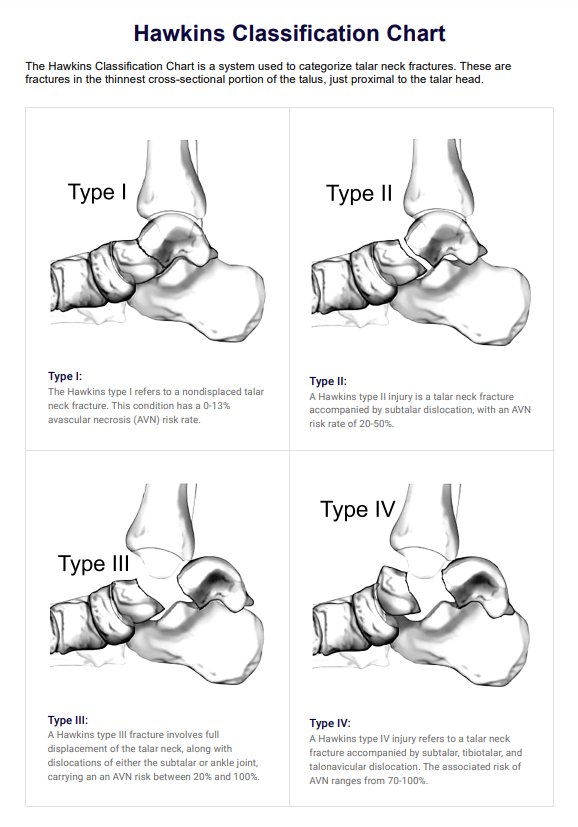




What are talar neck fractures?
Talar neck fractures are breaks or disruptions in the narrow portion of the talus bone, which sits between the ankle joint and the talus body. This type of talus fracture often involves the lateral process, a bony projection on the outside of the talus. They can occur due to various causes, such as impact to the medial malleolus, trauma from ankle injuries, falls, or accidents.
The talus bone transmits weight and forces from the leg to the foot. Fractures in the neck region can have significant consequences, as they may affect the stability and function of the ankle joint. In severe cases, talar neck fractures can lead to impairment of blood supply from the posterior tibial artery. This problem leads to complications like avascular necrosis (AVN), where the blood supply to the bone is compromised, resulting in bone tissue death (Jordan et al., 2017).
Talus fractures, particularly those affecting the talar neck, can extend to the talar body, impacting adjacent structures such as the talar dome or the subtalar joint. This is part of the foot's complex joint network. These fractures may also involve the articular surface, lateral process, medial surface, and posterior process, affecting both the bone integrity and the associated soft tissues.
Symptoms of talar neck fractures include pain, swelling, bruising, and difficulty weight-bearing on the affected foot. In some cases, the ankle joint may be deformed or unstable.









