




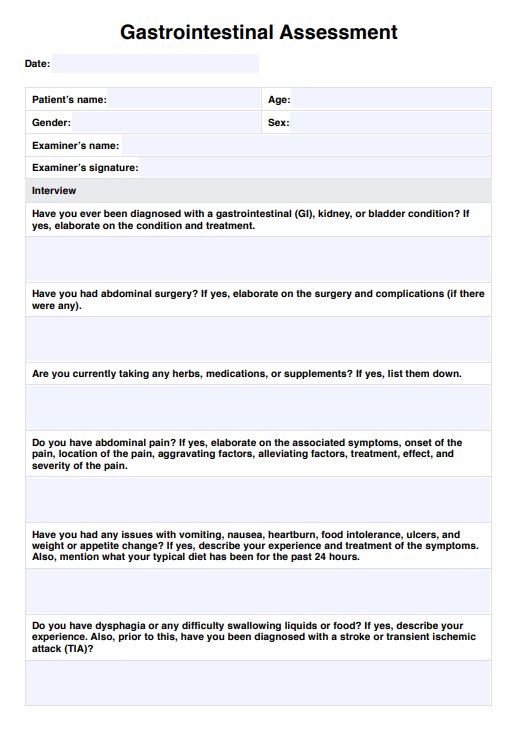



Gastrointestinal Assessment

## **What is a Gastrointestinal Assessment?**
A Gastrointestinal Assessment is a test practitioners conduct to assess the patient's abdomen and contents or their GI system function.
Like other clinical examinations, the healthcare professional must do the following to ensure that they've thoroughly examined the gastrointestinal system:
- Inspection (to observe the contour and symmetry of the abdominal wall, abdominal distention, intestinal peristalsis caused by intestinal obstruction, presence of masses/bulges indicating an abdominal aortic aneurysm, etc.)
- Palpation (light palpation and deep palpation to check for rebound tenderness, abdominal pain on palpation, etc.)
- Auscultation (to check for normal bowel sounds, hyperactive bowel sounds indicating bowel obstruction, etc.)
- Genitourinary system (this includes concerns on urinary tract infection, urinary frequency, urinary urgency, and urinary retention)
During this examination, the physician-in-charge must know how to divide the abdomen. Knowing these regions will be helpful when looking for symptoms and writing down results.
The first way to divide the abdomen is into four quadrants. Namely, the left upper quadrant, right upper quadrant, lower left quadrant, and right lower quadrant. This method is used to check bowel sounds from the patient's abdomen.
The second way is to divide it into nine regions. From upper to lower, left to right, the naming is as follows:
- Left hypochondriac
- Epigastric
- Right hypochondriac
- Left lumbar
- Umbilical
- Right lumbar
- Left inguinal
- Suprapubic
- Right inguinal
As for the flow and content of the gastrointestinal, it will depend on the patient's age and prior diagnoses, if any. However, generally, the practitioner does the following:
Ask the patient the reason for their visit
Gather the patient's gastrointestinal medical history
Inspect, auscultate, palpate, and percuss the abdomen - not necessarily in that order
Once finished, the practitioner formulates and clinical impression and proceeds to refer the patient to a specialist or have them undergo further testing.
Gastrointestinal Assessment Template
## **How does it work?**
Here's a step-by-step on how to use our template:
### **Step 1: Download the template**
Access and download a copy of our printable Gastrointestinal Assessment template by:
- Clicking the “Use this template” or “Download this template” button above.
- Searching for “Gastrointestinal Assessment” in Carepatron's template library on our website or app.
### **Step 2: Pre-test preparations**
Before conducting the test, it's essential to do the following pre-test preparations:
- Wash your hands and introduce yourself to the patient
- Confirm the patient details by asking them to fill out the necessary basic information on the template
- Explain how the test will be conducted
- Ask for the patient's consent
- Ensure the patient's privacy
### **Step 3: Interview the patient**
After finishing the pre-test preparations, you may conduct the test by asking the questions on the template to gather information on their last bowel movement, presence of abdominal pain, etc. Remember to listen attentively to the patient's answer and be observant of the patient's reactions.
### **Step 4: Conduct the examination**
Once finished with the interview, you can proceed to conducting the abdominal examination, specifically a physical assessment that involves inspection, auscultation, palpation, and genitourinary.
Remember to do a careful and thorough assessment, considering the abdominal organs when conducting the physical examination, and do not rush the test unless necessary.
### **Step 5: Record the results**
After every step or observation, especially if you find abnormal assessment findings, it's highly recommended that you write down the results so that the document will be as helpful to yourself and fellow practitioners as possible.
## **When would you use this template?**
Medical health practitioners can use our downloadable gastrointestinal assessment template while checking the patient's gastrointestinal and genitourinary system during their routine head-to-toe assessment. However, if a patient is not due for a full-body assessment, it can also depend on their condition. To help you out, here are symptoms when it's most likely that you must check your patient's gastrointestinal tract:
- Weight gain or loss
- Swallowing problems
- Belly Pain
- Nausea and vomiting
- Constipation or diarrhea
- Bleeding
- Bloating
- Heartburn
Whether it's an outpatient or inpatient, if they're exhibiting these symptoms, it's encouraged that you have them tested and utilize our template in case you need a guide, reference, or document to record your observations. You are also free to use this template to check if the cause of pain is a gastrointestinal disorder or something else while making a differential diagnosis.
## **Benefits of using a template**
Here's a list of the benefits of using a GI assessment or gastrointestinal assessment (nursing):
### **Streamline the process**
You're streamlining the process by having a ready-made template with questions to ask and the four significant steps you have to take. It's because you're removing the time and effort it takes to look from creating a document to writing results.
### **Early recognition**
Since the test has most, if not all, bases that need to be covered, you can find the source or cause of the patient's exhibited symptoms.
### **Written copies of results**
A template can also function as a document where you can write results. By utilizing it, you're effectively reducing the risk of forgetting your findings and can easily refer to your written observations in case fellow practitioners have any questions.
### **Digitally accessible**
Our template is entirely digital, so you can access and fill it out on any device you have. You can use your local PDF editor, or for your ease of editing, filling it out, and storing, do it right on Carepatron's software.
Commonly asked questions
Physicians who conduct head-to-toe assessments, which usually include a gastrointestinal assessment, and gastrointestinal system specialists such as gastroenterologists, will benefit from having a template for this assessment.
You can use the template while examining your patient or checking their condition after surgery, medication, or other treatments.
How you will utilize our gastrointestinal assessment is entirely up to you. You can use it as a guide, reference, etc.










EHR and practice management software
Get started for free
*No credit card required
Free
$0/usd
Unlimited clients
Telehealth
1GB of storage
Client portal text
Automated billing and online payments