What is the Cluster of Laslett test?
The Cluster of Laslett is a tool used in low back pain assessment to determine whether the sacroiliac joint is the primary source of a patient’s pain. Initially, the cluster consisted of six provocative tests, including the Gaenslen's test, but further research led Mark Laslett to refine it into an algorithm of four tests, as the other two did not provide additional diagnostic value. The four tests, which have the best predictive power in the refined cluster, include:
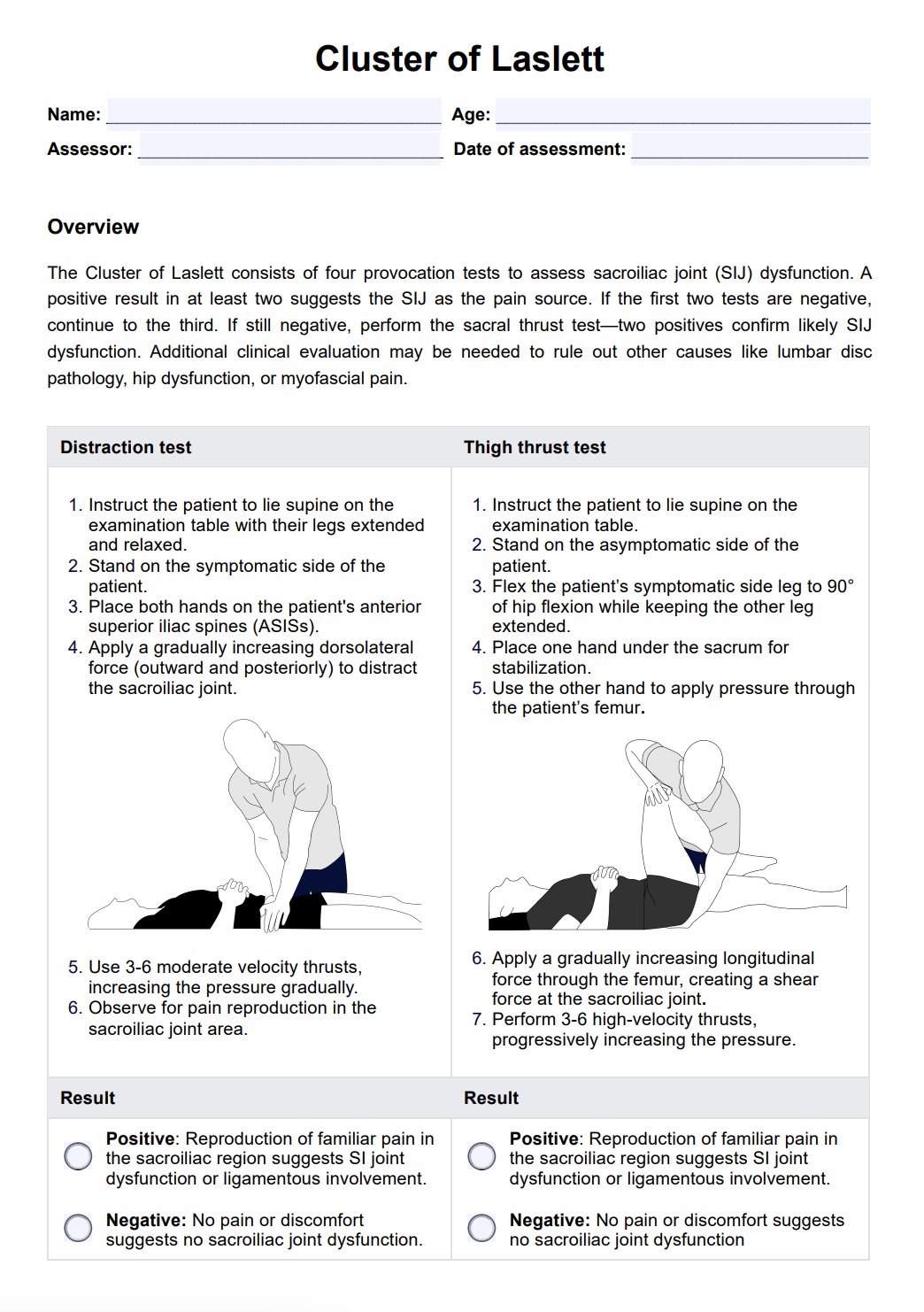
Distraction test
The patient lies supine while the examiner applies bilateral pressure to the anterior superior iliac spines (ASIS), directing the force outward. This maneuver stresses the anterior sacroiliac ligaments. A positive test is indicated by pain reproduction in the sacroiliac region, suggesting SIJ involvement.
Thigh thrust test
The patient lies supine with the hip and knee flexed to 90 degrees. The examiner places one hand under the sacrum for stabilization and applies a posteriorly directed force through the femur, creating shear stress at the sacroiliac joint (SIJ). A positive test is indicated by pain reproduction in the SIJ region, suggesting SIJ dysfunction.
Compression test
The patient lies in a side-lying position with the affected side upward. The examiner applies downward pressure on the uppermost iliac crest, compressing the SIJ. A positive test occurs when pain is reproduced in the SIJ region, indicating sacroiliac involvement.
Sacral thrust test
The patient is positioned prone while the examiner applies a posteriorly directed force over the sacrum, using both hands to apply a quick, firm downward pressure. This maneuver stresses the SIJ. A positive test is confirmed when pain is reproduced in the SIJ area, supporting the presence of SIJ dysfunction.
A diagnosis of sacroiliac joint dysfunction is considered more likely when two or more of these tests reproduce the patient’s pain. Each test in the Cluster of Laslett applies mechanical stress to the SIJ in different ways, ensuring a thorough assessment of joint involvement. The combination of multiple positive tests increases the likelihood that the SIJ is the primary pain generator rather than another structure, such as the lumbar spine or hip joint.
When at least two tests are positive, the Cluster of Laslett has a reported sensitivity of 88% and a specificity of 78%, meaning it is both a highly sensitive and specific tool for identifying SIJ dysfunction (Laslett et al., 2005). However, Saueressig et al. (2021) found that a positive result on a sacroiliac joint pain provocation test cluster gives only a 35% diagnostic accuracy of having correctly identified sacroiliac joint pain. This suggests that while the cluster is useful for ruling out SIJ pain when tests are negative, it may be less effective for confirming the SIJ as the source of pain when tests are positive.