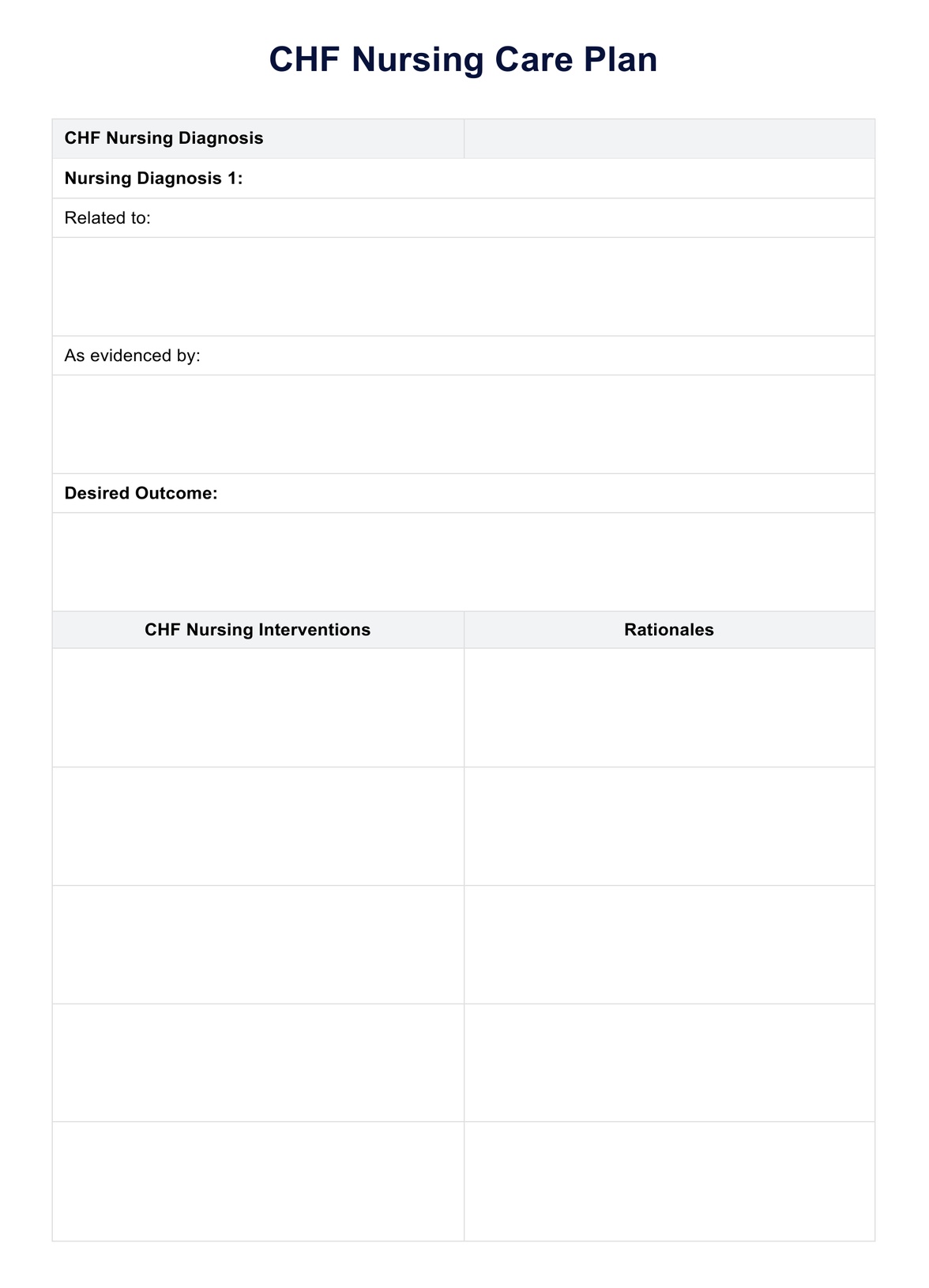
How does our CHF Nursing Care Plan Template work?
Using a Printable CHF Nursing Care Plan Template involves steps that guide healthcare professionals in systematically addressing the needs of patients with congestive heart failure. Each step is critical in ensuring that the care provided is comprehensive, individualized, and effective. Here's a breakdown of these steps:
Step 1: Patient assessment
The first step in utilizing the CHF Nursing Care Plan Template is conducting a thorough patient assessment. This includes evaluating the patient's current symptoms, physical examination findings, and diagnostic results from a complete blood count (CBC) test. It's also helpful to gather detailed information on the patient's medical history, especially if they have coronary artery disease or atrial fibrillation, and to check the patient's heart function, fluid status, and overall health, which are just as crucial for forming an accurate nursing diagnosis.
Step 2: Nursing diagnosis
Based on the initial assessment, the second step involves identifying specific and accurate nursing diagnoses related to CHF based on results and observation. Possible results include stable or improved cardiac function, decreased cardiac output, impaired gas exchange, excess fluid volume because of fluid retention, activity intolerance, peripheral edema, or other indications of worsening symptoms or vital signs.
Step 3: Care planning
The third step is to develop a care plan. This involves setting measurable and achievable goals for the patient's treatment and recovery. Goals may include improving breathing, reducing fluid overload, or enhancing physical activity tolerance. The care plan should be patient-centered, considering the patient's preferences and lifestyle.
Step 4: Implementing interventions
The fourth step involves implementing the care plan. These include administering medications, providing patient education, assisting with daily activities, and monitoring blood pressure and other vital signs. Each intervention should be evidence-based and tailored to the patient’s specific needs.
Step 5: Evaluation and adjustment
The fifth step is the ongoing evaluation of the patient's response to the care plan. This includes reassessing the patient's condition and determining the effectiveness of the interventions. If the patient's condition changes or certain interventions are ineffective, the care plan should be adjusted accordingly.
Step 6: Documentation and communication
The final step involves detailed documentation and communication. All assessments, interventions, patient responses, and adjustments to the plan must be thoroughly documented in the patient's medical record. Effective communication among the healthcare team is also crucial to ensure a cohesive and coordinated approach to patient care.