Everyone has a story to tell, and here we share and celebrate those who chose care as their life's work.
These are their words, their work and we're grateful to share them.
Elizabeth and Dennis handed their billing to Carepatron and grew My Therapeutic Concepts from five clients to seventy in two months, without losing their evenings.
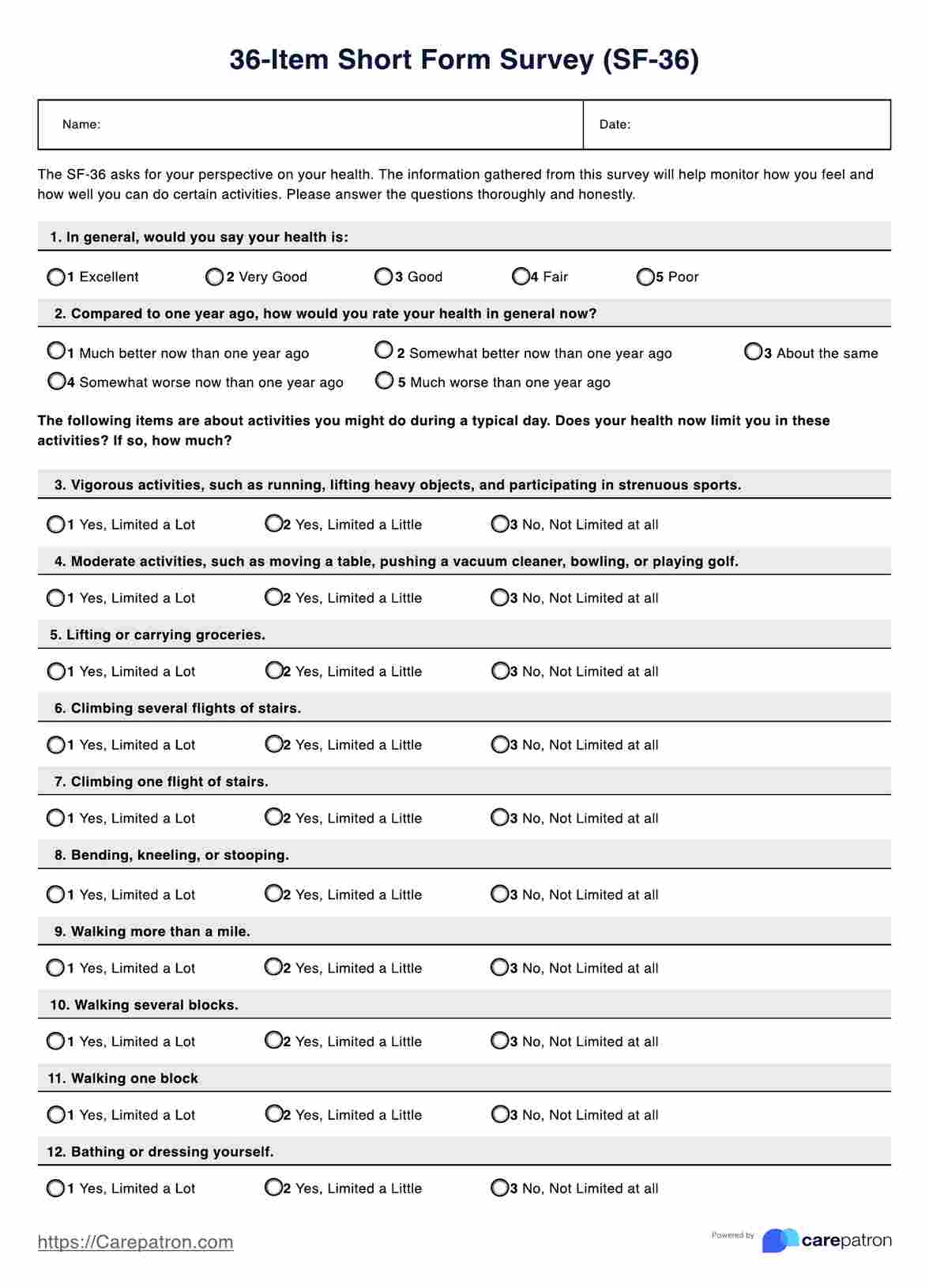
Looking for a tool to assess a patient or client's general health status? Read our guide to learn why it's important for people to be aware of their general health status, even if they don't have any major signs of concern, and then download our 36-Item Short Form Survey (SF-36) to help you assess your patient's general health status.
## **Knowing one's general health status**
It's important for individuals to be aware of their overall general health status and well-being because it makes them cognizant about the current quality of their life, happiness, and satisfaction. By acknowledging one's own current general health status and well-being, they can take the first steps to addressing any problems that might be impacting it, such as physical, mental, emotional, and social factors (WPA, 2023).
Having a good/great overall general health status and well-being can improve one's overall quality of life, promote positive behaviors, increase the chances of making full recoveries from illnesses, reduce healthcare burden, and add more years to one's life (WPA, 2023).
Knowing all of these factors is also important for healthcare professionals because it can help them assess morbidity, mortality, and functional status of patients. Self-reports of patient health status can assist with determining what tests to conduct and treatments to provide (U.S. Centers for Disease Control and Prevention, 2022).
## **What is a 36-Item Short Form Survey (SF-36)?**
Measuring our health is essential for accurately understanding our overall well-being. This helps us know what lifestyle changes we need to make to improve our physical, mental, and emotional wellness. By tracking our health over time, we can detect potential illnesses or issues and seek appropriate treatment before they become more severe or have lasting effects. Monitoring key aspects such as diet, exercise, sleep, and stress levels can also allow us to adjust accordingly for optimal wellness.
The SF-36 is a standardized health survey that helps individuals accurately measure their physical, mental, and emotional health. Developed by the RAND Corporation as part of its Medical Outcomes Study, the SF-36 is a widely used tool for tracking quality of life and health in clinical and research settings.
### **What to expect from the SF-36**
The SF-36 consists of 36 questions divided into eight domains, each measuring various aspects of health and satisfaction. Each domain is given a score based on the responses, with higher scores indicating better overall health and satisfaction. There are also shorter versions of the SF-36 survey, including the 12-Item Short Form Health Survey (SF-12), that can be used for quick health monitoring (Ware & Sherbourne, 1992).
Sample items/sections include:
- How much bodily pain have you had during the past 4 weeks?
- During the past 4 weeks, have you had any of the following problems with your work or other regular daily activities as a result of your physical health?
- Emotional problems interfered with your normal social activities with family, friends, neighbors, or groups?
This tool can be used by anyone working in primary care, those treating chronic conditions, social workers, physical/occupational therapists, psychologists, counselors, etc.
### **Why should I use it?**
The SF-36 can help you identify potential health risks in individuals and populations. This can help you create effective strategies for preventing or managing these risks. It can give you a good understanding of your patient's overall health and allow you to provide personalized care for better patient outcomes.
The tool can be used to track your patient's overall health and well-being. It can provide valuable insight into how well they are coping and alert you to potential issues that need further attention.
It is also helpful when treating a long-term illness or condition. You can use it to measure the effectiveness of treatments and how well your patient is doing over time.
The SF-36 is an effective tool to use when gathering self-reported information concerning a patient/client's overall general health status and well-being. Through validation and reliability tests, researchers have found that the response rate of the SF-36 is quite high (83%) and the rate of completion for its dimensions was 95% (Brazier et al., 1992).
It also had a Cronbach's alpha greater than 0.85 and a reliability coefficient greater than 0.75 for all the tool's dimensions, except for the social functioning part (Brazier et al., 1992). It's this good reliability and validity that contribute to its widespread use to this day.
## **How does this SF-36 work?**
The SF-36 survey consists of eight domains measuring various aspects of one's physical, mental, and emotional health. It's a self-report survey that takes approximately 10-15 minutes to complete and is used in clinical and research settings. Follow these steps to get started:
### **Step 1: Download the assessment**
To get a copy of our template, just click "Use Template" or "Download" to get the PDF file.
### **Step 2: Provide a copy to your patient**
Provide your patient with a copy of the questionnaire in paper or digital form. Explain the purpose of the survey and ensure that they understand how their responses will be used.
Explain the structure of the tool as well. They will begin with two questions about their overall health, especially compared to the past year.
After that are questions revolving around physical functioning and activities they are able to do, including activities of daily living.
Once they're done with the physical section, they will answer questions about their mental, emotional, and social well-being.
The last set of questions, after the mental, emotional, and social-related ones, are four True or False questions.
All your patient needs to do is select the specific answer options applicable to them per item.
### **Step 3: Have your patient complete the survey**
Instruct your patient to answer the 36 questions as accurately and honestly as possible. Give them sufficient time to complete the survey.
### **Step 4: Score the survey**
Once your patient has completed the survey, score their answers and interpret the results. The higher the score, the higher their overall physical and mental health. While there are no score ranges, do note that you can calculate two component scores besides the total: the physical component summary (items 3 to 22) and the mental component summary (items 23 to 32). Calculating these will give you an idea of which aspects of the patient/client's general health status need improvement.
## **Next steps after using the SF-36**
The next steps will depend on your findings. Please note that this test shouldn't be the sole assessment you use to determine what to do for your patients/clients. The reason for this is that it assesses the general health status of patients, not specifics.
The answers and the score of this test will give you an idea of what you should tackle. If their physical component summary score is low, then you should conduct tests that focus on physical health, musculoskeletal issues, respiratory issues, circulatory issues, etc. If the mental component summary score is low, you should conduct tests that assess them for mental health issues.
This tool should help you kickstart comprehensive assessments of patients.
## **References**
Brazier, J. E., Harper, R., Jones, N. M., O’Cathain, A., Thomas, K. J., Usherwood, T., & Westlake, L. (1992). Validating the SF-36 health survey questionnaire: new outcome measure for primary care. BMJ, 305(6846), 160–164. https://doi.org/10.1136/bmj.305.6846.160
U.S. Centers for Disease Control and Prevention. (2022, August 8). Health status. https://www.cdc.gov/nchs/hus/topics/health-status.htm
WPA. (2023, May 10). What is wellbeing and why is it important? Www.wpa.org.uk. https://www.wpa.org.uk/health-wellbeing/articles/importance-of-wellbeing
Commonly asked questions
The RAND Corporation developed the SF-36 as part of its Medical Outcomes Study. The questionnaire was designed to measure the functionality, disability, and health of individuals.
You can use the SF-36 to measure health in a variety of settings. It is most commonly used when monitoring the effectiveness of treatments and the overall health of individuals or populations. It can also be used when assessing a patient’s quality of life.
SF-36 stands for the 36-Item Short Form Survey. The 36 items refer to the number of questions used in the survey. There's a much shorter version of this called the SF-12, which only has 12 items.