


Hornblower TestsAI Template IconToolbar IconShare Icon

Hornblower Tests

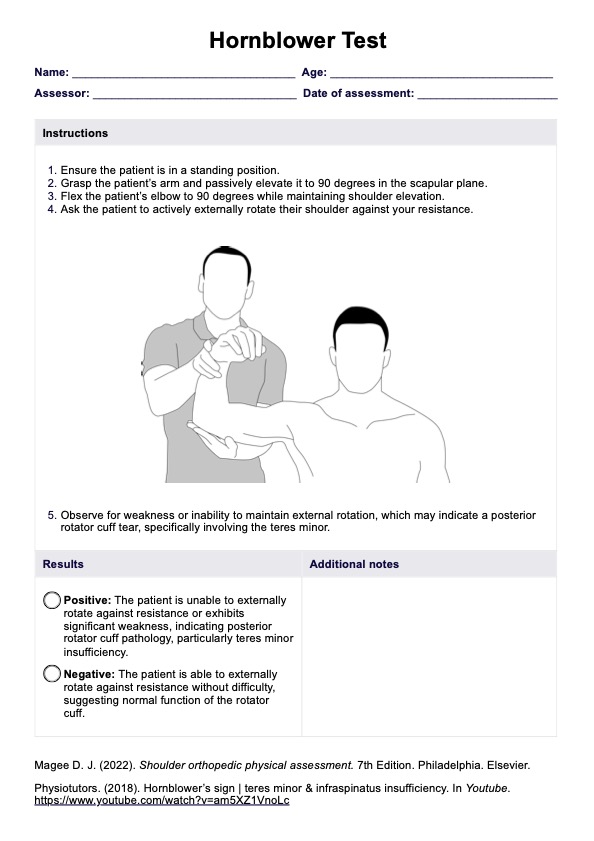
Conduct the Hornblower Test to check patients for possible teres minor tears. Get access to a free PDF template in this guide.

Ericka Pingol avatar

By Ericka Pingol on Aug 18, 2025.

Fact Checked by Gale Alagos.

Use Template

Commonly asked questions

The Hornblower’s Test is a clinical assessment used to evaluate the integrity of the teres minor muscle, a key component of the rotator cuff. It involves positioning the patient’s arm at 90 degrees of abduction and external rotation while applying resistance to assess muscle function. A positive test, indicated by weakness or an inability to maintain external rotation, suggests a teres minor tear or dysfunction.

The three tests for a rotator cuff tear are the Drop Arm Test, Empty Can Test, and External Rotation Lag Sign (ERLS). The Drop Arm Test checks supraspinatus function by having the patient lower their arm from abduction; pain or loss of control suggests a tear. The Empty Can Test evaluates supraspinatus strength with the arm in scapular elevation and the thumb down; weakness or pain indicates a tear. The ERLS assesses the supraspinatus and infraspinatus by testing the ability to maintain external rotation; failure suggests muscle dysfunction or a tear.

A rotator cuff tear often presents with persistent shoulder pain, especially at night or during overhead activities. This discomfort may be due to inflammation, muscle strain, or tendon damage. Another key warning sign is weakness or difficulty lifting and rotating the arm, which can indicate dysfunction of the supraspinatus, infraspinatus, or teres minor muscles. This limitation may worsen over time if left untreated.

EHR and practice management software

Get started for free

*No credit card required

Free

$0/usd

Unlimited clients

Telehealth

1GB of storage

Client portal text

Automated billing and online payments